
Traveling Soon? You Need These Supplements To Stay Healthy – InVite Health Podcast, Episode 231
During cold and flu season and especially during a pandemic, it’s important to know the most beneficial supplements you need when traveling.
Nutrition. Vitamins. You.
During cold and flu season and especially during a pandemic, it’s important to know the most beneficial supplements you need when traveling.
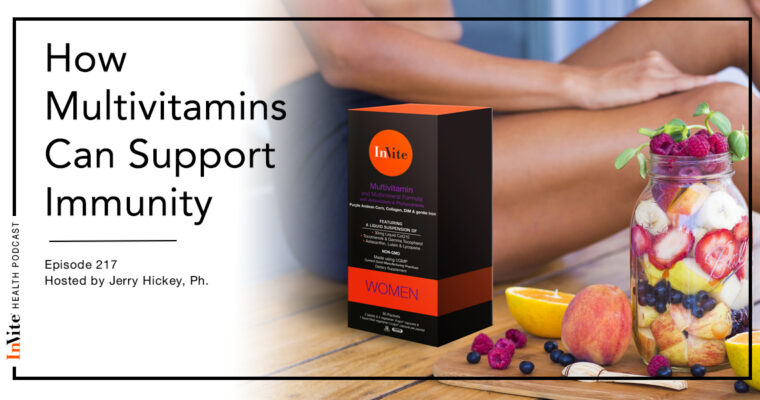
There’s mounting evidence that taking a high quality multivitamin in the winter can help boost immunity. But not all are created equal.
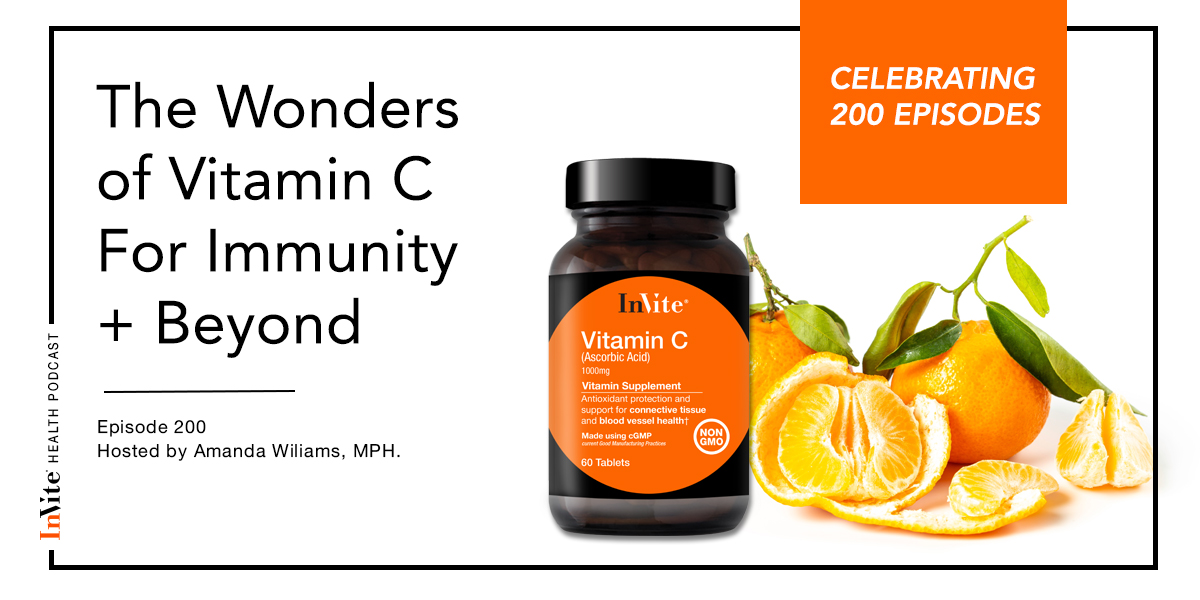
Invite Health Podcast, Episode hosted by Amanda Williams, MPH.
Subscribe Today!


When we think about antioxidants in the body, many people will think immediately of Vitamin C, and there’s a really good reason for this. Vitamin C is utilized in so many different pathways in the human body, and it really is quite critical and essential for our overall survival. Many times when we think about this vitamin, people will have heard that it’s good for the immune system. It certainly is, but there are so many other ways in which it is required by the human body.†
We know that, as humans, we do not internally produce Vitamin C, so it’s not an endogenous antioxidant like glutathione, which is produced in the human body. We know that we have to acquire it from different dietary sources. For the most part, many people will get enough Vitamin C to avoid things such as scurvy. But are we getting enough Vitamin C that we get into that category of having the ability to promote cellular longevity? That’s what the key is.†

A really interesting study that came out a couple of years ago talked about the impact of Vitamin C on our overall health. It was published in the Journal of Epidemiology and Community Health. The study looked at just how impactful having adequate levels in the body was when it came to all-cause mortality. In this study, what they actually assessed was looking at the long-term impact of the vitamin on human health. They took a group of people that they followed over the course of 16 years and they were looking at their serum blood levels, so the researchers were looking at the actual amount of Vitamin C that was circulating in their bodies. What they found was that those who had the highest levels in their blood of the vitamin had a 25% reduction in all-cause mortality. That’s some really important information to look at. Just being in the group that had higher Vitamin C levels led to longer lives.†
Ask Your Doctor: Vitamin C for Cellular Health – InVite Health Podcast, Episode 192. Listen Now >>
This is why we really have to understand what it is doing for longevity and aging gracefully. We know that Vitamin C has this potential to reverse these different age-related abnormalities, and this is really something that we should focus in on. We know that it is certainly critical when we talk about our immune system. Vitamin C helps with these immune-boosting properties and it helps to promote the actions of certain things like phagocytes, which chew up intruders in the body such as bacteria and fungus. It also helps with the activation of T cells, which are white blood cells that scan through the body, looking for any detectable levels of infections.†
Learn more about the role that this important vitamin plays in your body by tuning into the full podcast episode.
I definitely encourage you to consider adding additional Vitamin C to your routine, even if you already take a multivitamin. The amount you need varies. For some people, it may be 500mg per day. For others, 1000mg. For some, maybe 3000mg per day. It depends what your underlying health concerns are. We do know that dietary intake of Vitamin C alone is usually enough to keep us out of that scary zone of the development of scurvy, which has been, for the most part, eliminated. Making sure that we’re getting adequate amounts is essential because it plays an important role systemically.†


New research is sheading light on the importance of zinc for immune health.

Many people experience runny nose, sneezing, itchy ears and itchy throat due to seasonal changes and different pollens in the air. Let’s discuss what nutrients that can be beneficial to optimize your seasonal immune support.
Invite Health Podcast, Episode hosted by Amanda Williams, MPH
Subscribe Today!
On today’s episode, we will be discussing Olive Leaf extract and the immune system supporting properties that go along with it. It’s really quite interesting when you look at the amount of science that has gone into accessing the powerful constituents that are contained within the olive leaf itself. Across the spectrum, there are so many different ways in which olive leaf has been shown to be very beneficial.
What makes Olive Leaf Extract so unique?
I am always an advocate of people adhering to the Mediterranean diet because it is the most widely studied diet out there and has been shown to be the most effective when you think about brain health, heart health, control of blood glucose and cholesterol. Well, olive leaf coming from the olive tree is native to that Mediterranean region. Some of the main and active constituents of the olive tree really can do a wonderful job when we look at different health issues that we commonly come across. One area that is quite interesting is the way that olive leaf has been looked at when it comes to the immune system. Oxidative stress can drive up inflammation and dampen our normal immune system response, which is why olive leaf has been looked at as being a means to try to enhance those initial immune system responses. This is why an olive leaf supplement is a great option to add to an immune support routine.
How another important nutrient – DHEA – supports immunity. Listen now! >>
Oleuropein is a very unique compound that is derived from the olive leaf itself. It is responsible for most of the antioxidant properties that come from the olive leaf. Oleuropein is what gives an olive that bitter taste. The leaves themselves contain a really high amount of this powerful compound, which is what makes the extract form a really wonderful nutrient.
The Science Behind Olive Leaf and It’s Powerful Antioxidant
Published in the Scientia Pharmaceutica Journal in 2010, researchers studied Oleuropein and its pharmalogical properties, including it being an antioxidant, having anti-inflammatory properties, anti-atherogenic properties (the cardiovascular system), anti-microbial properties, as well as being anti-viral. Researchers studied the impact of Oleuropein from the olive leaf against different forms of viruses, including respiratory syncytial virus and para-influenza virus.†
The Immune Enhancing Powers of Nucleotides. Listen now >>
In one clinical study published in the journal Nutrients, researchers studied the effects of Oleuropein on upper respiratory illness in high school athletes. This is a good study group because people who have extensive endurance training from exercise have a little window where the immune system can depress itself, causing them to have a weakened immune system. This does not make you feel sick, rather it is the immune system trying to keep up with all of the stress that has been brought on because of that endurance exercise. You see this very commonly in marathon runners. So, in the study, the participants were broken up into two groups – one receiving Oleuropein, the other receiving placebo. They were looking at their measures of well-being and their training mode, as well as respiratory illnesses. What they were able to determine after doing this particular study, was that the group that was given the olive leaf extract containing Oleuropein did much better in terms of either not catching upper respiratory infections or they had a significant reduction in the number of sick days, which I think is really quite impressive.
Questions about olive leaf extract or its important antioxidant compound, Oleuropein? Leave me a comment below to join the discussion!
Thank you for tuning in to the Invite Health Podcast. You can find all of our episodes for free wherever you listen to podcasts or by visiting www.invitehealth.com/podcast. Make sure you subscribe and leave us a review! Follow us on Facebook, Twitter and Instagram at Invite Health today. We’ll see you next time on another episode of the Invite Health Podcast.

