Recent Posts

Consider Taking These Nutrients As You Age, Part 2 – InVite Health Podcast, Episode 316

Consider Taking These Nutrients As You Age, Part 2 – InVite Health Podcast, Episode 316

As we age, the need for certain nutrients increases for a number of reasons, including an increase in our prescription medications and gaps in our diet. In Part 2, Jerry Hickey, Ph. discusses the best anti-aging nutrients to focus on now.

Consider Taking These Nutrients As You Age, Part 1 – InVite Health Podcast, Episode 315

Consider Taking These Nutrients As You Age, Part 1 – InVite Health Podcast, Episode 315

As we age, the need for certain nutrients increases for a number of reasons, including an increase in our prescription medications and gaps in our diet.

How Different Types of Inflammation Impact Your Body – InVite Health Podcast, Episode 314

How Different Types of Inflammation Impact Your Body – InVite Health Podcast, Episode 314

inflammation

Invite Health Podcast, Episode hosted by Amanda Williams, MPH

Subscribe Today!

Apple PodcastsGoogle PodcastsiHeartRadioSpotify

You’ve probably heard by now that omega-3 fatty acids are incredibly important. When we talk about omega-3s, we’re referring to things coming from fish oil, krill oil, flaxseed and chia, for example. We know that they’re important because there are over 30,000 published research trials done on omega-3 fatty acids. They are essential to human existence. If we are not obtaining enough of them from our diet, it can affect so many different systems within our body, including the brain and heart. It goes far beyond those two areas and I want to talk in some detail today about the importance of omega-3 fatty acids and why you should make sure that you have them incorporated into your supplementation routine.† 

We know that omega-3 fatty acids are an integral component to so many aspects of our overall health. When we think about things such as inflammation, we know that omega-3 fatty acids help to combat or offset that. That’s why I want to talk about it in more detail.

How different types of inflammation impact the body

First, we need to differentiate between acute and chronic inflammation. What we really want to pay attention to is that chronic, low-level inflammation. That’s what contributes to the pathogenesis of the most common chronic disease states, including heart disease, diabetes, cancers, Alzheimer’s disease, kidney disease and respiratory diseases such as COPD and emphysema. We know that low-level inflammation, this chronic forest fire that keeps burning throughout the body, this is why omega-3s are so incredibly important.†  

Low DHEA Levels May Explain Chronic Inflammation – InVite Health Podcast, Episode 229. Listen Now >>

Acute inflammation, on the other hand, is a welcomed type of inflammation that occurs. This is a very well-controlled inflammatory response that actually has protective roles in the body. It helps to prevent the spread of infection throughout the body and prevent damage to different tissues. It helps to remove damaged tissues as well as those harmful pathogens. It allows the body to repair itself. At the most basic level, an acute inflammatory response is triggered in this setting. It’s a tissue injury or trauma that occurs within the body. Then we have infections, potentially by viruses, bacteria, parasites and fungi. We know there is a classic manifestation of acute inflammation that is characterized by the four cardinal signs of redness, heat, swelling and pain. The redness and the heat result from an increase in blood flow to the injury site itself. The swelling results from the accumulation of fluid at the injury site. As a consequence of this, we have increased blood flow and then we have swelling, which can become problematic because it can compress nerve endings and generate pain.† 

We have to recognize that there is a clear and distinct difference between that warranted acute inflammation versus chronic inflammation. The chronic inflammation is what leads to long-term consequences, which is why I always refer to it in that setting of inflammaging.†

Learn more about inflammaging by listening to the full podcast episode.

The Importance of Omega-3 Fatty Acids

What can we do to combat this type of inflammatory assault to the system? First and foremost is a proper diet. We need to focus on eating nutrient-dense fruits and vegetables, avoiding sugars and bad carbohydrates, and increasing our intake of omega-3 fatty acids in our foods. Getting enough omega-3s can really prove to be difficult when people are following a Standard American Diet, which is predominantly omega-6 fatty acids. We are very limited in terms of our exposure to omega-3s.† 

Fixing Nutrient Depletions In Vegan Diets – InVite Health Podcast, Episode 222. Listen Now >>  

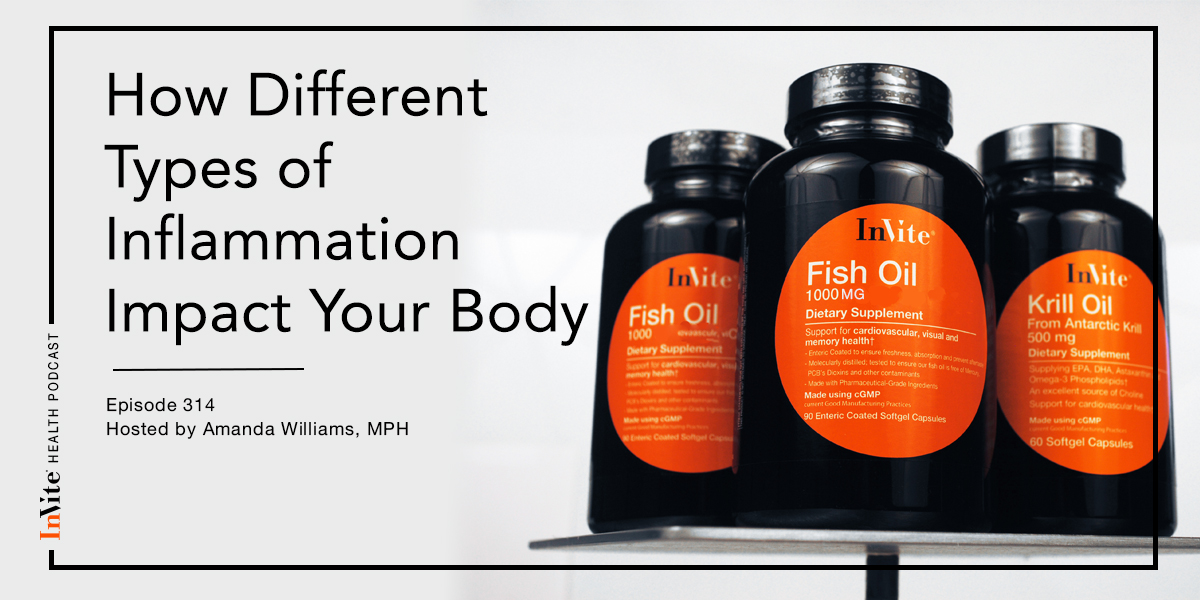
When we look at the different studies that focus in on chronic, low-grade inflammation and omega-3 fatty acids, we really start to see how it is that those omega-3s potentiate such a benefit in terms of easing inflammation within the body. Fish oil is a great source of omega-3 fatty acids. One of the best sources of fish oil if you’re not eating fatty fish such as salmon is to be taking a fish oil supplement or something like krill oil.† 

Hear about various studies on the effects of omega-3 fatty acids on the body in the full podcast episode. 

Thank you for tuning in to the Invite Health Podcast. You can find all of our episodes for free wherever you listen to podcasts or by visiting www.invitehealth.com/podcast. Make sure you subscribe and leave us a review! Follow us on Facebook, Twitter and Instagram at Invite Health today. We’ll see you next time on another episode of the Invite Health Podcast. 

Distinguishing Between Normal Brain Aging and Alzheimer’s Disease – InVite Health Podcast, Episode 313

Distinguishing Between Normal Brain Aging and Alzheimer’s Disease – InVite Health Podcast, Episode 313

As you age, you may begin to wonder, “is it normal forgetfulness or is this something else?” This episode is designed to help you identify the difference between Alzheimer’s and normal brain aging.  

The Difference Between Each COVID-19 Vaccine & How To Help Them Work Better – InVite Health Podcast, Episode 312

The Difference Between Each COVID-19 Vaccine & How To Help Them Work Better – InVite Health Podcast, Episode 312

With three COVID-19 vaccines on the market, how do you know which vaccine is best for you? Jerry Hickey, Ph. discusses how they compare, along with the clinically studied nutrients that may make them more effective.

Theanine: The Little Amino Acid That Packs A Powerful Punch – InVite Health Podcast, Episode 311

Theanine: The Little Amino Acid That Packs A Powerful Punch – InVite Health Podcast, Episode 311

theanine

Invite Health Podcast, Episode hosted by Amanda Williams, MPH

Subscribe Today!

Apple PodcastsGoogle PodcastsiHeartRadioSpotify

When it comes to staying calm, cool and collected, this can be a challenge. There can be a lot of different factors that can alter our perception within our own environment in terms of how we manage stress or how we actually handle the stress itself. I wanted to talk today in regards to theanine because I think theanine is one of the most useful amino acids out there when it comes to stress management.† 

There is so much science and research out there that really reinforce the utilization of theanine. Oftentimes, we refer to theanine in its nomenclature of L-theanine. When they put the ‘L’ in front, we’re just talking about the actual structural form of theanine. I want to talk about all of the interesting and unique studies that have come out recently on theanine.  Researchers have been looking at theanine for many, many years, but there is some new research that has come out that is reinforcing what we already know about this very, very powerful amino acid.†

The Real Impact of Pandemic-Related Stress and Anxiety – InVite Health Podcast, Episode 206. Listen Now >>

What is theanine?

When we think about amino acids, we know that they play a role as being that building block to proteins. They are heavily relied on in the body for many different functions. Theanine is quite unique because it is kind of this blend of glutamate and glutamine.† 

Glutamine is an amino acid that has many different functions that are incredibly important in the human body. It plays a very important role in the intestinal lining, for example. It is important for making sure we have the best uptake for different nutrients into our system. We can also see its role in cellular energy, lipid synthesis and regulation of acid-base balance. Then, theanine would make a lot of sense in terms of working within the human body.†  

Theanine is actually plant-derived and predominantly where we find the highest abundance of theanine coming from plants is from green tea. This is why green tea touts so many different medicinal benefits beyond that of just the antioxidant that it possesses.† 

Stress Management

We know that theanine has been most widely researched when it comes to stress and management of stress. The reason why is because theanine is working in a means to actually decrease the binding capacity of the excitatory neurotransmitter glutamate. Glutamate is excitotoxic and if we have too much of this, this can create problems.† 

Theanine can actually downregulate the glutamate, but at the same time, it can help to enhance or upregulate the production of gaba. Gaba is the primary inhibitory neurotransmitter. That’s what allows for that calming effect. What’s interesting is that when we have different imbalances between the neurotransmitters glutamate and gaba, then we can start to see some of those clinical implications. This is why, oftentimes, people will utilize even prescribed medications that will help to downregulate glutamate and enhance gaba production.† 

Nutrients To Help Mitigate The Impact of Stress – InVite Health Podcast, Episode 182. Listen Now >>

How theanine is actually working in the brain is quite interesting. We’re using an amino acid that is derived from green tea that has this ability to inhibit that excitotoxicity that’s occurring because of too much glutamate and it helps to enhance the calming properties of gaba. It’s actually mimicking gaba’s effects. We know that prescription anti-anxiety drugs can also do this, but we also know that these drugs can come with a whole slew of side effects, which can certainly become problematic over time.†

Learn more about the powerful impacts of theanine and the research behind it by tuning into the full podcast episode.

Thank you for tuning in to the Invite Health Podcast. You can find all of our episodes for free wherever you listen to podcasts or by visiting www.invitehealth.com/podcast. Make sure you subscribe and leave us a review! Follow us on Facebook, Twitter and Instagram at Invite Health today. We’ll see you next time on another episode of the Invite Health Podcast.