Recent Posts

Supporting Your Immune System & Protecting Yourself From Viruses

Supporting Your Immune System & Protecting Yourself From Viruses

As we approach the one year mark of facing the COVID-19 pandemic, researchers are learning more and more about what we can be doing to protect ourselves from this dangerous virus. Some of these methods may be as simple as boosting our intake of certain vitamins. 

Forgo Fast Food For Your Overall Health – InVite Health Podcast, Episode 278

Forgo Fast Food For Your Overall Health – InVite Health Podcast, Episode 278

Fast food may be convenient but it is lacking the nutrients that we need in order for our bodies to function properly. 

How Air Pollution is Harming Your Health – InVite Health Podcast, Episode 277

How Air Pollution is Harming Your Health – InVite Health Podcast, Episode 277

air pollution

Invite Health Podcast, Episode hosted by Amanda Williams, MPH.

Subscribe Today!

Apple PodcastsGoogle PodcastsiHeartRadioSpotify

The late professor Barry Commoner had a quote that always stuck with me: “Environmental pollution is an incurable disease. It can only be prevented.” That really resonated with me the first time I heard that. When we look at air pollution in this country and throughout the world, we can see the true harmful long-lasting effects. Take this pandemic, for example, and looking at air pollution as being a pre-determining factor in terms of severity outcomes. They did a study early on in the pandemic where they recognized that people in the regions of Italy that had the poorest air quality did much worse in terms of their exposure to COVID-19. Atmospheric pollution is driving poor health outcomes.†     

We need to understand that if we do nothing for the enormous amount of air pollution that we are exposed to every single day and we are not taking precautionary measures ourselves in terms of trying to get the right nutrients in every day and trying to live as healthy a lifestyle as we possibly can, then we’re in a lot of trouble. This is especially problematic in places like New York City, where we know air pollution is certainly linked to so many different chronic diseases. The exponential amount of people who have succumbed every year directly to air pollution is really very alarming. There’s usually around 3000 deaths per year that they can contribute directly to air pollution. That’s a major problem.† 

HOW TO PROTECT YOURSELF FROM INHALED POLLUTION – INVITE HEALTH PODCAST, EPISODE 119. Listen Now >>

Air pollution and heart health

Every year, there is an annual publication on air pollution and the health of New Yorkers where the researchers go through and they talk about the different particulate matters and their health impacts. The researchers track the number of hospital admissions due to respiratory disease, cardiovascular disease and exacerbation of asthma.†

I think the one area that really catches a lot of people’s eyes is when they realize the impact of air pollution on the heart. Researchers at the Columbia University Mailman School of Public Health did some interesting epigenomic work, where they were able to look at the true impact of air pollution on the cardiovascular system. One area that was really quite intriguing from all of that research was B vitamins and finding that people in New York City who had more cardiovascular disease brought on secondarily due to air pollution had low B vitamin status in the body. The researchers found that just supplementing with these crucial B vitamins could be critical in reducing the impact of air pollution.†  

invite health podcast offer

A study that came out in 2017 in the Scientific Reports Nature Research Journal talking about B vitamin supplementation and how that can mitigate the effects of fine particles on cardiac dysfunction and inflammation. The researchers talked about these ambient fine particles in air pollution, which we can’t see or smell but are breathing in every day. These particles can trigger acute cardiovascular events and they can create significant endothelial dysfunction and inflammation. The researchers wanted to see if giving folks B vitamins would do anything. They were testing their B vitamin levels, including folic acid, B6 and B12, and correlating that with coronary artery disease, congestive heart failure and overall cardiovascular disease. This decision was based on recent studies that suggested that B vitamins could minimize the health effects of environmental stressors through their anti-inflammatory and antioxidant properties. They saw that B vitamin supplementation could be successfully used to curb oxidative stress, inflammation and metabolic changes that have been brought on from environmental stressors, including air pollution. In just giving people B vitamins, they saw this significant shift in cardiovascular functionality.†     

Helping The Heart Stay Healthy – InVite Health Podcast, Episode 244. Listen Now >> 

The World Health Organization (WHO) estimates that 92% of the world’s population currently lives in places where air quality levels exceed the limits for what is considered to be okay. This means that 92% of people in this world, every single day, are breathing in air that contains higher than acceptable levels of these contaminants and air pollutants that get deposited into the respiratory tract, can affect overall systemic inflammation, can drive up oxidative stress and can affect the heart. Understanding that taking a blend of just folic acid, B6 and B12 could make a significant difference is incredibly important.†   

Tune into the full podcast episode for more details about how air pollution can impact your body.

Air pollution is not something that we should mess around with. We have to be wise, so at minimum, taking Methyl-B, which is the activated B vitamins from InVite Health, once per day. We also have to support our liver’s ability to detoxify, which can be done with the Daily Detox powder or the Detox Hx tablet. We have to make sure that we have adequate nutrients on board to ease inflammation and target oxidative stress. 

Thank you for tuning in to the Invite Health Podcast. You can find all of our episodes for free wherever you listen to podcasts or by visiting www.invitehealth.com/podcast. Make sure you subscribe and leave us a review! Follow us on Facebook, Twitter and Instagram at Invite Health today. We’ll see you next time on another episode of the Invite Health Podcast.

invite health podcast disclaimer

amanda williams invite health

The Harmful Impact Artificial Sweeteners Have On Your Health – InVite Health Podcast, Episode 276

The Harmful Impact Artificial Sweeteners Have On Your Health – InVite Health Podcast, Episode 276

Just how dangerous are artificial sweeteners? These sweeteners are widely used in a variety of foods, including processed foods, powdered drink mixes, soft drinks, dairy products and canned foods.

Why You Should Take A Probiotic When On Antibiotics – InVite Health Podcast, Episode 275

Why You Should Take A Probiotic When On Antibiotics – InVite Health Podcast, Episode 275

Antibiotics save lives. There’s no doubt about it. But there are some issues that can arise when taking them, many largely due to reducing the number of healthy bacteria in your intestines.

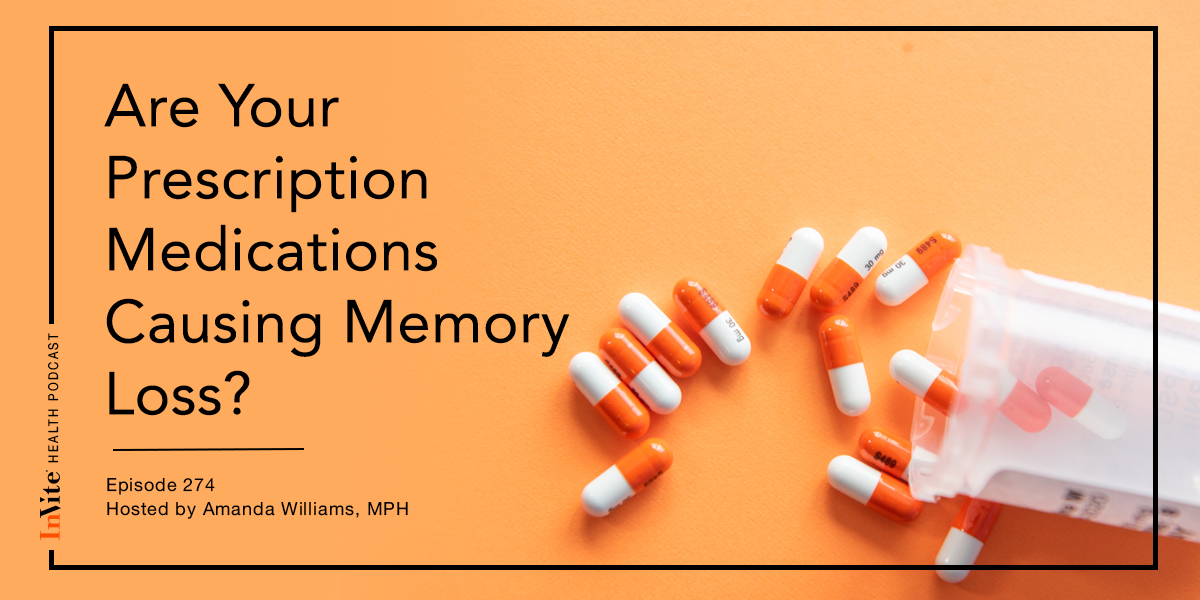
Are Your Prescription Medications Causing Memory Loss? – InVite Health Podcast, Episode 274

Are Your Prescription Medications Causing Memory Loss? – InVite Health Podcast, Episode 274

Invite Health Podcast, Episode hosted by Amanda Williams, MPH

Subscribe Today!

Apple PodcastsGoogle PodcastsiHeartRadioSpotify

There are certain classes of drugs that people are commonly prescribed that can actually affect, in a very negative way, someone’s cognition or memory over time. There are so many medications out there that can affect someone’s cognition and many times, people don’t even correlate it. First and foremost, they are usually completely unaware that’s even a potential side effect and oftentimes, their doctor is unaware of that, too. I want to talk about the different types of drugs or classes of drugs that we know can lead to a higher rate of cognitive decline and can even lead to dementia. To me, this is a very important topic because so many people are on prescribed medications. When you look at some of the more commonly prescribed medications in this country, they are often linked to declining cognition.† 

Anticholinergic medications

One of the most commonly prescribed medications that people are put on for an overactive bladder or for incontinence is oxybutynin, which also goes by the brand name of ditropan. This is an anticholinergic medication. When we look at things that are anticholinergic, what this actually means is that it’s blocking your cholinergic pathway. This is important because when we look at our cognition, we know that choline plays a huge part in this. Even when you look at drugs that are prescribed for Alzheimer’s disease, those are actually trying to enhance the cholinergic effect. If you look at a drug that actually blocks that, it would make sense that if we’re blocking the choline, then we’re blocking the ability for the brain to have that very important amino acid that is then transferred into a fatty acid.†        

Covid-19 Lingering Effects on the Brain – InVite Health Podcast, Episode 273. Listen Now >>

A report out of the University of California San Diego School of Medicine talks about different classes of drugs and how they are actually linked to an increased risk of Alzheimer’s disease. They published this in the Journal of Neurology. One of the main classes of drugs that they focused on was the anticholinergic drugs, which are utilized for dozens of different conditions, including bladder health, Parkinson’s disease, allergies, high blood pressure and incontinence. What the researchers recognized was that these anticholinergic drugs were depleting the brain’s storage of acetylcholine. Acetylcholine is a primary neurotransmitter that is required for our ability to think and have memory. If we’re blocking that, then that’s a major issue. Oftentimes, the people who are prescribed these anticholinergic medications are already up there in age and the metabolism of those anticholinergic drugs is certainly much different than it would be in someone in their 20s or 30s. The researchers were really delving into this and examining that brain and cognitive effect of different anticholinergic medications.†       

invite health podcast offer

Other medications

You certainly don’t want people to be on a medication that is creating more harm than it is good. What medications, other than the anticholinergic drugs, can have this impact on the body? 

Benzodiazepines are one of the most commonly prescribed medications out there. Whether we’re looking at something such as alprazolam, which also goes by the name of xanax, or lorazepam, many of these benzodiazepine medications are commonly prescribed for anxiety, as well as to older folks as a sleep aid. This is a big, big problem.†  

Harvard actually looked into this. They looked at 3500 men and women over the age of 65 and studied what medications they were on for the 10 years prior to the start of the study. Then, the researchers tracked the subjects’ health for the next seven years. During that time, out of the 3500 men and women, 800 of them developed dementia. What they were really focusing in on was the different types of medication that these people were on. They found that those who were prescribed and using anticholinergic drugs were more likely to develop dementia than those who did not. What was really quite alarming in this study was that the dementia risk increased along with the cumulative dose, meaning that if someone was taking an anticholinergic drug for the equivalent of roughly three years, they had a 54% increased risk for developing dementia. This is concerning when you think about how many people have issues with blood pressure or bladder health and are put on these medications technically for the rest of their lives and yet, every year, it’s wreaking havoc on their memory. Their family may play this off as part of aging without realizing it’s coming from the medication.† 

Benfotiamine: The Vitamin That Supports Memory – InVite Health Podcast, Episode 270. Listen Now >>

Other medications that have been identified as having a link with memory loss include diphenhydramine (benadryl), ataraks (hydroxyzine) and chlorpheniramine (over-the-counter cold medicine).†  

For more research on the relationship between prescription medications and memory loss, tune into the full podcast episode.    

Thank you for tuning in to the Invite Health Podcast. You can find all of our episodes for free wherever you listen to podcasts or by visiting www.invitehealth.com/podcast. Make sure you subscribe and leave us a review! Follow us on Facebook, Twitter and Instagram at Invite Health today. We’ll see you next time on another episode of the Invite Health Podcast.


invite health podcast disclaimer

amanda williams invite health