Tag: heart health

Potassium and Magnesium: Precious Minerals for Healthy Blood Pressure

Potassium and Magnesium: Precious Minerals for Healthy Blood Pressure

By Nicole Crane, BS, NTP In the United States alone, 72 million adults, nearly one third of all people over the tender age of 20, have high blood pressure, according to the National Heart and Lung Association. Worldwide, the number of people expected to have …

Could Children with Allergies Have An Increased Risk of Heart Disease?

Could Children with Allergies Have An Increased Risk of Heart Disease?

According to the American College of Allergy, Asthma & Immunology (ACAAI), 8.3 million American children have respiratory allergies, 9.5 American children have skin allergies and nearly 6 million children in the U.S. have food allergies. Though the organization reports that early identification of childhood allergies …

Could Your Heart’s Age be Older Than You Are? – InVite Health Blog

Could Your Heart’s Age be Older Than You Are? – InVite Health Blog

In a report published by the Center for Disease Control and Prevention (CDC), officials estimate that 3 out of 4 adults in the United States have a predicted “heart age” older than their chronological age, which increases their risk of heart attack and stroke.

Your heart’s age is calculated based on risk factors like high blood pressure, cigarette smoking, body mass index and diabetes, among others. The Framingham Heart Study, A Project of the National Heart, Lung, and Blood Institute and Boston University, has created a Heart Age Predictor, using many of those same factors.

The Study

In the Framingham Heart Study, data was collected from all 50 states that determined nearly 69 million adults in the United States between the ages of 30 and 74 years old have a heart age older than their actual age. The results also show that half of men and 2 in 5 women have a heart age that’s five or more years older than their chronological age. The average heart age for adult men was eight years older than their actual age, while it was five years older for women. CDC Director, Dr. Tom Frieden, stated, “Too many U.S. adults have a heart age years older than their real age, increasing their risk of heart disease and stroke. Everybody deserves to be young – or at least not old – at heart.”

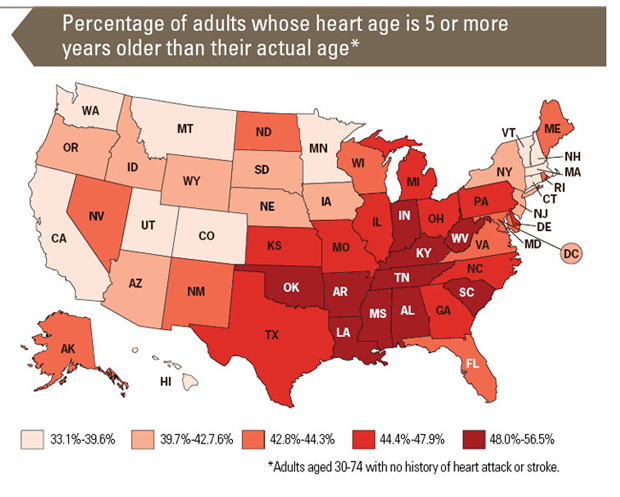
According to the CDC and the research study, geographic differences can be seen below; the highest heart ages were found in the South. Mississippi, West Virginia, Kentucky, Louisiana and Alabama had the highest percentage of adults with a cardiovascular age of 5 years or more above their actual ages. The states with the lowest percentages were Utah, Colorado, California, Hawaii and Massachusetts.
heart age, heart

To start managing the age of your heart, the U.S. Department of Health & Human Services advises you to quit smoking, eat a healthier diet, exercise regularly, and control your blood pressure and cholesterol.*

The University of Maryland Medical Center states that omega-3 fatty acids, essential fatty acids necessary for human health and crucial for overall growth and development, are very important. “Research shows that omega-3 fatty acids reduce inflammation and may help lower risk of chronic diseases such as heart disease, cancer and arthritis.” The organization goes on to say that those who get high amounts of omega-3 fatty acids, also tend to have decreased triglyceride levels (fats in the blood). Omega-3’s may also help with high blood pressure – “An analysis of 17 clinical studies using fish oil supplements found that taking 3 or more grams of fish oil daily, may reduce blood pressure in people with untreated hypertension.” And, overall, The University states that there is also evidence that suggests that EPA and DHA (two omega-3 fatty acids found in fish oil) help to “…reduce the risk of heart disease, including high cholesterol and high blood pressure.”

For more information on your heart’s health and age, visit the U.S. Department of Health & Human Services’s website by clicking here or visit The University of Maryland Medical Center’s Website by clicking here.

*Speak to your doctor about your blood pressure and cholesterol levels, including the best regulation and treatment methods for you.

Source: http://www.cbsnews.com/news/most-americans-have-a-heart-older-than-they-are/

InVite® Health Current Sale

Study says Vitamin D Deficiency Linked to Heart Problems

Study says Vitamin D Deficiency Linked to Heart Problems

Vitamin D, commonly referred to as the “sunshine vitamin”, is naturally produced in the body through sun exposure but also can be consumed through some foods like fish and eggs and through supplementation. A vitamin D deficiency can occur for a number of reasons, which …

Brain Health Benefits of the Mediterranean Diet

Brain Health Benefits of the Mediterranean Diet

You’ve heard it all before – exercise regularly, follow a healthy diet, stop smoking and drinking. Doctors and scientists have always followed the same guidelines for overall health and wellness. But a new study from the journal Neurology shows a rather new advancement – following …

Study Suggests New Blood Pressure Guidelines for Those Over 50

Study Suggests New Blood Pressure Guidelines for Those Over 50

According to CNN, about a third of adults in the U.S. suffer from hypertension, a leading risk factor for heart disease, stroke, kidney failure and other health problems.

Recent government data provided by the U.S. Department of Health and Human Services have indicated that between 1999 and 2014, the number of people who have their hypertension under control increased from 31% to 53%. Most doctors have long advised systolic blood pressure (BP), BP levels in the arteries when the heart muscle contracts, to be considered normal below 120 and would only treat patients with a pressure level of 140 or above (CNN). However, recent findings from a study performed by the National Institute of Health says patients in the “pre-hypertension” area, between 120 and 140, should be treated too.

For Americans over 50 years old that are suffering from hypertension, the study suggests there is a significant reduction in the risk of heart attack and stroke (if your pressure is kept below 120). Over nine thousand participants included in the study were split into two groups – one group received two forms of BP medication to adjust their blood pressure to a number below 140 and the other group took three forms of blood pressure medication to adjust their blood pressure to a number below 120.

Doctor Gary H. Gibbons, director of the National Heart, Lung and Blood Institute, a major sponsor of the trial, says this study “provides potentially lifesaving information that will be useful to healthcare providers as they consider the best treatment options for some of their patients, particularly over the age of 50.” These findings are in its preliminary stages and needs further review, as patients who take more medication to lower their blood pressure may face challenging side effects, like dehydration, headache and weakness.

Additional methods to regulating blood pressure to 120 or below include losing weight and exercising. Dr. Karen Margolis, director of clinical research at HealthPartners Institute for Education and Research suggests that losing about 9 pounds could reduce systolic blood pressure by 4.5 points. Studies performed by the American College of Cardiology and the American Heart Association, found moderate exercise like walking or cycling for one hour, three times a week reduced systolic blood pressure in sedentary older adults by 5 points in 10 weeks. Your diet also plays a major role in the balancing of blood pressure. Doctors have long advised patients with high blood pressure to cut back on their salt intake and increase fruits and vegetables in their diet.

Nutrients for High Blood Pressure

Taurine is an amino acid that offers great antioxidant protection for the entire body, especially cardiovascular health. It may be very useful for those with high blood pressure or high cholesterol, as it acts as a neurotransmitter and a regulator for the heart and circulatory system. Magnesium is another important mineral that aids in the function of over 300 metabolic reactions. Inadequate levels of magnesium can lead to an array of cardiovascular health problems, such as cardiac arrhythmias, blocked arteries, chest pain and high blood pressure. Before starting a supplement regimen, speak to your primary physician or a nutritionist.

For more information, visit the American College of Cardiology’s website at http://www.acc.org/.

Source: http://www.cnn.com/2015/09/18/health/how-to-lower-blood-pressure-tips/index.html and http://www.cnn.com/2013/12/18/health/new-guidelines-high-blood-pressure/index.html

InVite® Health Current Sale