How Vitamin C Supports Healthy Immunity – InVite Health Podcast, Episode 123
Vitamin C is one of the most crucial vitamins to support a healthy immune response. Here’s what you need to know about this essential nutrient.
Nutrition. Vitamins. You.
Vitamin C is one of the most crucial vitamins to support a healthy immune response. Here’s what you need to know about this essential nutrient.
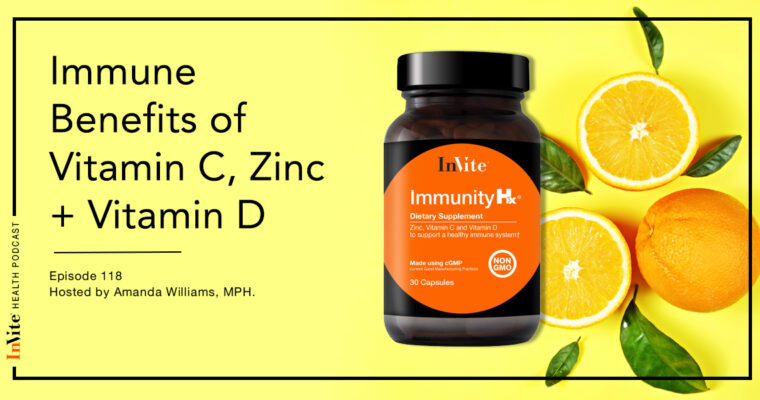
We are still in the midst of a pandemic and your health should be a priority. It is extremely important to turn to the fundamentals in order to keep your immune system working properly, including Vitamin C, Vitamin D and Zinc.
Invite Health Podcast, Episode hosted by Jerry Hickey. Ph
Subscribe Today!


On today’s episode, we are going to be talking about immune function during the summer months! Many times during the summer we put our guard down and may not think we will come across any viruses or bacteria. But actually, during the summer, we can all be subjected to these kinds of infections which is why highlighting the importance of certain nutrients, especially during the summer months, is so important. COVID-19 has not disappeared! People are still contracting this virus and certain states within the US are still seeing their case numbers increase.
The Importance of Folic Acid During The Summer
Interestingly enough, when we think about things like Vitamin D for example, most of us are now at a point where we understand that Vitamin D serum levels have a tendency to decline during the winter months. This is because you do not have as much exposure to the sun and numerous other factors, including your genetics. Most people are going to require any where from 2000 IU (international units) to 5000 IU every day, when it comes to Vitamin D3 supplementation.
How to Restore Your Aging Immune System. Listen Now >>
But other nutrients can have the opposite effect, including Folic acid. Folic acid is a type of water soluble B-Vitamin that is normally found in foods like beans, peas, lentils, and some green leafy vegetables including broccoli, Brussels sprouts and spinach. Folic acid helps your body produce and maintain new cells and also plays a role in making your DNA. Women who are pregnant need higher amounts of Folate, as it plays an integral role in neurological development of the child. When turning to supplementation, you will want to use the active form of Folate, which is methylfolate. 
Published in 2019 in the journal of Phytochemical and Phytobiology researchers studied the association between serum folate levels and UV radiation from the sun. UV radiation has consistently been reported to cause folate photodegradation in human skin. The study of 118,000 people reports, “Seasonal variations in UV radiation might explain seasonal changes in folate levels in the blood.” This means that every single one of the samples showed a decrease in their folate concentration in the summer. A second study studied a potential development of a folate deficiency. In this study, researchers found a 3.32% chance of participants developing a folate deficiency during the summer, as opposed to the winter.
Your New Summer Immunity Arsenal
Do not ignore the basics! A simple multivitamin is a great way to reap all of the benefits of essential vitamins and supplements. But a superior multivitamin that also contains Probiotics and Greens can help to enhance digestive health, detoxification, and immunity.
Enhance your wellness! B-Vitamins play an integral role in, not just the immune system, but also the way the body fends off oxidative stress, especially through UV exposure. Green tea has also been shown to help fend off UV radiation or exposure from the sun.
The Importance of B-Vitamins For Your Brain! Listen Now >>
The sunshine vitamin! We still need Vitamin D. Just because you are sitting in the sun now more than any other season, does not automatically mean you are getting adequate amounts. I encourage you to have your blood levels tested to find our what your serum Vitamin D levels are.
Thank you for tuning in to the Invite Health Podcast. You can find all of our episodes for free wherever you listen to podcasts or by visiting www.invitehealth.com/podcast. Make sure you subscribe and leave us a review! Follow us on Facebook, Twitter and Instagram at Invite Health today. We’ll see you next time on another episode of the Invite Health Podcast.


Here is what you can do to make your immune system stronger, including what supplements have been shown to help maintain overall health and wellness like specific Probiotic strains of beneficial bacteria.

Our immune system becomes less competent with age. This makes a person more vulnerable to diseases and can make a common infection, such as the flu much more dangerous. Here’s what you need to know about your aging immune system.

Invite Health Podcast, Episode hosted by Jerry Hickey. Ph
Subscribe Today!
In part 1, we discussed a report that came out of Brooklyn about a mother who had tested positive for the Coronavirus, with all the symptoms including issues with her breathing. A doctor who was an associate of her son, suggested a Glutathione supplement which, according to the patient, greatly helped her breathing. Listen to Episode 1 by clicking here! In today’s episode, we are going to dive further into the studies and science behind the very important and powerful antioxidant, Glutathione.
We have a very thin layer of liquid lining our lungs. This fluid has to be rich in certain antioxidants – natural vitamin E, vitamin c and especially Glutathione. The Glutathione buffers the lungs from inflammation, which can be caused by things that you inhale like mold, cigarette smoke, toxins, air pollution and dust. Research shows how important this antioxidant is for the lungs, ranging from cystic fibrosis to asthma.
Research from the University of Rochester Medical Center in upstate New York shows that free radicals inflame our lungs and are the major cause of lung damage in chronic lung diseases. They write that a drop in Glutathione in the alveoli that line our lungs is a central feature of chronic lung diseases with inflammation and that Glutathione is an important antioxidant that is therapeutic in preventing lung inflammation and lung damage.
A study by the University Colorado in Denver and a bunch of other academic research institutions studied the impact of lung health on older smokers, compared to younger smokers. The protective fluid lining their lungs that contains Glutathione and the other antioxidants dropped by 67%. Their response to smoking, which would normally trigger the response of Glutathione is almost gone. These smokers were also releasing more of the inflammatory precursors than you would see in younger smokers lungs. This drop in protection is connected with the onset of emphysema and other lung conditions related to smoking, including lung cancer.
There is an interesting study going on right now in Wuhan, China – which has been reported to be the source of the Coronavirus pandemic – where scientists are studying Glutathione attached to nano-sized silver particles to help treat Coronavirus infections. They claim that it is preventing the virus from attaching to tissues. I am not sure where this research is going, but they claim it may slow the viral replication. In other words, the “nastiness” of the virus. NAC and Alpha-lipoic acid are precursors to making Glutathione. They all have the ability to protect your lungs from inflammation caused by pollution, viruses, your immune system and many other factors.
A study published in the American Journal of Respiratory and Critical Care Medicine from the University of Southern California in Los Angeles and The Keck School of Medicine at USC, reports that lungs are uniquely exposed to pollution, toxins, viruses and bacteria so they need to be adaptive. The lungs use Glutathione to protect themselves from all of these things that we are inhaling and to adapt quickly to a changing environment. The study goes on to say that Glutathione plays an important role as an antioxidant in the lungs to stop the inflammatory processes.
Thank you for tuning in to the Invite Health Podcast. You can find all of our episodes for free wherever you listen to podcasts or by visiting www.invitehealth.com/podcast. Make sure you subscribe and leave us a review! Follow us on Facebook, Twitter and Instagram at Invite Health today. We’ll see you next time on another episode of the Invite Health Podcast.
