Tag: weight gain

Holidays and Digestive Woes

Holidays and Digestive Woes

Holidays and Digestive Woes Dr. Claire Arcidiacono, ND As we approach the holiday season family gatherings become more frequent. These family gatherings often include new or different foods that may affect your digestive health. Family gatherings also frequently include travel and even stress, both of 

UNDERSTANDING HYPOTHYROIDISM

UNDERSTANDING HYPOTHYROIDISM

UNDERSTANDING HYPOTHYROIDISM  Dr. Claire Arcidiacono, ND Hypothyroidism is where the body does not produce enough thyroid hormone. This can happen if there is a problem in the thyroid itself or a problem in the organ that controls the thyroid. For this lecture we will focus on 

Thyroid and Women’s Health

Thyroid and Women’s Health

Thyroid and Women’s Health

Dr. Claire Arcidiacono, ND 

Thyroid health is important for our overall wellbeing. But did you know that it can also affect women’s health concerns?   In general women are more likely to be diagnosed with thyroid issues. In fact, up to 1 in 8 women will be affected by thyroid disorders. Let us get into it, shall we?  

One of the ways that the thyroid can impact women’s health is by affecting our monthly cycles. Thyroid dysfunction can delay or speed up both puberty and menopause. It can also cause menstrual cycles to become irregular or even stop all together. Thyroid dysfunction can also cause the cycles to become heavier or lighter than normal. Studies show ovulation can be inhibited by thyroid disorders leading to problems with fertility. Women with thyroid disorders may notice that their periods are heavier than they expect or even contain larger than usual clots. This can lead to an increase in blood loss which can make you anemic. Something else that you may not realize is that if you are anemic, you will have heavier/ more clots during your period. This will leave you more anemic and thus more likely to have heavier periods! This is a feedback loop that can begin with heavier periods caused by thyroid disorder. (1) 

Every woman knows that post menopause, bone health is a very real concern. This is especially true for those with thyroid disorders. This is because any changes in thyroid hormones can affect the balance of bone dissolution and replacement; because thyroid hormones control bone metabolism. Studies show that in people with hypothyroidism, bone formation is slowed by up to 50%! Hyperthyroidism can cause rapid bone loss and decrease the quality of any new bone formed. (4) They go on to show that Levothyroxine in post-menopausal women with hypothyroidism have a decrease in bone density. (5) What does this mean? Since the thyroid controls the balance of bone production and absorption, it is important for post-menopausal women to be proactive with their bone health.  

Having too much or too little thyroid hormone can cause hair loss.  The thyroid hormones T3/T4 affect hair development. Unlike other causes of hair loss, thyroid disorders cause hair loss all over the scalp rather than in discrete areas. It is important to note, people with a thyroid disorder due to auto immune issues, are often prone to other autoimmune disorders such as Alopecia aerate. However, in the case of Alopecia, the hair loss that results is discrete and often circular areas of hair. (7) This is important because postmenopausal women tend to have hair loss. Because estrogen and progesterone are decreased, it leads to an increase in androgens. This causes hair to grow slowly and the hair follicles to shrink; causing the existing hair to fall out. (8) Working with the underlying thyroid condition can help the hair loss long term.  

Other concerns for women include mood swings and depression. It is well documented that menopausal women experience depression and anxiety. Thyroid disorders often have symptoms of depression and anxiety as well. (12)  

So, what can you do if you experience these symptoms? 

  • DIM has been found to help with heavy, painful periods as well as PMS. DIM has also been found to help reduce the symptoms of both Perimenopause and menopause. Even hair loss associated with Menopause has been found to be helped by using DIM! (2) In my experience DIM is also helpful for those who have irregular periods. Please see Invite’s I-3-C with DIM! 
  • Calcium D-Glucarate has also been found to have a ton of benefits for female health! For example, it can help with irregular cycles, heavy, painful cycles and even hair loss! (3) 
  • B vitamins have been found to help improve fertility in studies! (13) Please see Invite’s Methyl-B and B Complex 100! 
  • Omega 3s not only reduces inflammation but can help improve egg quality. (13) See Invite’s Fish Oil and Krill Oil! 
  • Iron can help if you are having heavy periods and become anemic! (13) In fact, I have had many women tell me that taking Iron has reduced how much clotting they experience! See Invite’s Iron Plus 
  • Calcium, magnesium, vitamin D and K are all considered essential nutrients for our bones! (6) And they are all in 1 convenient powder – Bone Powder! They are also found in Invite’s Multi Energy powder. If you do not like powders check out Invite’s Calplex, Cal-Mag, Vitamin K, Vitamin D (1000 and 3000 IU) as well as our extensive line of magnesium products! 
  • Green Tea has been found to help improve hair follicles! (9) Please see Invite’s Green Tea Tx and Hx!  
  • Ashwagandha is an amazing nutrient for thyroid health. Studies have shown that Ashwagandha helps subclinical hypothyroidism in just over 8 weeks. See Invite’s Thyroid Hx! (14) 
  • Coleus forskohlii has been found in studies to work to increase synthesis of T4 by the thyroid (15) See InVite’s Thyroid Hx 

SOURCES 

  1. https://www.harleystreetent.com/blog/why-women-are-more-prone-to-thyroid-problems 
  1. DIM Supplement Benefits For Women 
  1. The Benefits of Calcium D-Glucarate 
  1. https://www.abbott.in/corpnewsroom/nutrition-health-and-wellness/how-thyroid-problems-can-weaken-your-bones-.html 
  1. https://www.ncbi.nlm.nih.gov/pmc/articles/PMC3930806/ 
  1. https://www.ncbi.nlm.nih.gov/pmc/articles/PMC3330619/ 
  1. https://www.btf-thyroid.org/hair-loss-and-thyroid-disorders 
  1. https://my.clevelandclinic.org/health/diseases/16921-hair-loss-in-women 
  1. https://pubmed.ncbi.nlm.nih.gov/17092697/ 
  1. https://www.ncbi.nlm.nih.gov/pmc/articles/PMC4201279/ 
  1. https://www.insider.com/apple-cider-vinegar-for-hair-2019-3#:~:text=Adding%20apple%20cider%20vinegar%20to,hair%20growth%20and%20healthier%20hair.%22 
  1. https://www.stlukeshealth.org/resources/thyroid-disease-behind-your-mood-swings 
  1. https://progyny.com/education/best-vitamins-and-supplements-fertility/#:~:text=Vitamin%20B6%20and%20B12:%20Both,women%20with%20recurrent%20pregnancy%20loss. 
  1. Sharma, A. et al. (2018). Efficacy and Safety of Ashwagandha Root Extract in Subclinical Hypothyroid Patients: A Double-Blind, Randomized Placebo-Controlled Trial. Journal of alternative and complementary medicine (New York, N.Y.), 24(3), 243–248. 
  1. Hameed, S. I., Al-Shahwany, A. W., & Salih, S. J. (2020). Evaluation of the Activity of Some Plants Extracts on Thyroid Gland Regulation in Female Albino Rats. Iraqi Journal of Science, 254-265. 


How the Thyroid Impacts Weight Management

How the Thyroid Impacts Weight Management

How the Thyroid Impacts Weight Management Dr. Claire Arcidiacono, ND  One topic that comes up often around summertime is weight management. Everyone wants to be ready for the beach! And one part of managing our weight is by working with our thyroid. Everyone knows the 

Thyroid and Weight Management

Thyroid and Weight Management

The thyroid is very complex but we need to make sure to understand that the thyroid can impact weight. This can be through weight loss or weight gain. Learn more about weight management by continuing to read more!

All About Hypothyroidism

All About Hypothyroidism

hypothyroidism

Written by Dr. Claire Arcidiacono, ND

For further questions or concerns email me at carcidiacono@invitehealth.com

The thyroid can experience multiple dysfunctions. Here’s what you need to know about hypothyroidism.

What Is Hypothyroidism?

Hypothyroidism is where the body doesn’t produce enough thyroid hormone.  This can happen if there is a problem in the thyroid itself or if there is a problem in the anterior pituitary which is the organ that basically controls the thyroid.  For this lecture we will focus on the thyroid itself.†

In typical hypothyroidism blood tests will show higher than usual TSH and lower than usual T4 & T3.  For a more in-depth explanation, feel free to see last week’s blog on thyroid testing.†

ALL ABOUT THYROID TESTS. Read Now>>

Normal TSH is .5 to 5mu/l and normal T3 is 80-220mg/dl. T4 is 5-12ug/dl.  However,  this is where it gets interesting because “normal” doesn’t mean optimum. The optimum range for TSH is 1.3-2.5mu/l.  For example, a value of 3 indicates what is known in the holistic community as “sub-clinical hypothyroidism” and is very often accompanied by symptoms of low thyroid. While sub-clinical hypothyroidism isn’t usually severe enough to warrant conventional treatment, certain supplements have been found in studies to alleviate symptoms.† (1)

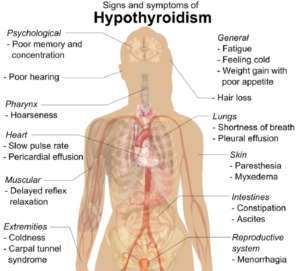
What, exactly,  are the most common symptoms of a low thyroid?  To start, you may experience difficulty concentrating as well as fatigue. There is also a feeling of being cold as well as slow heart rate which is often associated with shortness of breath. Weight gain is often associated with low thyroid.  Hair loss is another symptom that often has people coming in to see a nutritionist.  Just a heads up: if you are having hair loss, getting your thyroid tested is a great first step to finding out what is going on. Less commonly known as a symptom is depression.  In women, menstrual cycles can often be heavier than usual (although as the hypothyroidism persists, it can progress to lighter than usual cycles).  Since hypothyroidism is associated with a slowing down of things, it makes sense that there is delayed tendon reflexes. That is where the doctor hits your knee and you get to kick him.  Constipation as well as changes in digestive health are also noted.  I’ve included a picture for a system by stem breakdown of all the symptoms of hypothyroidism since the thyroid affects almost every system.† (2)
hypothyroidism

Now what can potentially lead to the symptoms of hypothyroidism? In many cases too little iodine is a trigger. Also treatment with radioactive iodine can affect the thyroid.  Injury to the hypothalamus or anterior pituitary can also lower the amount of thyroid hormone produced. Obviously, being born without a thyroid or having thyroid surgery can cause the thyroid hormone to be low. Even certain prescription medications can cause low thyroid as a side affect.†

Autoimmune such as Hashimotos Hypothyroidism, Postpartum Hypothyroidism as well as Myasthenia Gravis can cause the symptoms of hypothyroidism. But since this is such a large topic, I’ll talk about this later on.†

Last but not least, any autoimmune disorders such as celiac disease, Rheumatoid arthritis, SLE, and even diabetes can affect the thyroid.  From a more holistic point of view, “leaky gut” can also affect the thyroid. Which is why so many holistic practitioners say treat the gut!† (3)

How to help your thyroid

Working with hypothyroidism is one of those things that requires a gentle touch, if you will.  Many of the studies find herbs and supplements to help moderate thyroid symptoms, but they are very strong. I advise working with a qualified nutritionist from InViteⓇ Health.†

  1. Bladderwrack or kelp: Studies have shown that this helps with providing iodine to help in the case of iodine deficiency which is very common in hypothyroidism. In fact, studies have shown the iodine in kelp to be much easier for the body to use than just taking iodine by itself!† (4)

See InViteⓇ Health Thyroid HxⓇ to find this amazing source of iodine!†

  1. Ashwagandha: Studies once again show that this amazing herb is helpful for the thyroid. Studies have shown that Ashwagandha helps subclinical hypothyroidism in just over 8 weeks! Other studies show an increase in T4 from the baseline.† (5)

See InViteⓇ Health Thyroid HxⓇ to find this amazing plant!†

3.Coleus forskohlii has been found in studies to work to increase synthesis of T4 by the thyroid. In one animal study, levels of TSH went down, while the levels of T3/T4 went up.† (6)

See InViteⓇ Health Thyroid HxⓇ to find this amazing plant!†

  1. Black Cumin seed or Black Seed has been found in studies to have a protective role in hypothyroidism. In 1 study black cumin raised T3.† (7)

See InViteⓇ Health Black Seed with Rosemary and Cordyceps as well as our InViteⓇ Multi for Men!†

  1. L-tyrosine, zinc, and selenium are all important nutrients for producing thyroid hormones.† (8)

See InViteⓇ Health Thyroid HxⓇ, Zinc tablets/lozenges, Immunity HxⓇ, as well as all our wonderful InViteⓇ multivitamins!†

  1. Glandular type supplements are also an option for thyroid disorders and are available at select InViteⓇ stores! For more information call 212-249 -2036.† (9)

These are very basic ideas for hypothyroidism.  But this is a very complex issue. Working on diet, stress and even gut health are all important aspects of helping our thyroid. This is why it is so important to get the blood work and a list of medications you take for any reason and visit a store such as our 71 Street store. This ensures the best protocol for you.†

BEING MINDFUL ABOUT STRESS – INVITE HEALTH PODCAST, EPISODE 474. Listen Now>>

Next week, hyperthyroidism!

(1) https://www.uclahealth.org/endocrine-center/normal-thyroid-hormone-levels

(2) Longo DL, Fauci AS, Kasper DL, Hauser SL, Jameson JL, Loscalzo J (2011). “341: disorders of the thyroid gland”. Harrison’s principles of internal medicine (18th ed.). New York: McGraw-Hill. ISBN 978-0071748896.

(3)[8] Garber JR, Cobin RH, Gharib H, Hennessey JV, Klein I, Mechanick JI, Pessah-Pollack R, Singer PA, Woeber KA (December 2012). “Clinical practice guidelines for hypothyroidism in adults: cosponsored by the American Association of Clinical Endocrinologists and the American Thyroid Association”. Thyroid. 22 (12): 1200–35. doi:10.1089/thy.2012.0205. PMID 22954017.

(4)Catarino, M. D., Silva, A., & Cardoso, S. M. (2018). Phycochemical Constituents and Biological Activities of Fucus spp. Marine drugs, 16(8), 249. https://doi.org/10.3390/md16080249

(5)Sharma, A. et al.  (2018). Efficacy and Safety of Ashwagandha Root Extract in Subclinical Hypothyroid Patients: A Double-Blind, Randomized Placebo-Controlled Trial. Journal of alternative and complementary medicine (New York, N.Y.), 24(3), 243–248.

(6)Hameed, S. I., Al-Shahwany, A. W., & Salih, S. J. (2020). Evaluation of the Activity of Some Plants Extracts on Thyroid Gland Regulation in Female Albino Rats. Iraqi Journal of Science, 254-265.

(7)Ismail, M. et al. Effect of Nigella sativa L. on serum concentration of thyroid hormone, thyroid stimulating hormone and glucose in alloxan-induced diabetic rabbits. Ir Vet J. 2003;59(9):462–4.

(8)https://pubmed.ncbi.nlm.nih.gov/19594417/

(9) https://www.naturalmedicinejournal.com/journal/2014-08/thyroxine-and-triiodothyronine-commercially-available-thyroid-supplements