Recent Posts

Getting to know NAC

Getting to know NAC

Getting to know NAC (N-Acetyl L-Cysteine)   Dr. Claire Arcidiancono   During this time of year I often get asked “what can I do to help boost my immune system?” What can I do to help my lung health/ function? And perhaps the most common 

Immune Health Part 2

Immune Health Part 2

Immune Part Two: Dr. Claire Arcidiancono   In our last blog we went over the innate immune system and how it works. In this blog we will be reviewing the adaptive immune system as well as inflammation.  Lastly I will be doing a walk through 

The Immune System made easy!, Part 1, Invite Health Blog

The Immune System made easy!, Part 1, Invite Health Blog

Written by: Dr.Claire Arcidiacono, ND
For further questions or concerns email me at carcidiacono@invitehealth.com†
Chronic infections are a topic I find particularly important because they are related to so many different chronic and acute health concerns. When we speak of chronic infections it is important to understand how the immune system works. To start with, there are 2 main components of the immune system. These are the innate immune system and the adaptive immune system. (1) These however are not the first line of defense against pathogens. Before I delve into the interesting world of the innate vs the adaptive immune response, I’d like to mention several “barriers “that are in place to help protect us from pathogens or as I like to say, “bad guys”. †
The first defense against infections is actually our skin. The skin is not only a physical covering that protects us from infections but also an active part of our body that secretes antimicrobial peptides. (2) There are also antibacterial enzymes in our bodily secretions such as saliva, tears, breast milk, vaginal secretions and even our stomach. (3) As I mentioned in my series on digestive health, gastric stomach acid helps to kill any pathogens that may enter through food. (4) Good bacteria also help to prevent an overgrowth of bad bacteria in a few ways including competing for space and resources. (5) Physically our body responds to the presence of pathogens by coughing and sneezing. Both tears and urine help to “wash” away any irritants in the pathway.  † (6)
After a pathogen breeches our physical barriers, they trigger a response from our innate immune system.  The innate response is immediate and strong; however, it is not specific to the particular pathogen that you were exposed to. This part of the immune system does not have a “memory”. The innate immune cells include what are called white blood cells. These cells can find pathogens and eliminate them, most commonly by contact or by engulfing them. These innate leukocytes or WBC include macrophages, neutrophils and dendritic cells. Other WBC that are important in the innate immune system include the lymphoid cells, mast cells, eosinophilic cells, basophils and natural killer cells. † (7)
What exactly do these cells do to help us fight infections? Let’s break it down, shall we? †
The Neutrophils as well as the Macrophages travel in the blood stream to fight off pathogens. Neutrophils are usually the first to arrive at the location of infections or inflammation. (8)  Please see the attached picture of a Neutrophil. † (9)
                                                                                                                                       
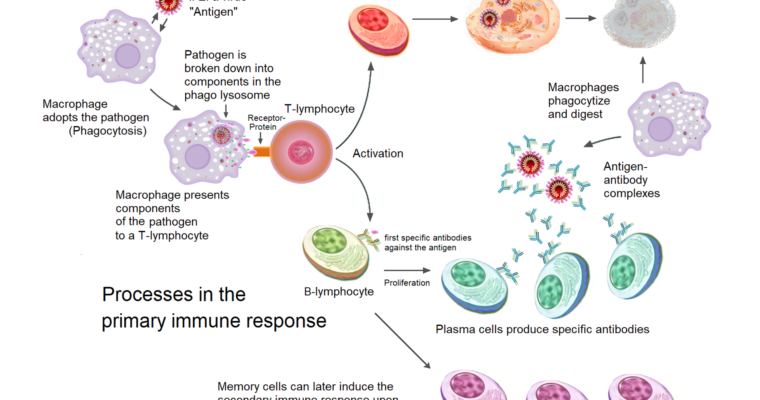
Macrophages are interesting because while they can and do act in the innate immune system to help protect the body they also act as antigen presenting cells that activate or “turn on” the adaptive immune system. (10) Please see the picture! † (11)
                                                                                                                                       
Dendritic cells are in places such as the skin, nose, lungs, stomach, and the intestines. What is interesting about these areas is that they are all openings in the body. In other words the outside world interacts with the inside of our body. These cells are considered to be a link between the innate immune system and the adaptive immune system. This is because one of their important jobs is to present antigens to the T cells which are an important part of the adaptive immune system. (12) Please see the attached picture. † (13)
                                                                                                                                         
The granulocytes are cells that have particles in them that are called granules and these granules that are inside of them are released as the cells do their job. WBC of this type are the mast cells, basophils and the eosinophils. Mast cells are usually seen in connective tissue and mucus membranes and help to regulate the inflammatory response. † (14) Please see the attached mast cell. (15)
Basophils and eosinophils in contrast do not contain these granules and in fact are closely related to neutrophils and secrete different chemicals that fight parasites. Unfortunately, they also have a role in allergies. (16) Please see the attached Eosinophilic cell.  † (17)
                                                                                                                                       
Lastly the Natural killer cells are part of the innate immune system which helps to get rid of compromised host cells for example those that have developed cancer. (18) Please see the attached picture.  † (19)
                                                                                                                                       
After the innate immune system is triggered, the pathogens can trigger the adaptive immune system. In our next blog I will review the cells of the adaptive immune system. I will also do a quick walk through of the immune system as its world work its way through an infection. †
REFERENCES
1. Litman GW, Cannon JP, Dishaw LJ (November 2005). “Reconstructing immune phylogeny: new perspectives”. Nature Reviews. Immunology. 5 (11): 866–79. doi:10.1038/nri1712. PMC 3683834. PMID 16261174.
2. Agerberth B, Gudmundsson GH (2006). “Host antimicrobial defence peptides in human disease”. Current Topics in Microbiology and Immunology. 306: 67–90. doi:10.1007/3-540-29916-5_3. ISBN 978-3-540-29915-8. PMID 16909918.
3. Boyton RJ, Openshaw PJ (2002). “Pulmonary defences to acute respiratory infection”. British Medical Bulletin. 61 (1): 1–12. doi:10.1093/bmb/61.1.1. PMID 11997295.
4. Smith JL (2003). “The role of gastric acid in preventing foodborne disease and how bacteria overcome acid conditions”. J Food Prot. 66 (7): 1292–1303. doi:10.4315/0362-028X-66.7.1292. PMID 12870767.
5. Gorbach SL (February 1990). “Lactic acid bacteria and human health”. Annals of Medicine. 22 (1): 37–41. doi:10.3109/07853899009147239. PMID 2109988.
6. Boyton RJ, Openshaw PJ (2002). “Pulmonary defences to acute respiratory infection”. British Medical Bulletin. 61 (1): 1–12. doi:10.1093/bmb/61.1.1. PMID 11997295.
7. Kumar H, Kawai T, Akira S (February 2011). “Pathogen recognition by the innate immune system”. International Reviews of Immunology. 30 (1): 16–34. doi:10.3109/08830185.2010.529976. PMID 21235323. S2CID 42000671.
8. Actor J (2012). Elsevier’s Integrated Review Immunology and Microbiology (Second ed.). doi:10.1016/B978-0-323-07447-6.00002-8.
9. https://en.wikipedia.org/wiki/Neutrophil#/media/File:Neutrophils.jpg
10. Mills CD (2012). “M1 and M2 Macrophages: Oracles of Health and Disease”. Critical Reviews in Immunology. 32 (6): 463–488. doi:10.1615/CritRevImmunol.v32.i6.10. PMID 23428224.
11. https://en.wikipedia.org/wiki/Macrophage#/media/File:Giemsa_Stain_Macrophage_Illustration.png
12. Monga I, Kaur K, Dhanda S (March 2022). “Revisiting hematopoiesis: applications of the bulk and single-cell transcriptomics dissecting transcriptional heterogeneity in hematopoietic stem cells”. Briefings in Functional Genomics. 21 (3): 159–176. doi:10.1093/bfgp/elac002. PMID 35265979.
13. https://en.wikipedia.org/wiki/Dendritic_cell#/media/File:Dendritic_cell_revealed.jpg
14. Krishnaswamy, Ajitawi & Chi 2006, pp. 13–34.
15. https://en.wikipedia.org/wiki/Mast_cell#/media/File:Mast_cell.png
16. Uhm TG, Kim BS, Chung IY (March 2012). “Eosinophil development, regulation of eosinophil-specific genes, and role of eosinophils in the pathogenesis of asthma”. Allergy, Asthma & Immunology Research. 4 (2): 68–79. doi:10.4168/aair.2012.4.2.68. PMC 3283796. PMID 22379601.
17. https://en.wikipedia.org/wiki/Eosinophil#/media/File:Blausen_0352_Eosinophil_(crop).png
18. Sompayrac 2019, pp. 1–4.
19. https://en.wikipedia.org/wiki/Natural_killer_cell#/media/File:Human_Natural_Killer_Cell_(29120480442).jpg
Anti-Aging Recipes

Anti-Aging Recipes

ANTI-AGING AWARENESS: MY GO-TO RECIPES by: Allie Might, FMC, INHC, ATT   September is Anti-Aging Awareness month, so I thought this would be a great time to discuss this topic. So many things fall under anti-aging, such as eye health, brain health, heart health and 

Understanding Vertigo, Invite Health Podcast, Episode 669

Understanding Vertigo, Invite Health Podcast, Episode 669

Subscribe Today! Please see below for a complete transcript of this episode. UNDERSTANDING VERTIGO, INVITE HEALTH PODCAST, EPISODE 669 Hosted by Amanda Williams, MD, MPH. *Intro Music* InViteⓇ Health Podcast: [00:00:04] Welcome to the InViteⓇ Health Podcast, where our degreed health care professionals are excited 

The True Role of Vitamin K, Invite Health Podcast, Episode 668

The True Role of Vitamin K, Invite Health Podcast, Episode 668


Subscribe Today!

Apple PodcastsGoogle PodcastsiHeartRadioSpotify

Please see below for a complete transcript of this episode.

THE TRUE ROLE OF VITAMIN K, INVITE HEALTH PODCAST, EPISODE 668

Hosted by Amanda Williams, MD, MPH.

*Intro Music*

InViteⓇ Health Podcast[00:00:04] Welcome to the InViteⓇ Health Podcast, where our degreed health care professionals are excited to offer you the most important health and wellness information you need to make informed choices about your health. You can learn more about the products discussed in each of these episodes and all that Invite Health has to offer, at www.invitehealth.com/podcast. First-time customers can use promo code podcast at checkout for an additional 15% off your first purchase. Let’s get started.† [00:00:34]

*Intro Music*

Amanda Williams MD, MPH: [00:00:40] There are many misconceptions when it comes to vitamins and minerals, but one really sticks out when it comes to misinformation and just not understanding what this vitamin is doing for the human body, and that’s vitamin K. I am Dr. Amanda Williams, scientific director at Invite Health, and this is a topic that I have discussed in length with so many individuals on a 1 to 1 basis, because there is a lot of fear about supplementation with vitamin K. Is it safe? Should I be taking it? What if I’m on a blood thinner? Is this going to be a problem? And there is a lot that we understand about the mechanism of action, about vitamin K but there are so much more that we are actually learning. Understanding how Vitamin K is playing a role even in respiratory health. Most people, if they think about vitamin K, they think about blood clotting or they think about bone health. And we have to understand that vitamin K is not causing blood clots, that’s the first misconception. It’s part of what is known as the blood coagulation cascade. So it plays a role as a cofactor. The body requires Vitamin K, Vitamin K1 in particular when it comes to the way that the body can clot up if we have an injury. So say, for example you have a cut and you start to bleed, Vitamin K is then looked at as being a factor in allowing the body to be able to stop itself from having excessive bleeding, but it’s not creating blood clots and this is where that common misconception comes into play. And there is much out there still in the traditional medical world that if someone is on a blood thinner than they have to at all costs avoid vitamin K and even avoid green leafy vegetables where you may get too much vitamin K. Now, interestingly enough, all the way back in 2005, University of Texas, School of Pharmacy did a really fascinating study, where they gave individuals who were taking warfarin, so taking a very powerful blood thinner. So, warfarin, very powerful blood thinner, and they gave these individuals low dose vitamin K and through supplementation of giving them the low dose vitamin K, they found that this actually helped them have more regular INR readings, which is the international normalized ratio. And INR is the way that they can test to see how much warfarin they should be giving someone. Is the blood getting too thin? Is the blood getting too thick? And they found that when folks who were taking warfarin started to supplement with low dose vitamin K, that they actually had longer periods where their INR stayed in a healthy range, so they didn’t have to keep auto adjusting the warfarin dose, so this in and of itself was a wonderful finding. However, most doctors still didn’t catch on to this like, well, hey, if someone eats a salad, is that going to screw up their warfarin? No. If anything, what this study indicated was that this was going to help to improve a better time slot to which their INR would remain in a normal range. So you fast forward and we go down the road another ten years and another study came out looking at the genetic influence that even plays into this when it comes to vitamin K. So, we always have to understand that our genes are regulating every single process in the body, including vitamin utilization. So in this particular study, they were looking once again at INR control, so looking at the rate in which the blood remains at the right viscosity, so not too thin, not too thick, and recognizing that individuals who had better uptake of vitamin K or their gut-based vitamin K production coming from the microbiome was much more efficient they had significantly better normalization of their INR. So say if they had to be on warfarin, they had to be on this blood thinner. They found that vitamin K levels influenced this significantly. So, having better vitamin K levels, not avoiding vitamin K, but actually taking vitamin K in to their diet or via supplementation helped with that gene regulation of how vitamin K was actually working. So, this is one misconception, is vitamin K, this danger vitamin. And the answer to that clearly is no.† [00:04:55]

[00:04:56] So, let’s talk all about vitamin K and what vitamin K is actually doing in the body. There are multiple utilizations of vitamin K. We know that just from The Journal of the American Heart Association. They know that vitamin K reduces arterial calcification. So, we don’t want to have calcium building up within our artery walls, it’s not a good thing. In addition to this, we also know the basics of vitamin K as far as strengthening bone, which can lower the risk of osteopenia, osteoporosis, and of course, fractures. We can look at how vitamin K plays a significant influence on blood glucose regulation. So even from lowering the risk of diabetes, we can see the influence of Vitamin K’s actions in the brain and cognitive function. We know that it is playing a driving force in inflammatory regulation. So, having low levels of inflammation in the body can be linked to having healthy vitamin K levels. So, vitamin K is a fat-soluble  vitamin. We know this, we know that there are other fat soluble vitamins, including A, D and E, and we know that vitamin K comes in two different forms. You have vitamin K1, which is found predominantly in green leafy vegetables, and then we have vitamin K2, which we generally find more in things like hard cheeses, eggs, for example. In any case, we know that our daily exposure just from diet alone on vitamin K is not generally up to par, as with most other vitamins and minerals. Just our dietary intake of those are not going to be high enough for that particular vitamin or said mineral to be able to perform all of the actions that the body is requiring. Same thing when we look at vitamin K, so vitamin K2, this is the one that’s been probably researched more extensively in terms of its cardiovascular benefits in the more recent years. So, you have vitamin K2 and it has two different forms, you have MK 4 and MK7. MK7 is the one that they usually zero in on on most clinical trials. MK7 is, you know, found once again in those different cheeses, different fermented foods. Natto, for example, so we can draw that correlation between those cardiovascular benefits in a traditional Japanese diet because of that high consumption of natto in their diet. And then hence why is that? Because of that MK7, Vitamin K2 form. So, looking at vitamin K’s use and we say, okay well maybe we’re going to use the invite K1/K2 complex, because we know it’s beneficial for our bones and we know it’s beneficial for helping to assist calcium find its way to the bones. I always say vitamin K2 can kind of be looked at as that helper. It finds calcium, or it may just be lingering around and says, hey, do you need a lift? I’ll help you find your way to the bones. So when we think about bone mineralization, Vitamin K2 is definitely integral to this. And so if we can get that calcium out of the vascular system and into the bone, hence we’re getting that double benefit, and this is why supplementation with vitamin K1 and K2 is definitely warranted, especially in situations if we have underlying concerns with cardiovascular health or metabolic concerns such as diabetes. For example, we know that diabetics have a tendency to have low levels of vitamin K1 and 2 in their system, which can lead to, once again significant problems. We always want to be able to identify where these vitamins are working. The actions that they’re taking, how supplementation with vitamin K1 and K2 has been shown to even improve overall cognitive function. So, the action is not limited somehow just to the health of our heart and the health of our blood vessels or to the health of our bones. We can see how we get this whole body health benefit from this one vitamin. Now, there are two forms of that vitamin, but in any case, supplementation with vitamin K1/K2 complex definitely is going to lead you down that right path for that overall systemic benefit. And these are the things that we always want to be able to zero in on. †  [00:09:31]

ICYMI: B-COMPLEX VITAMINS ARE NEEDED FOR A HEALTHY BRAIN, INVITE HEALTH PODCAST, EPISODE 667>>LISTEN NOW

[00:09:32] I talked recently about the the benefit of vitamin K when it comes to respiratory health. The recent study that just came out indicating how Vitamin K can definitely play this protective role in individuals who have respiratory disorders and seeing an improvement in overall pulmonary. function in individuals who have chronic bronchitis, COPD, Emphysema. So their findings indicate that supplementation with Vitamin K would be advantageous because in those individuals who have low serum levels, your blood level of vitamin K is too low. This has been linked directly to poor lung function, so hence supplementation for someone who has respiratory concerns with vitamin K would be incredibly wise choice. And I always enjoy talking about, you know, just simple vitamins and simple minerals. Because sometimes we so much overlook the true importance of why we come into this world equipped with these different nutrients on board and understanding that if we have low serum levels of vitamin K, this is been directly associated with an increased risk of all cause mortality. What’s that mean? It means death due to any cause and when they start to extrapolate out all the factors leading to that death that they can find that those low vitamin K levels are a contributing factor. So, when you look at all cause mortality, that’s basically by definition what we’re looking at. So, we have a death because of cancer, let’s just say, and they start to look at all of the factors. They look at diet, they look at sedentary lifestyle, they look at serum vitamin levels, serum mineral levels and you can see that correlation between low blood levels of vitamin K and an increased risk. We certainly see this with low levels of vitamin K2 in particular when it comes to coronary heart disease and in the British Medical Journal, they were looking at the vitamin K levels of close to 3000 people between the ages of 46 and 49 years old, and then they followed them for over a decade and then they started to assess their risk levels for coronary heart disease and they could once again draw back this increased risk for heart disease in individuals who had that low vitamin K level. So, whether we’re looking at metabolic conditions such as type two diabetes, pre-diabetes, that link between low vitamin K intake and the development or the exacerbation of that disease state, we definitely know that vitamin K is a protective driver for all things in the body. So, we really do get these whole body benefits when it comes to vitamin K supplementation. Unfortunately, as I mentioned, there are so many bits of misconception on vitamin K, you know, when it comes to vitamin deficiencies. Vitamin deficiencies aren’t as common as vitamin insufficiencies. So to be truly deficient in one said vitamin usually isn’t the case. However, we know that insufficient levels is what can drive, kind of be like this little slow burn in the body. Because if we don’t have enough vitamin K, we have some, but not enough. You can now start to see where those problems can start to arise in all systems when it comes to regulation of inflammation, when it comes to brain health, heart health, and pancreatic health. So, this is why understanding the function of vitamin K and the need for vitamin K in the system is really very essential and hence why vitamin K matters. So, that’s all that I have for you for today. Hopefully you walk away with this one with a little bit better understanding of the importance of vitamin K and definitely speak with one of our nutritionists when it comes to how you can incorporate vitamin K1/K2 complex into your daily supplementation routine. I want to thank you so much for tuning in to the InViteⓇ Health Podcast. Remember, you can find all of our episodes for free wherever you listen to podcasts or by visiting Invitehealth.com/podcast. Now do make sure that you subscribe and you leave us a review. You can follow us on Facebook, Twitter, and Instagram, and we will see you next time for another episode of the

InViteⓇ Health Podcast [00:09:32]

*Exit Music*