Tag: pneumonia

Pneumonia Part 2

Pneumonia Part 2

Pneumonia Part 2 Dr. Claire Arcidiacono, ND  In our first blog on pneumonia, we covered the basics of pneumonia. In this blog we will be reviewing risk factors for pneumonia, details about the vaccine and what you can do to help boost your immunity. Let 

Pneumonia

Pneumonia

Pneumonia Dr. Claire Arcidiacono, ND Pneumonia is one topic that seems more complicated than it is. Part of the confusion is because of the vaccine. But what even is pneumonia? How do I know if I have it? And who are the people that should 

Pneumonia

Pneumonia

Pneumonia

Dr. Claire Arcidiacono, ND


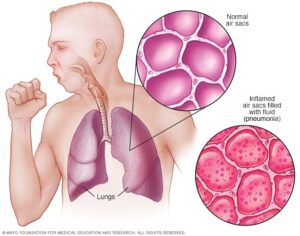
I wanted to finish up this series on respiratory health with a discussion on pneumonia. While pneumonia can be mild it can also become life threatening. What is pneumonia? Basically pneumonia is an infection that causes inflammation in the air sacs in one or both lungs. As a result of the inflammation the sacs may fill with fluid or pus which can trigger a cough. Please see the attached picture. (1)

What can cause pneumonia? Pathogens that usually cause pneumonia include bacteria, bacteria like organisms, fungi and viruses. Pneumonia is classified according to type of organism that causes it as well as where you acquired the infection. The first type is the most common and is called community -acquired pneumonia. As the name implies this occurs outside of hospitals or other health care facilities, or in other words “in the community”. The next type is called hospital acquired pneumonia. This tends to be caused by bacteria more than the other pathogens. Related to hospital acquired is health-care acquired pneumonia which is pneumonia that occurs in people who live in long-term care facilities or receive care in outpatient clinics such as kidney dialysis centers. Lastly there is aspiration pneumonia which is where you inhale food, drink, vomit or saliva into your lungs. This is more likely if there is a problem with your gag reflux.

While anyone can get pneumonia there are certain risk factors that increase your risk. To start with the 2 age groups most at risk are children under 2 and adults over 65. Being hospitalized and being on a breathing machine increase your risk.  Having a chronic disease such as asthma or COPD increase your risk. Having a weak or suppressed immune system can also increase risk.  Lastly smoking can also increase the risk of pneumonia.

What are the most common symptoms of pneumonia? Well you may have a cough with phlegm. There may be chest pain when you cough or breath.  There may be fatigue as well as fever, sweating and shaking chills. Your digestive system may be affected resulting in nausea, vomiting or even diarrhea. In those over 65 there may be a lower than normal body temperature as well as confusion. (1)

When it comes to pneumonia it is important to talk about complications. Pneumonia can lead to bacteremia which is where bacteria literally get into our blood. Sounds series right? Well it absolutely is. Bacteremia can lead to septic shock.  Pneumonia can also lead to lung abscesses which are pockets of puss in our lungs. Pneumonia can also cause what is called pleurisy, pleural effusions and empyema. If the pneumonia is severe it can lead to respiratory failure. Pneumonia can even lead to failure of certain organs such as the kidneys and heart. (2) As you can see pneumonia can haves dangerous complications. What can you do to help reduce the risk of pneumonia?

  • There are a number of life style factors that can help. Talk to your doctor about whether or not a vaccine is right for you. Practice good hygiene. Have a food diet.  Quit smoking. (3)
  • Olive Leaf has been one supplement that has come up over and over again. In fact studies have found that Olive Leaf is helpful in ameliorating lung disease such as pneumonia. (4) Please see Invite’s Olive Leaf and Renalaid.
  • Garlic, according to studies “could be used as an effective antibacterial nutrient” for pneumonia causing bacteria. (5) Please see Invite’s Aged Garlic.
  • NAC is another nutrient that has come up frequently in this series. Studies have found that NAC may decrease the oxidative and inflammatory damage in pneumonia. (6) Please see Invite’s NAC.
  • Black Seed has been found in studies to help slow the growth of bacteria such as those that are associated with pneumonia. (7) Please see Invite’s Black Seed formula.

Our last blog on this topic will be a nice summary to wrap things up before we move on!

Sources:

  1. https://www.mayoclinic.org/diseases-conditions/pneumonia/symptoms-causes/syc-20354204
  2. https://www.webmd.com/lung/complications-pneumonia
  3. https://www.nhlbi.nih.gov/health/pneumonia/prevention
  4. https://www.ncbi.nlm.nih.gov/pmc/articles/PMC10295110/
  5. https://pubmed.ncbi.nlm.nih.gov/12602248/
  6. https://www.ncbi.nlm.nih.gov/pmc/articles/PMC6250560/
  7. https://www.researchgate.net/publication/348808654_EFFECTIVENESS_TEST_OF_BLACK_CUMIN_SEEDS_NIGELLA_SATIVA_EXTRACT_ON_THE_GROWTH_OF_KLEBSIELLA_PNEUMONIAE_AND_PSEUDOMONAS_AERUGINOSA_BACTERIA

Vitamin D Expert Dr. Matthews – InVite Health Podcast, Episode 566

Vitamin D Expert Dr. Matthews – InVite Health Podcast, Episode 566

Do you know someone that is an athlete with a concussion? Tune if for a podcast with a special host Dr. Matthews, surgeon and vitamin D specialist.

How Resveratrol Supports Healthy Lungs – InVite Health Podcast, Episode 540

How Resveratrol Supports Healthy Lungs – InVite Health Podcast, Episode 540

Your lungs are at risk of damage on a daily basis due to pollution, aging and more. The good news is that the nutrient resveratrol can help them stay healthy.

Cold And Flu Season Tips from Jerry Hickey, R.Ph.

Cold And Flu Season Tips from Jerry Hickey, R.Ph.

As the weather starts to get colder and the days start to feel shorter, cold and flu season slowly begins to creep up on us. Here are some tips and information on cold and flu season by Jerry Hickey, R. Ph.

How is the flu virus spread?

Usually the flu virus is spread through droplet infection – sneezing and coughing. Breathing in droplets expelled into the air by an infected person’s cough is the most common route. These droplets can get inhaled through your nose or land in your face or eyes, where you are almost sure to spread the virus by touch. Without meaning to, you are unknowingly spreading a lot of germs, and you are putting your loved ones and even strangers at risk. To reduce the spread of any flu-related symptoms, taking the relevant precautions, like wearing an N95 mask,  can not only keep you protected from the germs of other people, but you are also protecting the health of others. As well as this, you should consciously avoid touching your eyes, nose, or mouth during flu season because germs are often spread when a person touches something that is contaminated with germs and then touches his or her eyes, nose, or mouth.

If you shake hands with a person who is coughing or sneezing, it would be a good idea to wash your hands with antibacterial soap or hand sanitizer. You can also get the flu from saliva when sharing cups, glasses, or other household objects used by a person who has the flu.

How long does the flu last on inanimate surfaces?

Flu viruses can last long enough outside of the human body to contribute to spreading infection. Studies have shown that flu viruses generally can survive on surfaces (such as phones and doorknobs) between 2 to 8 hours depending on the environment. Washing your hands frequently with a bar of antibacterial soap and water will help protect you from contracting the flu through touch. Alcohol wipes and hand sanitizers can help disinfect the hands and surfaces if there are infected people.

What is the incubation period for the flu?

Once the flu virus is introduced into your body from an infected person, the virus multiplies quietly in your body until you get symptoms of the disease which can be about two to five days later, referred to as the incubation period. When the symptoms are active at the peak of the infection, that is when you generally spread the flu because this is when you are actively sneezing and coughing.

For how long will I be contagious for?

Usually five to seven days for adults. Young children can be contagious for ten days to two weeks. Kids can also have diarrhea when they get the flu; something you usually don’t see in adults. According to the CDC, people with compromised (lowered) immune systems – such as people with AIDS or people taking drugs to prevent transplant rejection – can shed flu virus for weeks or months after infection.

Besides the flu shot and prescription antiviral drugs are there nutrients that help protect me from the flu?

Yes, research shows that the amino acid NAC, and consuming Green Tea may decrease the risk of developing upper respiratory tract infections including the flu (NAC and Green Tea) and cold viruses (Green Tea). Other nutrients like medicinal mushrooms, Astragalus herb, Nucleotides and Olive Leaf can help support immune system function and may improve resistance.

Read Jerry Hickey, R. Ph’s ‘Combating Cold and Flu Viruses with Green Tea and NAC’ by clicking here!

The Real Killer – Pneumonia

We are moving into the cold and flu season and the CDC is urging many of us to get this season’s flu vaccine. The reason for this is a higher mortality rate connected to cold weather and the flu. Yet most individuals do not realize that pneumonia is the big killer and that many deaths related to the flu actually occur because of a concomitant or secondary pneumonia infection.

Unfortunately in many recent seasons the best guess by experts has not always targeted the strains of influenza reaching our shores and spreading infection and although immunized, infection can still occur. The great news is that there is strong preventative action you can take to protect yourself from lung infection aka pneumonia – the real killer.

The pneumococcal polysaccharide vaccination (PPV) stimulates resistance to 23 out of 80 pneumococcal bacteria; the vast majority of pneumonia infections are caused by the 23 serotypes contained in the vaccine. The vaccine is injected into the body to stimulate the normal immune system to produce antibodies that are directed against pneumococcal bacteria. All adults over the age of 65 are candidates for the injection and it is usually given around September but it is not too late. Usually one dose of PPV is all that is needed. Yet in some circumstances a second shot is recommended for those over 65 who had their first dose when they were under 65, if five or more years have passed since the first dose.

For more information on PPV, contact the CDC at 1-800-CDC-INFO, 1-800-232-4636 or visit www.cdc.gov.

InVite® Health Current Sale