
PMS Getting You Down? Here’s What To Do About It – InVite Health Podcast, Episode 324
It’s estimated that nearly 90% of women experience some symptoms of PMS, such as bloating, headaches and moodiness. Here’s how specific nutrients can help.
Nutrition. Vitamins. You.
It’s estimated that nearly 90% of women experience some symptoms of PMS, such as bloating, headaches and moodiness. Here’s how specific nutrients can help.

When it comes to hair loss, many people start to go into panic mode when they start to see that their hair is thinning out. There are multiple reasons as to why someone can be losing hair or have thinning hair , including the chemicals in your commonly used hair care products and nutrient deficiencies.
Magnesium
Invite Health Podcast, Episode hosted by Amanda Williams, MPH.
Subscribe Today!


You’ve probably never thought about whether you’re deficient in magnesium, but it certainly would not be uncommon. We know that greater than 50% of Americans fail to eat enough of this important mineral in their diets. They’re just not obtaining it. Due to our stressful lives and other conditions that can potentially deplete our body of this very important mineral, then it makes sense that a lot of people in this country are deficient or insufficient. This is a major problem because we know that magnesium is an essential mineral, as well as being an electrolyte that we have to obtain from our diet.†
Magnesium has over 300 different functions in the human body and it plays such a crucial role in hormonal balance, detoxification, blood pressure regulation, maintaining bone health and more. Half of the body’s magnesium is stored in the bones and that’s where it’s part of the skeletal matrix. It helps our neurons in our brain. We have to have enough for normal heart rhythm. It helps to regulate blood pressure because it allows for vasodilation, which allows the blood vessels to remain more open so you get optimal blood flow through them. But magnesium is this one mineral that most Americans are not getting enough of. This is common with other trace minerals as well because our soil is not as nutrient-rich as it once used to be.†
Learn more about how important this mineral is to the body by listening to the full podcast episode.
Nutrients That Offer Optimal Blood Pressure Support – InVite Health Podcast, Episode 263. Listen Now >>

Knowing that most Americans have an inadequate magnesium intake, which increases their risk for different cardiovascular diseases, type 2 diabetes and bone loss, what can we be doing? We have to make sure that we are supplementing with this important mineral each and every single day.†
At a bare minimum, you can be looking at taking a multivitamin. InVite® Health’s Multivitamins are all options because they are all going to yield you some magnesium. But it’s actually better to take a stand-alone magnesium product every day in addition to your multivitamin. This is because we know that magnesium is critical for our overall health. We like to start with it at a low dose and then you work your way up. Your body will let you know once you have enough magnesium because it really allows for relaxation, even in the intestines. You may have more of a tendency to have loose stool. This is why, with magnesium, low and slow is the way to go.†
Alarming Findings On Nutrient Deficiencies – InVite Health Podcast, Episode 303. Listen Now >>
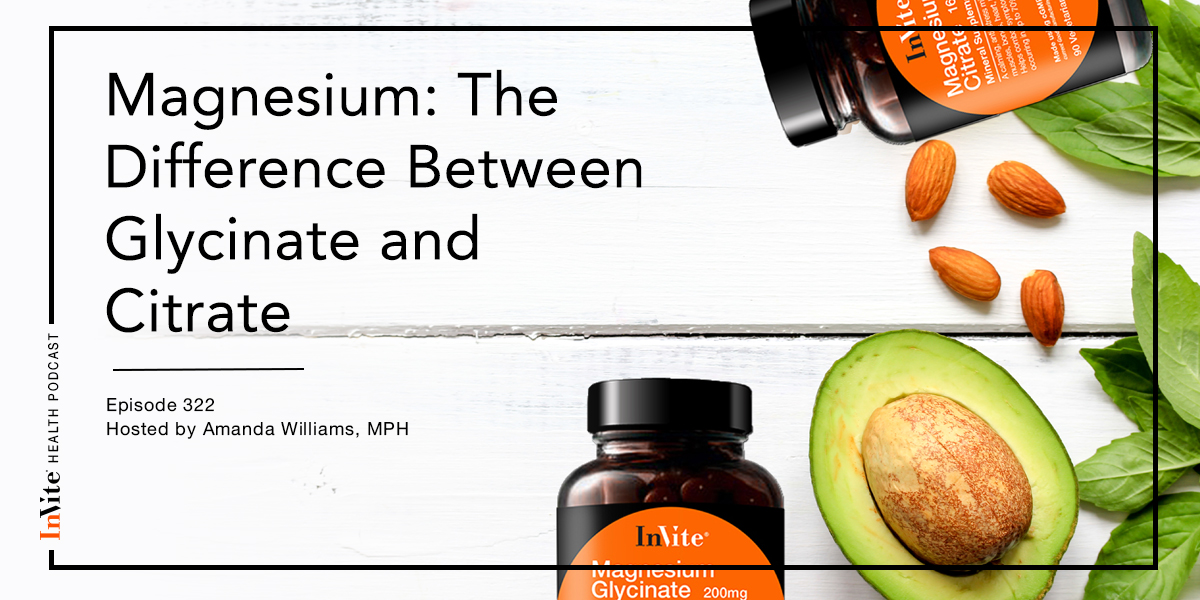
They’re both really, really excellent. They both have elemental magnesium, but it’s just a difference of what they’re bound to.†
Magnesium citrate, for example, is bound to citrate. This is absorbed relatively fast and is really great for people who have more of a tendency to have constipation. It gets into the intestines and really allows for the relaxation of that smooth muscle in the intestines. For people who have a tendency to get muscle cramps or headaches, sometimes citrate is the preferred choice.†
Magnesium glycinate is actually a derivative of the amino acid glycine. Glycine helps to work alongside many of our neurotransmitters, including GABA, so it helps to promote that calming feeling. Magnesium glycinate oftentimes in the evening can be very beneficial to help to support healthy sleep. It is very beneficial for targeting issues with insulin resistance, so for many diabetics, they’ll find that magnesium glycinate is their preferred choice.†
For more information on the benefits of this important mineral, tune into the full podcast episode.



PCOS is a hormonal metabolic disorder that causes a variety of symptoms, including an irregular menstrual cycles, ovarian cysts, facial hair and insulin resistance. Here are some nutrition tips to keep you healthy.

In part 1 Jerry Hickey, Ph. discussed the symptoms of heart failure and factors that can increase your risk. Now let’s review the nutritional side of heart health.

heart
Invite Health Podcast, Episode hosted by Jerry Hickey. Ph
Subscribe Today!
Heart failure is scary. It happens when your heart cannot pump enough blood and oxygen for your body’s needs. A lot of symptoms come out of that. It may be because the heart muscle is weakened. That can happen with age, with diseases and after a heart attack. The heart doesn’t meet the needs of the body and doesn’t support the organs in the body. This is a serious condition, but your heart is still beating.†
Heart failure is common. About 6.2 million adults in the United States have it. In 2018, heart failure was mentioned on 380,000 death certificates. That’s over 13% of all death certificates. Heart failure cost the nation an estimated $31 billion in 2012. This total includes the cost of healthcare services, medication to treat it and missed days of work.†
Heart failure is very scary, but it can be helped. You can be helped beyond the regular medications, which is interesting. When I was in pharmacy school, people with heart failure typically got a drug called digoxin, which came from the foxglove plant. This made them feel better, but it didn’t keep them alive. It didn’t help survival, it only helped their quality of life.†
The drugs today, which include beta blockers like metoprolol, ace inhibitors like lisinopril, ARBs like losartan and aldosterone-blocking drugs like spironolactone, actually keep the patients alive, as well as improving their quality of life.†
Learn more about the drugs commonly prescribed for heart failure patients in part 2 of this podcast episode, coming tomorrow!
Your heart can begin to weaken as you age and then begin to fail you. In fact, there’s a common situation where fibrous scar tissue builds up in the heart with age. A supplement called Ubiquinol may be helpful. Ubiquinol is the active version of coenzymeQ10. In people with heart failure, ubiquinol is very promising and it can be very helpful.†
Obesity is also a big risk factor for developing heart failure because with all of that extra weight, there’s a lot more fluid for the heart to pump around. The blood vessels are stiffening and it’s just not good for the heart.†
Diabetes is another big risk factor and so is sleep apnea. Lung disease can contribute to its development, but many of the people who develop heart failure initially had a problem related to their heart. This can include high blood pressure that they never took care of. Maybe they had a heart attack. Maybe they have coronary artery disease, and that’s actually the number one cause of heart failure.†
THE LINK BETWEEN COCOA, DIABETES AND INSULIN SENSITIVITY – INVITE HEALTH PODCAST, EPISODE 269. Listen Now >>
Tune into the full podcast episode for more details on factors that can contribute to heart failure, as well as symptoms that are often associated with it.
You can lower your risk of getting heart failure if you eat a really good diet with a lot of vegetables, fresh fruits, seeds, nuts and fish. It’s very good for your heart.
Frequent exercise can also be helpful. They say about 30 minutes of high-quality exercise every day. This could be fast walking, lifting weights, gardening, walking up and down the stairs and even vacuuming.
Reducing the amount of salt in your diet can help reduce swelling and helps take pressure off your heart, lungs and kidneys.
A number of nutritional supplements have very good evidence that they can help people with heart failure. Some of these nutrients include:
To learn more about supporting the heart with powerful nutrients, make sure to listen to the full podcast episode.
Thank you for tuning in to the Invite Health Podcast. You can find all of our episodes for free wherever you listen to podcasts or by visiting www.invitehealth.com/podcast. Make sure you subscribe and leave us a review! Follow us on Facebook, Twitter and Instagram at Invite Health today. We’ll see you next time on another episode of the Invite Health Podcast.