Recent Posts

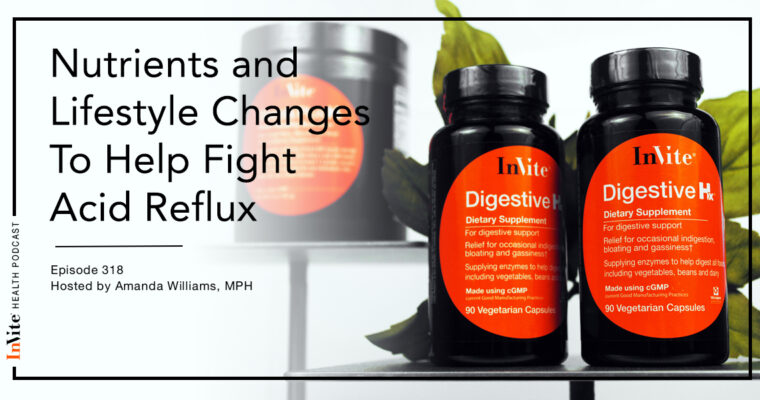
Nutrients and Lifestyle Changes To Help Fight Acid Reflux – InVite Health Podcast, Episode 318

Nutrients and Lifestyle Changes To Help Fight Acid Reflux – InVite Health Podcast, Episode 318

You’ve probably experienced the burning sensation of acid reflux at least a few times in your life. But what causes it and what can you do to help fight it? Amanda Williams, MPH dives into the nutrient and lifestyle changes you need to take to fight it off.

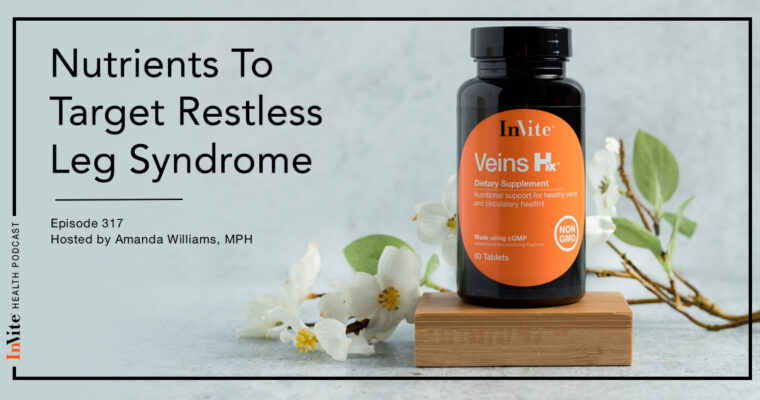
Nutrients To Target Restless Leg Syndrome – InVite Health Podcast, Episode 317

Nutrients To Target Restless Leg Syndrome – InVite Health Podcast, Episode 317

Have you ever heard of restless leg syndrome? Amanda Williams, MPH discusses how many people it affects and what nutrients may be beneficial.

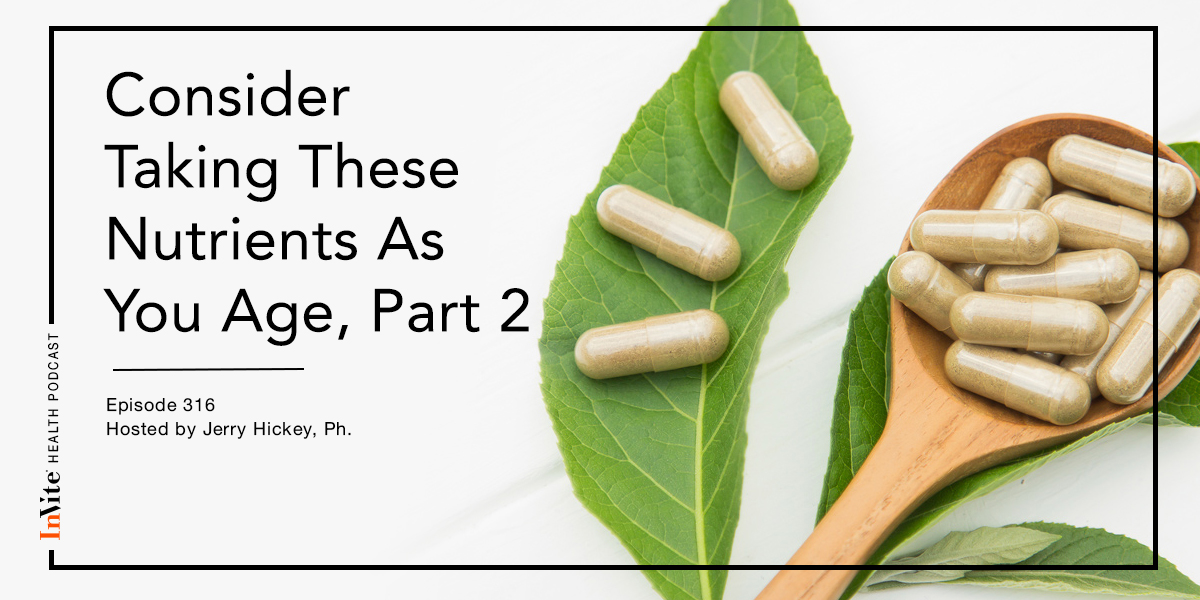
Consider Taking These Nutrients As You Age, Part 2 – InVite Health Podcast, Episode 316

Consider Taking These Nutrients As You Age, Part 2 – InVite Health Podcast, Episode 316

Invite Health Podcast, Episode hosted by Jerry Hickey. Ph

Subscribe Today!

Apple PodcastsGoogle PodcastsiHeartRadioSpotify

Welcome to part two of our episode on nutrients you should consider taking when aging. You can catch up on the first part of this podcast here. 

There are a number of different nutrients that, as we age, we have trouble absorbing. We become less efficient at utilizing them. We may also lose them in our urine. Taking a little bit extra of these nutrients helps make up for that.   

Nutrients for Healthy Aging, Recommended by Jerry Hickey, Ph.

  • Omega-3 Fatty Acids: This nutrient is commonly sourced from fish oil. With age, we absorb less fish oils from our foods. This means that there is less omega-3 content in our heart and brain, which of course coincides with a drop in both heart health and brain function. These fatty acids are important for eye health, brain health and heart health. You need them for memory functions. Without fish oils, you have a high risk of all kinds of brain diseases including Parkinson’s disease, Alzheimer’s disease and vascular dementia. Omega-3s are an essential fatty acid, meaning that your body can’t make it. You have to get them from a source. A good source is eating an ocean-type fish like mackerel or salmon three times a week, but you can also take a krill oil or fish oil capsule. Mussels also contain a high level of fish oils. For people who are vegan or vegetarian, you can also get omega-3 fatty acids from flaxseeds, walnuts and algae.†

Consider Taking These Nutrients As You Age, Part 1 – InVite Health Podcast, Episode 315. Listen Now >>

  • Fiber: Fiber is important at any age because it feeds your good bacteria and helps protect you from developing strokes. Fiber can lower your cholesterol, blood sugar and risk of colon
    cancer. Most people do not get enough fiber in their diets because they are not eating enough vegetables, fruits and whole grains. You can take a fiber supplement to support this.†


  • Lutein: Lutein is an orangey, reddish pigment found in green leafy vegetables. You need about 10mg of lutein in your bloodstream every day because this reflects the amount of lutein in your eyeballs and brain. You need lutein to protect your eyes, support good vision, promote memory and protect your brain. Studies are finding that older people with more lutein in the brains have better memory function. Lutein absorption declines with age. As a double whammy, statin drugs also lower the amount of lutein in your body. This is why it is important to supplement with a high-quality lutein supplement.†   
  • Collagen: Your body is made out of collagen, which is a type of protein. When you’re young, you can eat beans, fish, eggs or some other form of protein and you’re very capable of converting that protein into collagen because you’re growing and you need more skin and longer bones, ligaments and tissues. Collagen is 36% of the bone and works together with calcium and Vitamin D to support strong bones. Collagen also has the ability to prevent the bones from chipping and breaking when you hit them because it gives them shock-absorption capacity. Collagen makes your joint cartilage in your knees so you don’t get bone-on-bone arthritis.† 

What You Need To Know About Gout – InVite Health Podcast, Episode 309. Listen Now >>

Tune into the full podcast episode for more details on Jerry’s recommendations to support the aging body. Don’t forget to catch up on the first part of this podcast episode to hear the remainder of Jerry’s recommendations.

Thank you for tuning in to the Invite Health Podcast. You can find all of our episodes for free wherever you listen to podcasts or by visiting www.invitehealth.com/podcast. Make sure you subscribe and leave us a review! Follow us on Facebook, Twitter and Instagram at Invite Health today. We’ll see you next time on another episode of the Invite Health Podcast.

Consider Taking These Nutrients As You Age, Part 1 – InVite Health Podcast, Episode 315

Consider Taking These Nutrients As You Age, Part 1 – InVite Health Podcast, Episode 315

As we age, the need for certain nutrients increases for a number of reasons, including an increase in our prescription medications and gaps in our diet.

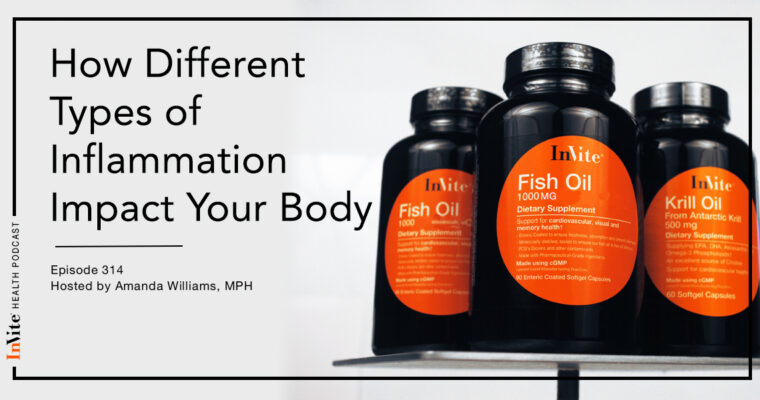
How Different Types of Inflammation Impact Your Body – InVite Health Podcast, Episode 314

How Different Types of Inflammation Impact Your Body – InVite Health Podcast, Episode 314

Did you know there are different kinds of inflammation that can impact your body in different ways? The good news is that omega-3 fatty acids have been studied for its benefits against inflammation.

Distinguishing Between Normal Brain Aging and Alzheimer’s Disease – InVite Health Podcast, Episode 313

Distinguishing Between Normal Brain Aging and Alzheimer’s Disease – InVite Health Podcast, Episode 313

brain

Invite Health Podcast, Episode hosted by Jerry Hickey. Ph

Subscribe Today!

Apple PodcastsGoogle PodcastsiHeartRadioSpotify

Many older adults worry about their memory and the other abilities of their brain. For instance, they may find it’s taking longer to learn something new or maybe they’re forgetting to pay their bills once in a while. Well, is this normal forgetfulness or is this something else? This episode is designed to help you identify the difference between Alzheimer’s and normal brain aging.  

Forgetfulness and the aging brain 

Mild forgetfulness and absentmindedness is often a normal part of aging, not a sign of a serious memory problem. Fortunately, on a yearly basis, only a tiny percentage of people with what would be perceived as normal age-related memory loss will convert to dementia. It’s very rare.† 

This Gene Increases The Risk of Alzheimer’s; How to Fight Back – InVite Health Podcast, Episode 301. Listen Now >

A memory lapse for a second is normal and no big deal. Everybody forgets something, especially when we’re distracted or busy. This may happen more often as we get older. Mild memory loss is a normal part of aging and not something to worry about. It doesn’t necessarily mean you’re going to develop dementia. As we age, we can have some “senior moments,” as they call it.† 

When to become concerned about your memory loss

Dementia is not as common as you think it is. If memory loss makes it hard for you to carry out your daily tasks, then you have a sign that shouldn’t be ignored. For instance, are you forgetting something you just heard? A big clue that it’s something worse is asking something over and over again. That’s a big clue that the memory is having a big problem. Relying on a number of notes to get through your day is a clue. If you or your family are noticing these things happening to you, you really need to talk to your doctor.†

Another clue that it’s not just memory loss is if you’re struggling to do things like follow directions on something very familiar to you, like a recipe, or if you can’t keep track of things such as paying the bills like you used to. It could be a warning sign of memory problems.†    

According to the National Institute on Aging, a way to tell the difference between normal brain aging and a serious memory problem is that a serious problem makes it hard to do everyday things like driving and shopping. Signs can include:

  • Asking the same question over and over again
  • Getting lost in familiar places
  • Not being able to follow instructions
  • Becoming confused about time, people and places

If you have problems with your daily typical activities, it could be a sign of a more serious memory issue. It’s normal to forget where you parked your car, especially if you were rushing when you parked or you’re distracted when you’re parking. But if it happens regularly, check with your doctor. That could be a sign of dementia.†

Tune into the full podcast episode for more details on the differences between normal aging in the brain and dementia. 

Enhanced Memory Support with Cognition Hx® – InVite Health Podcast, Episode 293. Listen Now >>

How to help your memory

If your memory is okay but you’re still concerned, you should use your brain. It’s like your muscles. If you don’t use it, then you lose it. Read, learn to play an instrument, sing, solve puzzles and be social. Exercise is great for the brain. It’s great for circulation to your brain, it’s great for brain health and heart health, but it’s also a stress reducer. Stress triggers the release of cortisol, a stress hormone. A little bit of that once in a while is good for the brain, but if you’re chronically stressed and you’re chronically releasing this, it is bad for your brain. A very safe option if you’re stressed is L-theanine, which comes from the green tea plant.† 

For more information about foods and supplements that can help boost your memory and brain health, listen to the full podcast episode. 

Thank you for tuning in to the Invite Health Podcast. You can find all of our episodes for free wherever you listen to podcasts or by visiting www.invitehealth.com/podcast. Make sure you subscribe and leave us a review! Follow us on Facebook, Twitter and Instagram at Invite Health today. We’ll see you next time on another episode of the Invite Health Podcast.