Recent Posts

Magnesium Spotlight: The Difference Between Citrate and Glycinate – InVite Health Podcast, Episode 322

Magnesium Spotlight: The Difference Between Citrate and Glycinate – InVite Health Podcast, Episode 322

You’ve probably never thought about whether you’re deficient in magnesium, but it is extremely common. Greater than 50% of Americans have this deficiency. But, when it comes to supplementation, how do you know which form is best for your needs?

Diet and Nutrition Tips for PCOS – InVite Health Podcast, Episode 321

Diet and Nutrition Tips for PCOS – InVite Health Podcast, Episode 321

PCOS is a hormonal metabolic disorder that causes a variety of symptoms, including an irregular menstrual cycles, ovarian cysts, facial hair and insulin resistance. Here are some nutrition tips to keep you healthy.

Heart Failure Is Scary But It Can Be Helped, Part 2 – InVite Health Podcast, Episode 320

Heart Failure Is Scary But It Can Be Helped, Part 2 – InVite Health Podcast, Episode 320

heart failure

Invite Health Podcast, Episode hosted by Jerry Hickey. Ph

Subscribe Today!

Apple PodcastsGoogle PodcastsiHeartRadioSpotify

In part 1 of this podcast, I discussed the symptoms of heart failure and factors that can increase your risk of heart failure. Today, I want to cover supplements. Let’s roll up our sleeves and really go into nutrition for heart failure. 

Heart Failure Is Scary But It Can Be Helped, Part 1 – InVite Health Podcast, Episode 319. Listen Now >>

Vitamin D and Heart Health

A report from the Federal University of Pernambuco down in Brazil has to do with Vitamin D. It’s published in the journal ESC Heart Failure. We know that Vitamin D is important for strength and muscle function. Well, your heart is a super high-function muscle, so if Vitamin D is needed for your other muscles, obviously it’s needed for your heart muscle. According to this study, the risk of heart failure was more than 12 times higher in older people who lack Vitamin D. But here’s the thing: their base level for lacking Vitamin D was higher than the accepted level.  Typically, Vitamin D deficiency is 20 ng/ml or below. In this study, it was 30 ng/ml or below. Lacking Vitamin D is bad for all muscles and your heart is a muscle that is pumping once over 100,000 times a day. It requires Vitamin D.†  

It doesn’t hurt to take a Vitamin D supplement. You’re never going to get enough Vitamin D from your food. It’s not happening. Even when they fortify dairy, you get about 100 units of Vitamin D. Young people with healthy skin can make plenty of Vitamin D in about 15 or 20 minutes. If they get 15 to 20 minutes of sun every day, they’ll make sufficient Vitamin D. However, if you have darker skin, it becomes harder. If you’re wearing sunscreen or wearing a lot of clothing, it is also harder. Also, if you have older skin, it’s not that successful in creating Vitamin D anymore. It becomes less efficient.†   

Learn more about how the body creates Vitamin D by tuning into the full podcast episode. 

The Benefit of Fish Oil

According to a meta-analysis, fish oils may help reduce the risk of developing heart failure by 15%. This is from the journal Clinical Nutrition and it was done by Harvard University and Brigham and Women’s Hospital. They looked at seven prospective studies with data on 176,000+ people, of which 5,500 developed heart failure. People with the highest level of EPA and DHA in their blood had a 14% lower risk of heart failure compared to people with the lowest levels. It’s important to distinguish that they looked at the amount of EPA and DHA in their blood instead of asking how much fish patients eat. This is more powerful evidence because it shows the exact levels of fish oils that can be beneficial.† 

Consider Taking These Nutrients As You Age, Part 1 – InVite Health Podcast, Episode 315. Listen Now >>

When you eat fish or take fish oils, there are other oils that can be in there, but the two they look at are EPA and DHA. These oils are very important for your muscles and your heart is a muscle. There are a number of studies that show that older people with sufficient levels of fish oils in their blood tend to lose less muscle with age. They tend to lose less strength and can hold onto their muscles. Your heart is a very important muscle. Fish oils are known to lower inflammation in the heart, but they also seem to help lower the risk of heart failure. They’re very good for the heart.†    

For additional details on nutrients that can help with heart failure, listen to the full podcast episode.

What do you think about this information on heart failure? Leave a comment below to join the discussion.

Thank you for tuning in to the Invite Health Podcast. You can find all of our episodes for free wherever you listen to podcasts or by visiting www.invitehealth.com/podcast. Make sure you subscribe and leave us a review! Follow us on Facebook, Twitter and Instagram at Invite Health today. We’ll see you next time on another episode of the Invite Health Podcast.

Heart Failure Is Scary But It Can Be Helped, Part 1 – InVite Health Podcast, Episode 319

Heart Failure Is Scary But It Can Be Helped, Part 1 – InVite Health Podcast, Episode 319

Heart failure is scary. It happens when your heart cannot pump enough blood and oxygen to function properly. Factors like obesity, diabetes, not exercising and a bad diet can all contribute to it. Here are some lifestyle changes you should focus on.

Nutrients and Lifestyle Changes To Help Fight Acid Reflux – InVite Health Podcast, Episode 318

Nutrients and Lifestyle Changes To Help Fight Acid Reflux – InVite Health Podcast, Episode 318

You’ve probably experienced the burning sensation of acid reflux at least a few times in your life. But what causes it and what can you do to help fight it? Amanda Williams, MPH dives into the nutrient and lifestyle changes you need to take to fight it off.

Nutrients To Target Restless Leg Syndrome – InVite Health Podcast, Episode 317

Nutrients To Target Restless Leg Syndrome – InVite Health Podcast, Episode 317


Invite Health Podcast, Episode hosted by Amanda Williams, MPH

Subscribe Today!

Apple PodcastsGoogle PodcastsiHeartRadioSpotify

Have you ever heard someone complain about restless leg syndrome? Maybe you’ve wondered to yourself what that was. Does that mean your legs are just flailing around? I want to talk about restless legs today, including statistically how many people it affects and what you can be doing nutritionally if you happen to be affected by this or maybe you know someone who is.  

What is restless leg syndrome?

What we do know about restless leg syndrome is that roughly 10% of adults suffer from this in the United States. It is a newer phenomenon, but it actually has been researched quite extensively over the past couple of decades. They now recognize that restless leg syndrome is actually a neurological condition that causes this irresistible urge to move the legs.† 

This can be triggered by many different things, but we do know that it’s unpleasant and can even have painful throbbing or pulling feelings within the legs. This sensation that people complain about is quite real and what they are dealing with is incredibly problematic because it can disrupt their sleep and it can affect them throughout their day.†    

Why Sleep Is Required For Memory – InVite Health Podcast, Episode 296. Listen Now >>

Factors that contribute to restless legs

I want to talk about what you can be doing in terms of dietary and lifestyle modifications that may help to promote a more comfortable leg environment throughout the day.†  

One thing that we recognize is that the Standard American Diet is a factor in creating this issue. The high sugars, bad carbohydrates and starches that most Americans are consuming on a regular basis are a major problem. Certain stimulants such as caffeine may be exacerbating restless legs, along with the really bad foods they are eating.†  

There are many natural interventions that can be beneficial for those who are suffering from restless leg syndrome, including iron. Low iron levels are a really big problem. Iron deficiency or iron insufficiency can become a major factor in the role in which the pathogenesis of restless leg syndrome actually presents itself. They have been able to indicate that those who have been diagnosed with restless leg syndrome often have an iron deficiency, so iron supplementation is usually started with those patients. I turn to things like our Iron Plus Hx formulation, which contains iron as its protein form called bisglycinate. This is much easier for the body to absorb and it doesn’t cause those GI disturbances often associated with other forms of iron like ferrous sulfate.† 

Researchers also recognize that low levels of folate may be playing a role in the exacerbation of these symptoms, which is why, when you’re using our Iron Plus Hx formulation, it also contains folic acid. This is really beneficial because if you have a tendency to have that low folate, then we know that this is another main reason as to why you are suffering more of those significant symptoms.†      

How to help with restless leg syndrome

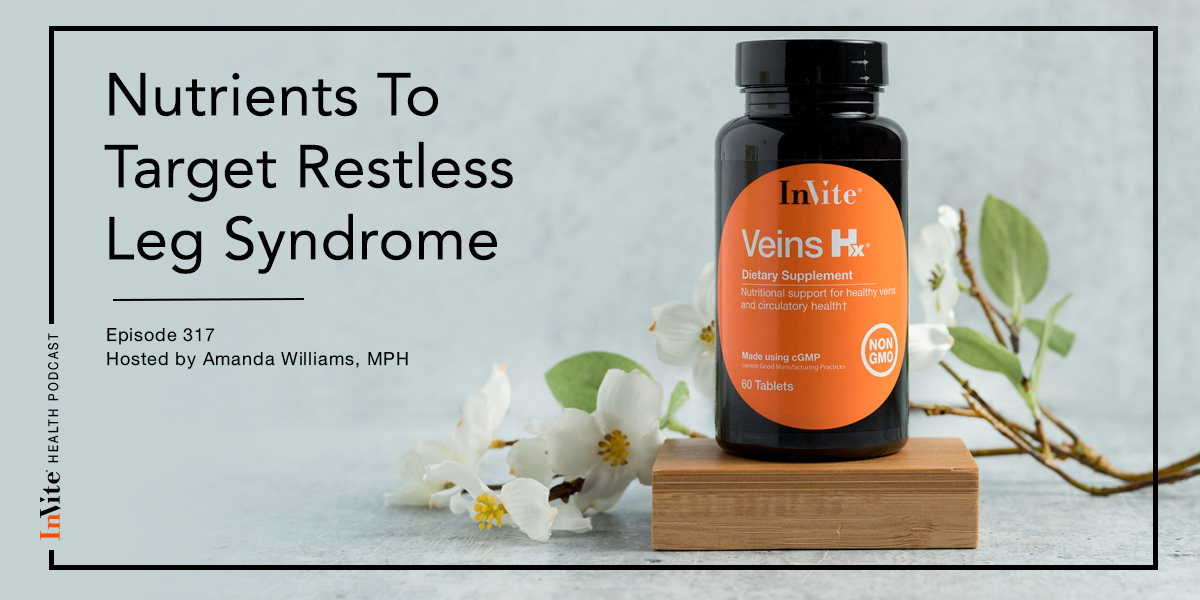
We can certainly look at things that would help to promote proper vascular flow, like grape seed extract, for example. Horse chestnut, which you find in our Veins Hx, can also be helpful. Oftentimes, when I talk to people who have issues with restless legs, I make sure that they are taking a good, comprehensive multivitamin, such as the Core Multivitamin, but then they are also taking Veins Hx, Iron Plus Hx and magnesium.† 

Grape Seed for Healthy Circulation – Invite Health Podcast, Episode 22. Listen Now >>

Tune into the full podcast episode to hear more of Amanda’s recommendations for facing restless leg syndrome.           

Thank you for tuning in to the Invite Health Podcast. You can find all of our episodes for free wherever you listen to podcasts or by visiting www.invitehealth.com/podcast. Make sure you subscribe and leave us a review! Follow us on Facebook, Twitter and Instagram at Invite Health today. We’ll see you next time on another episode of the Invite Health Podcast.