How To Be Proactive About Bone Health – InVite Health Podcast, Episode 232
The older we get, the weaker our bones can become. Here’s what you need to be proactive about bone health as you get older.
Nutrition. Vitamins. You.
The older we get, the weaker our bones can become. Here’s what you need to be proactive about bone health as you get older.

During cold and flu season and especially during a pandemic, it’s important to know the most beneficial supplements you need when traveling.
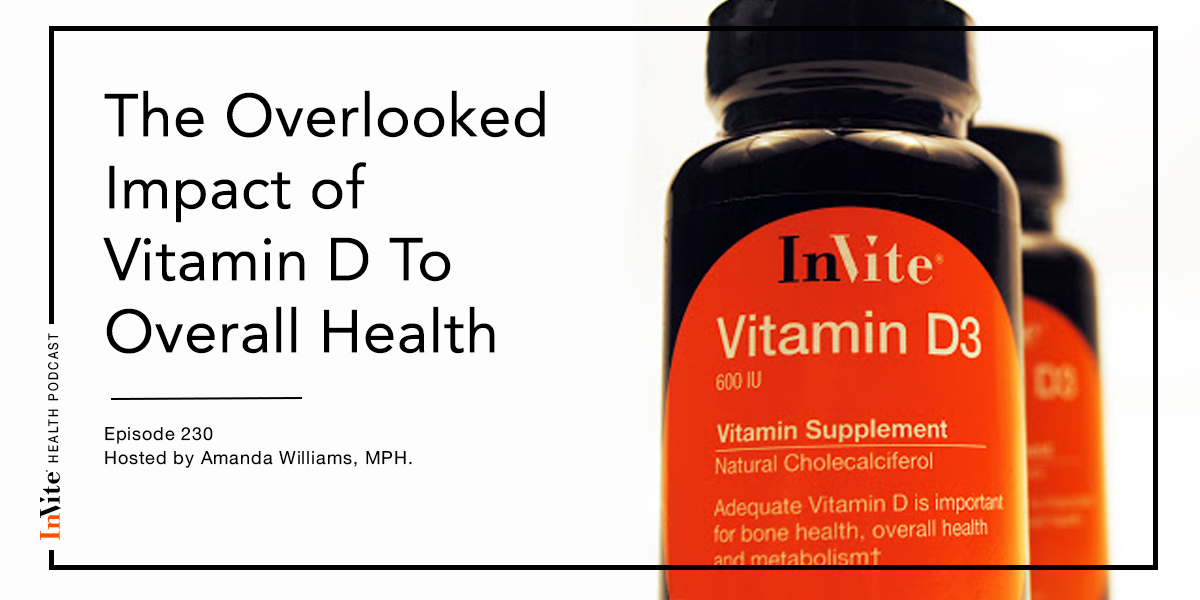
vitamin d
Invite Health Podcast, Episode hosted by Amanda Williams, MPH.
Subscribe Today!


As of a few years ago, many people would think of Vitamin D simply as our bone health vitamin and not really understand all of the other things that Vitamin D is doing to maintain our health. I want to talk about that in some specifics today because I think it’s important being that we are still in the midst of this pandemic and there have been so many different studies that have come out looking at the analysis of Vitamin D levels among asymptomatic as well as critically-ill COVID-19 patients. I do think that there is a strong correlation between Vitamin D status and the actual severity of COVID-19 infections. I want to talk in detail about what Vitamin D can do for the body besides supporting bone health.†
The important functions of Vitamin D
We know that when it comes to bone mineralization, we require Vitamin D. This is in conjunction with things such as calcium, phosphorus and other minerals within the bone to maintain that bone density. But we know that this vitamin actually exhibits many non-skeletal effects throughout the human body, especially on the immune system, as well as the endocrine and cardiovascular systems. If we are taking Vitamin D in from our foods, just to maintain normal bone development and the maintenance of our bones, we have to consider if we are getting enough. This is why, as a whole, most people have either an insufficiency in Vitamin D or an actual deficiency in Vitamin D. It is estimated that over 1 billion people globally are impacted via vitamin deficiencies.
Tune into the full podcast episode for more information on deficiencies.

Vitamin D helps to regulate cell differentiation. This refers to the way that your cells are actually dividing. This is done by binding to the vitamin receptor found in most cells throughout the body. That should clue you in that Vitamin D is highly unique. Your vitamins don’t have receptors throughout the body, but this vitamin does, which is why we know it plays more of a hormonal role in the body as it does an actual role like a typical vitamin. Observational studies have shown this association between low levels and an increased risk of developing things such as colorectal cancer and breast cancers. We cannot overlook just how significant the impact of Vitamin D is on our overall health.†
Other observational studies have looked at the association between it’s status and the susceptibility or the severity of different illnesses and autoimmune conditions, such as diabetes, rheumatoid arthritis, Lupus and multiple sclerosis. There is adequate evidence out there now that directly links this inverse relationship between low levels of circulating vitamin and the increased risk for the severity of these types of autoimmune conditions.†
THE IMPORTANCE OF VITAMIN D FOR STRENGTH AND MOBILITY – INVITE HEALTH PODCAST, EPISODE 158. Listen Now >>
There are trials out there investigating whether Vitamin D is linked with cognitive decline, even in the setting of Alzheimer’s disease and dementia, as well as other neurodegenerative diseases. We know that there is this inverse relationship between circulating levels and glucose tolerance. When we look at things like insulin resistance, for example, in the setting of metabolic syndrome, we have to understand that this vitamin is playing a role in that as well.†
For more information about the important role this vitamin plays in the human body, listen to the full podcast episode.
Thank you for tuning in to the Invite Health Podcast. You can find all of our episodes for free wherever you listen to podcasts or by visiting www.invitehealth.com/podcast. Make sure you subscribe and leave us a review! Follow us on Facebook, Twitter and Instagram at Invite Health today. We’ll see you next time on another episode of the Invite Health Podcast.



DHEA controls many aspects of our inflammatory and immune responses. Here’s what you need to know when it comes to chronic inflammation.

There is evidence that specific and varied infections organisms, certain viruses and bacteria, can trigger the effects of Alzheimer’s disease.
Alzheimer’s
Invite Health Podcast, Episode hosted by Jerry Hickey. Ph
Subscribe Today!
In Alzheimer’s disease, there’s a hypothesis that’s given credibility by many neurologists about the plaque buildup in the brain. There’s been evolving science indicating that infectious organisms are causative of Alzheimer’s disease. Now, there’s a merging of the two hypotheses.
Could an infection cause Alzheimer’s disease?
Here’s a study published in the Journal of Alzheimer’s Disease and called “Microbes and Alzheimer’s Disease.” There are many different academic research institutions involved. In this manuscript, they’re saying that there are infections getting into the brain of elderly people, which is interesting and scary because older people develop leakiness of their blood-brain barrier.
The blood-brain barrier is extra insulation on the blood vessels in the brain. Don’t forget that all your blood vessels are connected, so the blood that goes through your feet and through your heart also goes through your brain. You don’t want the wrong thing leaving that blood and entering the brain. This could be very dangerous. One of the aspects of Alzheimer’s that’s being researched is leaky blood-brain barriers in elderly people. The major component of the blood-brain barrier is collagen and older people make a lot less collagen, so there is something to that.
Research Says This Type of Dementia is Curable – InVite Health Podcast, Episode 216. Listen Now >>
A second way of looking at this is infections in the mouth, gums or lips. These can work their way into the brain indirectly. A third way is an imbalance of bacteria in the intestines, which is one of the things they allude to in this manuscript.
Tune into the full podcast episode to hear some excerpts from “Microbes and Alzheimer’s Disease.”
The researchers go onto say that certain microbes that get into your brain cause an infection, but they can remain latent for many decades and then they can reactivate when your immune system weakens. Then, they list evidence for an infectious immune system component. “Viruses and other microbes are present in the brain of most elderly people, although usually dormant.” They got into their brain somehow, either through severe gum disease or maybe through the nose. Reactivation can occur after stress and immunosuppression. Older people go through immunosenescence, an age-associated decline in immune system function, so these researchers are saying that as we develop immunosenescence, these viruses and bacteria can become reactivated because they’re not being kept in check by the immune system anymore.
Then, they go onto the second step of evidence for an infection as a component of Alzheimer’s disease. “Herpes simplex encephalitis produces damage in localized regions associated with memory, cognitive function and effective processes, as well as personality,” just like you see in Alzheimer’s disease patients.
How Huperzine A Supports Memory – Invite Health Podcast, Episode 152. Listen Now >>
Now, number three. “In the brain of Alzheimer’s disease patients, pathogen signatures like herpes 1 specifically colocalize with Alzheimer’s disease pathology.” They’re saying that in the places you see the damage from Alzheimer’s disease, like in the entorhinal cortex, an important part of the brain that’s like your internal GPS, that they’ll see that there’s evidence that there’s an infection in that part of the brain where there’s damage.
Number four, “Herpes simplex virus infection as revealed by seropositivity is significantly associated with the development of Alzheimer’s disease.” Seropositivity refers to a blood test. They see frequently that people have herpes infections and they also have Alzheimer’s disease. I think it’s probably more complex than that and there’s probably also a genetic factor involved here.
Listen to the full podcast episode to learn more about the possible causes of Alzheimer’s disease and stay tuned for part two of this episode coming tomorrow.
Thank you for tuning in to the Invite Health Podcast. You can find all of our episodes for free wherever you listen to podcasts or by visiting www.invitehealth.com/podcast. Make sure you subscribe and leave us a review! Follow us on Facebook, Twitter and Instagram at Invite Health today. We’ll see you next time on another episode of the Invite Health Podcast.