Telling The Difference Between Allergies, The Flu, A Cold And COVID
As the temperature starts to drop, many can experience symptoms that can cause confusion and maybe even panic. Here’s what you need to know.
Nutrition. Vitamins. You.
As the temperature starts to drop, many can experience symptoms that can cause confusion and maybe even panic. Here’s what you need to know.

Doctors are finding that there are brain diseases that seem to be curable, including what is called autoimmune dementia.
vitamin c
Invite Health Podcast, Episode hosted by Jerry Hickey. Ph
Subscribe Today!


Welcome to part two of our episode “Important Update – Vitamin C and COVID-19.” In part one, we spoke a great deal about Vitamin C and lung infections. You can listen to part one of “Important Update – Vitamin C and COVID-19” by clicking here. In today’s episode, we are going to discuss the important of this vitamin for fighting off infections and boosting immunity, as seen in numerous recent reports.
The role of Vitamin C in the immune system
Vitamin C clears out used neutrophils during an infection so they don’t damage nearby healthy tissues. It also enhances the formation of B and T cells. B cells are cells that create antibodies. They’re also called immunoglobulins. In other words, that’s what gives you resistance to many infections. The antibodies are specific for a particular infection and once you make them, the immunity can be long-lasting and you probably won’t get the infection again.†
T cells do a number of things for the immune system. Just like B cells, they’re highly educated. They’re called acquired immunity. They help stimulate the production of antibodies and other types of cells that kill viruses. They control the immune system to kill the virus or bacterial infection properly. At the end of the infection, they call off all the immune system cells so that they don’t hurt the body and cause consistent inflammation.†
Additional details about how this vitamin interacts with the immune system can be found in part one of this podcast.
Research on Vitamin C
Here’s a study that just came out in the journal Critical Care. The researchers found that plasma Vitamin C levels drop like crazy in people admitted to the intensive care unit with COVID-19. If they develop acute respiratory distress syndrome, levels are undetectable in 90% of these patients. The patients who are admitted into the intensive care unit with lung troubles and difficult breathing, their Vitamin C levels are so low that 90% of them, doctors can’t even detect any of this vitamin.†
They said, “Moreover, Vitamin C might have implications for the treatment of COVID-19-associated acute respiratory distress syndrome. Moreover, other clinical studies that included surgical patients and patients with pneumonia showed encouraging results in terms of decreased incidence and severity of lung injury and mortality.” In other words, if you have sufficient Vitamin C, it helps protect your lungs and it helps prevent severe lung injury, according to this report.†
For more studies relating to why this important nutrient is being utilized for COVID-19, tune into the full podcast episode.
Chief Scientific Officer and Pharmacist, Jerry Hickey, Ph.’s Recommendations
You can’t really overdose on Vitamin C because the body regulates it. If you take too much, you lose it in your urine quickly. It’s very safe to use. It’s safe, it’s non-toxic, it’s not expensive, and it’s important for boosting and supporting the immune system. I think it’s something well worth using.†
My recommendation for daily use depends on your health. If you’re a smoker or a diabetic, you need more. Each cigarette burns up about 25mg of Vitamin C in your bloodstream. Diabetics utilize Vitamin C very poorly and very inefficiently. I would give a diabetic 1000mg three times a day with their food to saturate their blood with this vitamin. For you and me, 500mg twice a day if you’re not sick should be plenty. If you start to get sick, go up to 1000mg twice a day.†
**During this podcast, episode Jerry mistakenly said that the University of Otago is located in Australia. It is actually located in New Zealand.
Thank you for tuning in to the Invite Health Podcast. You can find all of our episodes for free wherever you listen to podcasts or by visiting www.invitehealth.com/podcast. Make sure you subscribe and leave us a review! Follow us on Facebook, Twitter and Instagram at Invite Health today. We’ll see you next time on another episode of the Invite Health Podcast.


The largest hospital system in New York State, Northwell Hospital, is utilizing Vitamin C for COVID patients. Here’s why.
Let’s discuss changes to your diet and different nutrients that can be incredibly supportive when dealing with irritable bowel syndrome.
stress
Invite Health Podcast, Episode hosted by Amanda Williams, MPH.
Subscribe Today!
Staying focused has never seemed more important than it does right now. With so many people whose normal routine has perhaps been changed due to the pandemic and maybe you’re working from home now, maybe you’re doing school from home, trying to pay attention in a different environment can be difficult. Losing focus is much more common. You’re out of your normal routine, and this can have an impact in terms of the way that our brain is reacting and responding to that.
We know that there can be higher levels of stress that certainly can create issues with focus. We also understand that, because of this time, for many people, it’s easy to get distracted. Sometimes we’re concerned about family members, coworkers, and close friends who are struggling. There’s a lot of different reasons as to why people are trying to manage their mind space during this period. I want to talk about some nutrients that you can be incorporating into your daily routine that can be beneficial for optimizing our attention and our focus and just overall comprehensive for genuine brain-supporting power.

What can we be doing about brain stress?
Sometimes, we take for granted all of the things that we put on our brains every single day and the workload that we expect our brains to carry for us. During this time, sometimes you’re not eating properly. Maybe you’re not sleeping as much as you should be. You’re focused on other things, so this is one reason as to why I like to make sure that we pay attention to the nutrients and we incorporate them into our daily routine to really optimize the way that our brain is responding and reacting to periods of stress.†
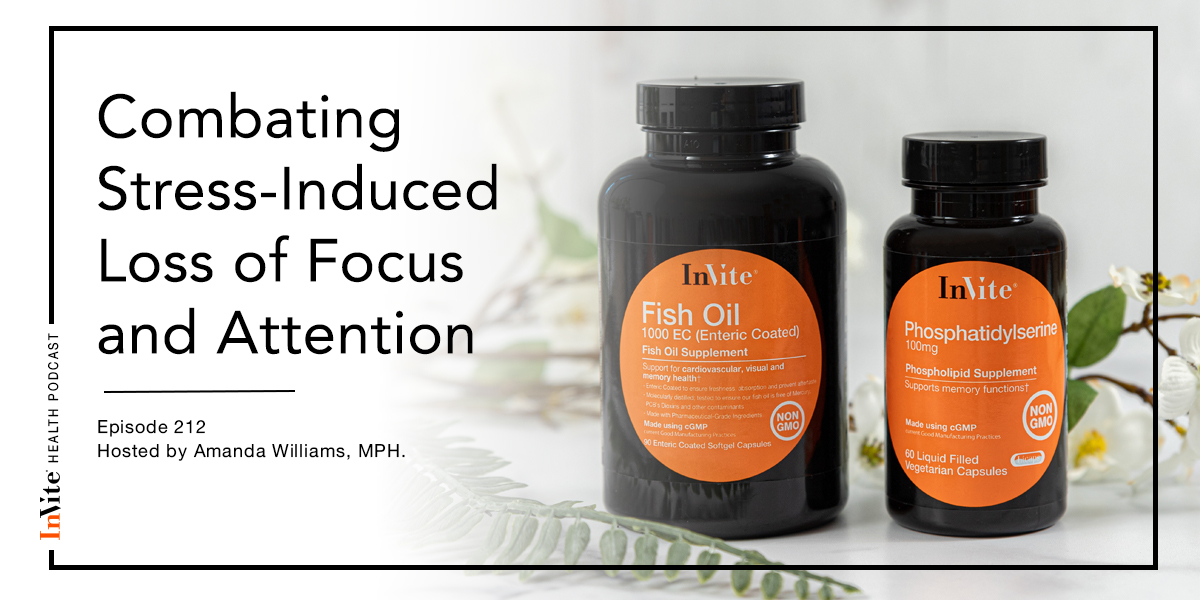
We can look at Omega-3 fatty acids, for example. We know that the brain is predominately made up of these fats, and we know that dietary intake of Omega-3s is certainly not what it should be, so we definitely want to make sure that we have Omega-3s on board. Whether we’re sourcing them from fish oil, krill oil, or flaxseed, however you need to incorporate your Omega-3s, make sure that you are getting those on board.†
The Real Impact of Pandemic-Related Stress and Anxiety – InVite Health Podcast, Episode 206. Listen Now >>
But we don’t want to forget about other fats. We want to think about nutrients like Phosphatidylserine and Phosphatidylcholine. Both of these are so incredibly important when it comes to the health of our brain. We know that dietary shortages of these two key nutrients can play a role in terms of our functional capabilities and our cognitive capabilities. If we can incorporate these into our supplementation routine, this can really help to support memory and cognitive performance.†
To hear more about Amanda’s recommendations for brain-supporting supplements, tune into the full podcast episode.
Thank you for tuning in to the Invite Health Podcast. You can find all of our episodes for free wherever you listen to podcasts or by visiting www.invitehealth.com/podcast. Make sure you subscribe and leave us a review! Follow us on Facebook, Twitter and Instagram at Invite Health today. We’ll see you next time on another episode of the Invite Health Podcast.