Fixing Nutrient Depletions In Vegan Diets – InVite Health Podcast, Episode 222
Vegan diets are becoming popular. But, eliminating all animal products from your diet does increase your risk of nutritional deficiencies.
Nutrition. Vitamins. You.
Vegan diets are becoming popular. But, eliminating all animal products from your diet does increase your risk of nutritional deficiencies.

Here’s what to do to avoid dehydration during the winter months and to ensure you’re getting the proper nutrients and fluids you need.
joint
Invite Health Podcast, Episode hosted by Amanda Williams, MPH.
Subscribe Today!


Roughly a quarter of the US population has arthritis. That may seem like an astronomical number, but what’s actually really more alarming is that it is doctor-diagnosed arthritis, so there are many more people who fall into the category of having arthritis who actually have not been diagnosed. Perhaps you get up in the morning and you have a stiff knee and you’re just kind of dealing with it. Maybe you’re going to your doctor, but that topic never comes up because you’re focused on something else. So that is just the number that we know of – about 25% – and we know that that is predominately of the osteoarthritis form. Then, we have rheumatoid arthritis as well.
It used to be the school of thought that rheumatoid arthritis was solely an autoimmune condition and osteoarthritis was the result of chronic wear and tear, and that, over time, we got this destruction that occurred within that joint space. Now that there’s so much more research out there, we actually recognize that osteoarthritis has this really strong immune system component to it. While it’s not as pronounced as the destructive nature of rheumatoid arthritis, we do have to recognize that the immune system is playing a role in triggering the symptoms of both osteoarthritis and rheumatoid arthritis.†
Beyond Joint Health: The Power of Curcumin and Boswellia – InVite Health Podcast, Episode 205. Listen Now >>
Today, I want to talk about a really unique nutrient that has been discovered by scientists that can be incredibly beneficial for those who are dealing with either form of arthritis, even for those who have not been technically diagnosed. We know that there are many folks out there who do not have doctor-diagnosed arthritis. Maybe it’s self-diagnosed, maybe you know that every morning when you get up, your joints feel stiff. Maybe if you do any type of physical activity, you notice that you have more swelling or pain within a particular joint. This is why I want to talk about this in some more significant detail and really talk about the science behind this key nutrient. I want to talk about a really unique approach to targeting joint discomfort and why this actually happens in the first place.†
The Link Between Collagen, Arthritis and The Immune System
We know that, throughout our lives, collagen production begins to diminish. By the time we are mid-50s or 60 years old, we’ve lost a good 50% of our Type I collagen. This is really quite critical because when we think about collagen in the body, this is the most abundant protein that we find. It is important not only for joint spaces, but when we think about our bones, hair, skin, and blood vessel lining. Collagen is found throughout the entire body. If we start to have rapid destruction of collagen that’s occurring in those joint spaces, then this can really start to rev up that immune system.†

This is what we’ve recognized in both rheumatoid arthritis as well as osteoarthritis, is that we have this wearing away of that collagen and then the immune system recognizes that as being foreign. In doing so, it starts to rev up and we get this really hyperactive immune system response, which drives up all of this inflammation and can lead to significant destruction within the joint spaces. We’ve always recognized that to be the case with rheumatoid arthritis, hence an autoimmune condition, but we always looked at osteoarthritis as just being wear and tear. We now realized that it has to do with the diminishing levels of the actual Type I collagen.†
How can we remedy these situations?
First and foremost, we want to think about Type I collagen. Taking a hydrolyzed Type I collagen can help restore the amount of collagen that has been lost throughout those decades. Making sure that we are taking a highly-absorbable form, one that the body recognizes, so that we can start to replenish that. Not only is that going to be beneficial for the joints, this is also beneficial when we think of all the other utilizations of collagen in the body, such as benefits for the hair, skin, and blood vessels. All around, taking hydrolyzed collagen is an excellent choice to help to replenish those lost stores.†
The Power of Glucosamine & Chondroitin For Joint Health Support – InVite Health Podcast, Episode 194. Listen Now >>
Let’s look at what we can do if we’re already experiencing that discomfort and immobility that can occur within the joints. Then we look at Type II collagen. Type II, in its undenatured state, offers immune system support. A high quality form of undenatured Collagen Type II has been studied and researched extensively at all these wonderful research universities. It is a registered trademarked form called UC-IIⓇ. This has been shown to be so incredibly effective across the spectrum, not just for targeting rheumatoid arthritis for that immune system control, but indeed, also joint health.†
Learn more about the impacts and background of collagen by tuning into the full podcast episode.
Thank you for tuning in to the Invite Health Podcast. You can find all of our episodes for free wherever you listen to podcasts or by visiting www.invitehealth.com/podcast. Make sure you subscribe and leave us a review! Follow us on Facebook, Twitter and Instagram at Invite Health today. We’ll see you next time on another episode of the Invite Health Podcast.



There’s evidence that Phosphatidylserine, along with vegetable and fish oils, improves the brain function of those with ADD and ADHD.

Alpha-Lipoic-Acid is one of the most important antioxidants in our body that plays crucial roles in numerous body systems.
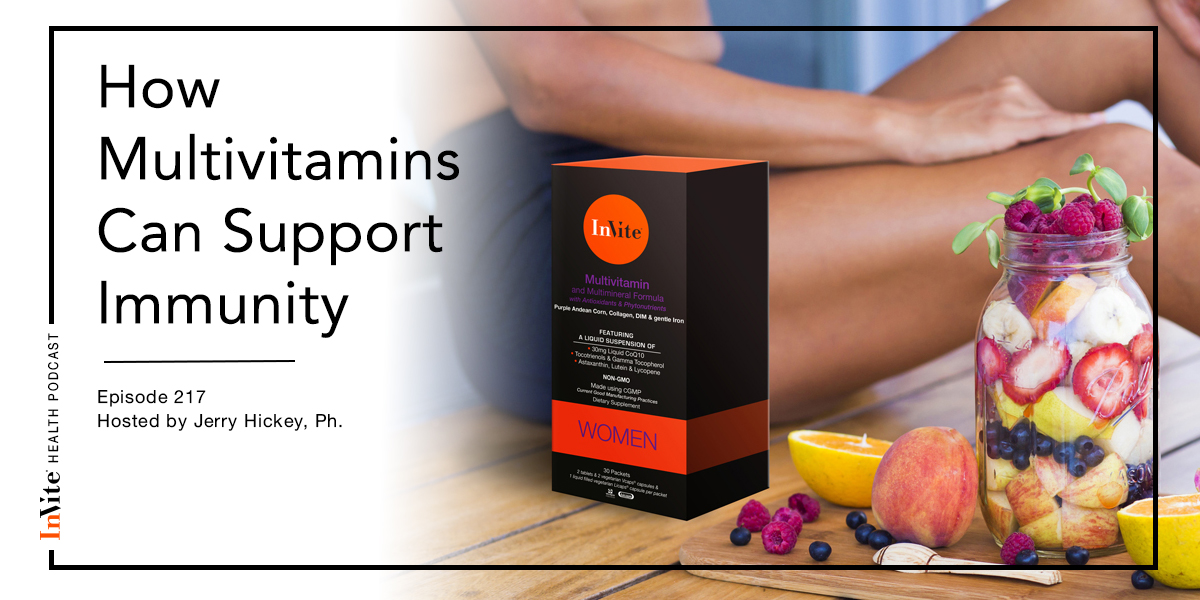
multivitamins
Invite Health Podcast, Episode hosted by Jerry Hickey. Ph
Subscribe Today!
There’s mounting evidence that simply taking a well-formed multiple vitamin and mineral supplement throughout the winter can help you get through with a lower likelihood of getting really sick with a virus. This is really, truly important during the time of the COVID-19 pandemic, and the flu is coming up. We’re going to discuss some of the research on multiple vitamins and staying healthy over the winter.
Some data on vitamins and immunity
In a recent report from England, researchers from a number of academic research institutions mostly based in London wanted to see if certain vitamins help protect from respiratory tract infections like influenza or COVID-19. They looked at Vitamin A, Vitamin E, Vitamin D and Vitamin C specifically. The research team published their findings in BMJ Nutrition, Prevention & Health. They looked at data from a large segment of people living throughout the UK. They looked at their Vitamin C intake, their Vitamin D intake, their Vitamin A intake and their Vitamin E intake. They looked at how much they had in their food and if they took supplements. They found that they couldn’t look at Vitamin C because the people who wound up with respiratory tract infections were not taking Vitamin C supplements, so that’s off the board. For Vitamin A and Vitamin E, they found that both nutrients sourced from food and supplements are connected to a lower prevalence of respiratory tract infections in the United Kingdom. They found that Vitamin D from food had no effect on protecting the lungs and the respiratory tract, but Vitamin D from supplements was associated with fewer respiratory tract infections and fewer respiratory tract complaints. This is very interesting data.
Fending Off Blue Light With Multivitamins – InVite Health Podcast, Episode 208. Listen Now >>
Researchers at Oregon State University performed a very small but extremely interesting study in adults aged 55 to 75. It was a three-month-long study. They found that, compared to people who did not take a multivitamin supplement, older adults who took the multivitamin mineral supplement daily were sicker for a shorter period of time with less severe symptoms. The researchers from Oregon State University hypothesized that the daily multivitamin and mineral contains micronutrients essential for your immune system, which I agree with wholeheartedly. They’re pointing specifically at Vitamin C, Vitamin D and Zinc. These nutrients could improve your immune cell function as you grow older. This is in the journal Nutrients.
For more research on how multivitamins and minerals can help your immune system, tune into the full podcast episode.
What to look for in a multivitamin supplement
If you get a good multivitamin, you’ll get beta carotene (the precursor to Vitamin A), but make sure that it’s natural beta carotene. You’ll get Vitamin E, but, once again, make sure it’s natural Vitamin E. The synthetic Vitamin E doesn’t work well and most vitamin companies use synthetic Vitamin E and synthetic beta carotene because they’re much less expensive. But you want to get these nutrients in their natural forms. You want at least 400 units of Vitamin D and make sure it’s Vitamin D3, which is more active than the other form, D2. My recommendation is to get a well-made multivitamin. Make sure they don’t use titanium dioxide. Sometimes when there’s liquid-filled capsules, which is sometimes the case with a multivitamin, they want to make it look nicer and protect the ingredients, they coat the capsule with titanium dioxide. That’s not good. Titanium dioxide is a heavy metal and when you ingest it, it’s been shown to irritate the lining of the intestines and you could develop leaky bowel syndrome, which is not a good thing. It also seems to get into the pancreas and damage the beta cells that release insulin and can increase your risk of developing diabetes. So make sure if you buy any supplement, it does not have titanium dioxide.
Why Multivitamins Are Essential for Immunity – Invite Health Podcast, Episode 167. Listen Now >>
Tune into the full podcast episode to hear more of Jerry’s recommendations.
Thank you for tuning in to the Invite Health Podcast. You can find all of our episodes for free wherever you listen to podcasts or by visiting www.invitehealth.com/podcast. Make sure you subscribe and leave us a review! Follow us on Facebook, Twitter and Instagram at Invite Health today. We’ll see you next time on another episode of the Invite Health Podcast.