From Bones to Osteopenia: The Benefits of Calcium- InVite Health Podcast, Episode 584
Allie Might, INHC, AADP, ATT goes into the benefits of calcium and how it supports broken bones, osteopenia and osteoporosis
Nutrition. Vitamins. You.
Allie Might, INHC, AADP, ATT goes into the benefits of calcium and how it supports broken bones, osteopenia and osteoporosis
Amanda Williams MD, MPH goes into depth on the American diet and how one of our InVite products can support your liver health.
Written by Dr. Claire Arcidiacono, ND acid
For further questions or concerns email me at carcidiacono@invitehealth.com†

Next to constipation and diarrhea, one of the most common concerns that people have is regarding stomach acid. This includes GERD or gastroesophageal re-flux disease. Other common concerns that relate to stomach acid include Peptic ulcers, gastritis, and ironically, too little stomach acid. Since this topic is a complex one to clearly understand, it’ll be broken down into 2 parts.†
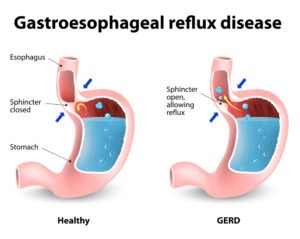
So what exactly is GERD or gastroesophageal re-flux disease? GERD is known as acid re-flux or heartburn. The lower esophageal sphincter or “doorway” between the stomach and esophagus doesn’t close properly causing the acid and other stomach contents to leave the stomach and enter the esophagus. Normally the stomach has protections so it’s able to handle the acid without being damaged or causing pain. In contrast, the esophagus doesn’t have these protections and thus when the acid rises up it causes complications and pain.(1)†
While most people know the symptoms of GERD include heartburn or burning in the chest, it can have quite a few other symptoms or be asymptomatic. In addition to heartburn, there can be a metallic or acid like taste in the mouth. In my practice, this is actually one of the things I always ask people since it’s a classic symptom of GERD even if there is no burning feeling. The acid can cause bad breath and even an increase in saliva. As the acid causes damage, pain with swallowing or even just a chronic sore throat is common. Some people with GERD never have any pain, but do develop symptoms such as a chronic cough, trouble breathing, increase in asthma attacks and even chest pain that can be confused as coming from other things such as the heart. This is typically known as silent GERD since the classic heartburn is absent. While GERD can cause nausea or vomiting, this is less common in adults and is actually seen more in children and infants. (3) Children and infants can get GERD but the symptoms are actually different than in adults. They can include vomiting, spitting up, coughing, wheezing, and food refusal that leads to weight loss. There can also be excessive burping and bad breath. (4)†
Even worse, over time the acid can damage the enamel of teeth as well as the gums. Very often, I see people with dry mouth or burning mouth that turns out to be GERD. (5)†
But what is an ulcer? It’s basically a sore on the inside of you. A Peptic Ulcer is similar to GERD in that the acid is causing the damage either to the stomach (gastric ulcer) or the first part of the intestines (duodenal ulcer). GERD is basically the acid burning a path from the stomach to mouth via the esophageal “highway” where a peptic ulcer has the acid concentrating on 1 spot forming an open sore. (6)†
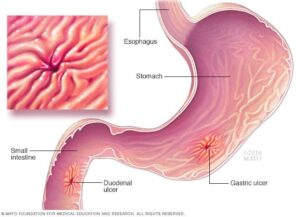
Symptoms of a peptic ulcer that are similar to GERD include an increase in saliva, nausea/vomiting abdominal pain, bloating, vomiting blood, tarry/foul stool and in some cases, heartburn. In a gastric ulcer, you can experience a decrease in appetite vs increase in appetite with a duodenal ulcer. In up to 15% of people there are no symptoms. (8) Gastritis is similar to an ulcer and GERD in that there is inflammation of the stomach lining but unlike an ulcer, it’s not concentrated in one spot.†
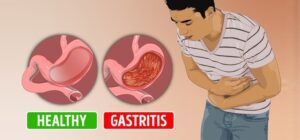
It is very common to have gastritis, an ulcer and/or to suffer from GERD. Symptoms of gastritis can include abdominal pain, nausea/vomiting, heartburn, bloating and gas and even changes in appetite. (10).†
So far everything mentioned is caused by damage due to the stomach acid. But what if there’s not enough acid? In most cases, people have too much acid; not having enough acid can actually contribute to hypochlorhydria or low stomach acid. Signs of hypochlorhydria can include abdominal pain, bloating, gas, diarrhea/constipation and all the symptoms mentioned for GERD/Ulcers and gastritis. Undigested food in the stool is also a sign of hypochlorhydria. Long term, nutritional deficiencies can develop leading to brittle nails, hair loss, paleness, fatigue, numbness, and memory loss. (11)†
Next week we will talk about risk factors for all of these as well as complications. We will also talk about supplements that studies and my own clinical experience have found to be helpful!†

Jerry Hickey, Ph. talks all about the importance of protein, why you need it, what happens if you lack it and the foods you can get it from.
Written by Dr. Claire Arcidiacono, ND leaky gut For further questions or concerns email me at carcidiacono@invitehealth.com† This week’s topic is a combination of things very distinct topics that all fit together. An anal fissure is a tear or cut in the skin of the anal …
enhance enhance
Subscribe Today!


Please see below for a complete transcript of this episode.
Hosted by Amanda Williams MD, MPH
*Intro music*
InViteⓇ Health Podcast Intro: Welcome to the InViteⓇ Health Podcast, where our degreed healthcare professionals are excited to offer you the most important health and wellness information you need to make informed choices about your health. You can learn more about the products discussed in each of these episodes and all that InViteⓇ Health has to offer at www.invitehealth.com/podcast. First time customers can use promo code PODCAST at checkout for an additional 15% off your first purchase. Let’s get started!†
*Intro music*
Amanda Williams MD, MPH: [00:00:40] We’ve all heard someone complain about how they’re having a bad hair day. It may even be you who has said that before. And we know that when it comes to the health of our hair, there are many different factors that can influence that. We can look at the different hormonal influences, we can certainly look at environmental factors that can impact the health of our hair. And I want to zero in on different nutrients that can really be very, very beneficial when it comes to the way that our hair ages. This is important because sometimes we take for granted that our hair is to remain healthy throughout our lives. And because there are so many different moving parts, one could say when it comes to your hair, I want to zero in on the common reasons as to why someone can experience either the thinning of hair, loss of hair, maybe the feel of your hair isn’t what it used to be. So I want to get into all of those details with you when it comes to hair health. [00:01:50]
[00:01:51] I am Dr. Amanda Williams, scientific director at InVite Health. And when it comes to hair loss, we know this is a big problem that many people deal with. It was always kind of looked at as being more of an issue for men as opposed to women and male pattern baldness and certainly we, you know, look at the statistics and you can clearly see that men are impacted by hair loss more so than women. However, that number is not as far off as you may actually recognize. It’s estimated that, you know, right, right around 35-40 million men experience hair loss, but over 20 million women experience hair loss. And this usually is happening right around 30-35 years old when you start to see this significant shift in the health of the hair. And when you start to break that down and say, well, you know, why would that be? Why is it that so many men are dealing with hair loss? And why is it that so many women are dealing with with hair loss? And we can start to kind of piece it all together. We can look at those hormonal influences. We certainly know that when it comes to the adrenergic effect from the androgens, we can clearly link this with men, but we can also link that with women as well. When we look at the totality of hair loss in this country and we’re not talking about like full baldness, we’re talking about, you know, the generalized looking at hair loss. There are some folks that estimate this up even higher than the numbers that I gave out of the 35-40 million men, 20 million women. There are some that estimate this number to be closer to 80 to 100 million folks in this country over the age of 35 who experience this. And as I said, many women are really feeling the impacts of this. [00:04:06]
[00:04:06] And we have to look at why that is and what we can be doing, because certainly this can be incredibly problematic on the emotional and social side to this. And, you know, some people say, oh, well, it’s because you’re being vain and it doesn’t matter if you lose your hair. But for a lot of people their hair is their identity. And we have to be able to to recognize that and do what we can in our power to prevent, you know, further hair loss and to prevent the degradation of our hair as we get older. So we can look at thinning hair, we can look at the balding process itself. We can also look at, as I mentioned, just that the shift or the change in the health or the texture of the hair. [00:04:56]
[00:04:57] So I actually have formulated a product called Hair Enhance Hx. I took a lot of time working through the the science on this formula because I’ve had so many people come to me over the course of many, many years who have had those common complaints. My hair feels like it’s thinning out or you know, I was brushing my hair today and I look down at the brush and there’s an awful lot of hair, so, you know, I’m losing hair at a greater rate than I would like to or, you know, I feel like my hair is thinner on one side than the other or I get people who come to me and say, you know, I am experiencing a lot more gray hairs than I would like. Some people are, you know, not big into using, you know, color treatment when it comes to covering up those grays. Because then you’re basically putting a chemical if you’re using a standard color treatment onto your hair, which means it’s going to get on to your scalp. And that can be certainly problematic. So I always advise if you’re going to do any type of color treatment to your hair, make sure that you are seeking out a hair stylist that only uses organic. So organic hair color is what you want to be using, especially in this day and age, because we know that there are so many different harmful chemicals that we need to be aware of and that we need to avoid at all costs. [00:06:20]
[00:06:21] So in formulating this product, I started to kind of reflect back on the many different causative reasons that I’ve talked to folks throughout the years when it comes to their concerns with hair. And many people like to, you know, kind of zero in on utilizing topical approach. And I’m not saying that that’s a bad thing, but we have to be aware that what is occurring with the lackluster of our hair, loss of hair is coming from the inside. So we really need to approach this from the inside out. And in formulating the Hair Enhance Hx product, I started to pinpoint, you know, what are the different targeted pathways, what are the different enzymatic processes that need to be addressed when it comes to supporting the strength and the integrity of the hair? So I zeroed in on, of course, the key nutrients most people have heard about the benefit of biotin, that very important B vitamin when it comes to the strength and the sheen of the hair as well as for, say, your fingernail. So hair, skin and nails definitely biotin. Is that B vitamin that most people turn to? So I included biotin into this formulation along with zinc. Zinc is very key for a couple of different reasons, not only for that structural strength of the hair itself, but for anyone who has any type of underlying thyroid issue. Zinc deficiencies or zinc insufficiency is a very common place that we always have to look at. If we have inadequate zinc exposure, this can affect the health of the hair, the health of the thyroid function, our metabolism in general. So I included zinc into this formulation along with the key amino acids that we know are critical when it comes to that structural integrity. [00:08:20]
[00:08:21] So having the methionine and that cysteine in this formulation along with arginine. So there’s a reason why I put arginine into this formula. When it comes to nitric oxide, we know that the amino acid l-arginine is critical in how the body releases nitric oxide. So we have to have arginine in order for that nitric oxide to be released. Well, one of the interesting things about our hair is the more nitric oxide that we have, the better opening up of that hair shaft we actually get so the hair can move through. And so by having arginine into this formulation, this helps to enhance the growth or the stimulation of new hair growth. So it’s not only for the structural component to it, but it’s actually to promote the growth of new hair. This is very important. I also mentioned that many folks come to me and say, you know, I have a lot of stress in my life. I feel like because of stress, I’m getting a lot more gray hair. And so because of that, we have to understand that there is a key amino acid in the body or I’m sorry, not an amino acid, an antioxidant. An endogenous antioxidant that’s very critical to the regulation of hydrogen peroxide. If we have excess hydrogen peroxide, this can lead to significant graying or bleaching of the hair. [00:09:49]
[00:09:50] So through the utilization of catalase catalyze is an endogenous antioxidant, we know that as we get older, our body produces less catalase. So I included catalase into this formulation to be able to help stabilize and regulate how much hydrogen peroxide is actually building in the body. Because if we can dull that out, we can get less hydrogen peroxide, then the likelihood of getting less of that hair bleaching will actually occur. So we have the catalase in this formulation for that specified reason. Then we have to look at, you know, how it is structurally that things such as keratin and silica really provide that tensile strength. So when someone’s looking at their hair, maybe you feel like you have a lot of, you know, dry ends or split ends. We have to think about the chemicals that potentially you’re putting topically onto your hair. So if you’re using a typical shampoo or conditioner that has chemicals in it, any phthalates, alcohols, parabens, we want to be able to avoid that. So you want to use the InVite Health shampoo and conditioner, which are all natural, no chemicals whatsoever, all coming from essential oils and from plant based. And that’s really key because we don’t want to add insult to injury. We want to be able to promote the health of the hair from the inside out. But we don’t want to complicate matters by putting chemicals on top of our head. And all of these things at the end of the day matter. As I mentioned, this is a multi-modal approach when it comes to the health of our hair. [00:11:29]
[00:11:30] So we’ve got all of these different nutrients that are contained within the hair enhance. We have the methionine, the cysteine, that arginine, we have the hydrolyzed keratin, we have that silica, all of which have been studied specifically for their benefit when it comes to our hair. We also have to look at how antioxidants play a role into the health of the hair, which is why I have tocotrienols. I have the ethanol max, that’s a registered trademark form of vitamin E, which has been shown in human clinical trials to actually promote new hair growth. I also include in this formulation the power of fisetin, and fisetin is a incredibly powerful antioxidant which has been studied and shown that the power of these flavanols can be very beneficial for maintaining the health of the hair. And it does this in a couple of different mechanisms, not only to fend off a lot of the oxidative stress, but also to enhance the proper blood flow to the hair follicle itself. So when you start to look at these different botanicals and you look at studies on alopecia, where there is significant hair loss that has been brought on, we have to always look at, you know, what different nutrients can be beneficial. And we know that fisetin along with the apple polyphenols which are really quite fabulous. [00:13:03]
[00:13:04] There’s a specific reason why I put Apple polyphenols into this formulation. The science, the science speaks volume. I remember coming across this study that was published in the Journal of Medicinal Foods many years ago, looking at how the polyphenols are. The powerful antioxidants that are derived from these specific apples do so much to enhance the keratin expression in human hair. And so they did this randomized clinical trial where they were utilizing the Proanthocyanidins coming from these Apple extracts, and they showed that this helped with the biosynthesis by working in conjunction with keratin to promote the growth of hair. [00:13:53]
[00:13:53] So we look at the the tocotrienols and we say, okay, well we know the Ethanol Max has been shown in human trials to that through supplementation of this specific form of vitamin E, this can actually promote hair growth. And then we look at the apple polyphenols and we say, okay, well, we partner that up with the keratin. And voila, we have this really nice way to enhance the growth of new hair. So you partner that with the arginine which we know is opening up that hair shaft, we’ve got the cysteine and the methianine to really support the structural integrity of the new hair that is being grown. And you say to yourself, Yeah, if I’m having a bad hair day, maybe what I need to do is work from the inside out. And looking at that hair enhance formulation and this combination of powerful nutrients that can really help to enhance and support the health of our hair is probably something I should be incorporating into my daily supplementation routine. [00:14:54]
[00:14:55] Now, I mentioned in the beginning of the podcast that much of what happens in male pattern baldness as well as female pattern baldness comes down to the hormonal influence or the impact of hormonal dysregulation, which is why includes saw palmetto and I didn’t rinky dink around with this and say oh let me just put a little bit of saw palmetto in this I have a lot of saw Palmetto in this formulation, there’s 320 milligrams in this formula. The reason why I went with a high amount of saw Palmetto extract is we know that saw Palmetto is a powerful way for us to target the pathway which is responsible for the loss of hair. And so through the action of saw palmetto, this is targeting that testosterone to dihydrotestosterone pathway. When men and women, this is key, when men and women have a dysregulation of how testosterone is being transferred in the body and if we start to make too much dihydrotestosterone, this is that direct causal link for both male and female pattern baldness. So with the utilization of Saw Palmetto, we can help to impede that pathway and we keep the the hair in a much healthier form. So looking at the hair enhance, we’ve got all of these wonderful nutrients combined together, we’ve got the silica extract coming from bamboo, we have that fisetin that powerful polyphenol to fend off so much of the oxidative stress, the environmental factors that our hair can be damaged from. You think about the pollutants in the air, all of the different chemicals that our hair is exposed to throughout our lifetime. So we want those antioxidants to be able to protect our hair from the inside out. So I definitely encourage you to check out this formulation. It’s called Hair Enhance Hx. For anyone who’s having a bad hair day, make sure that you include this into a daily supplementation routine. Three caps daily gets you on that fast track to healthier hair. You can partner this up with Collagen Hx or with the Collegex HA to really give you that structural support and enhance that nice, flowy hair that you are seeking. [00:17:25][149.6]
[00:17:26] And I want to thank you so much for tuning in to the InVite Health podcast. Remember, you can find all of our episodes for free. Wherever you listen to podcasts, do make sure that you subscribe and you leave us a review. You can follow us on Facebook, Twitter and Instagram at InVite Health. And we will see you next time for another episode of the InVite Health podcast and. [00:17:26]
*Exit Music*