cocoa
Invite Health Podcast, Episode hosted by Jerry Hickey. Ph
Subscribe Today!
Diabetes is a plague on our society. It’s so common. We need more education on how to not have diabetes. It has to do with lifestyle. Sleeping matters because you’re handling your blood pressure better when you get enough sleep. Food absolutely matters. Good food choices prevent diabetes, as well as exercise and physical activity. A lack of exercise, poor food choices and a lack of sleep can really increase your chances of getting diabetes. Let’s talk about how we as humans handle our sugar.
Blood sugar and insulin’s functions in the body
When you eat food, you’re breaking it down to its different components, one of which is sugars. These sugars could become pretty high during a meal, so the body prevents that because, when the sugar is too high, it can start to damage organs, tissues and cells. The body releases insulin from a gland called the pancreas. The pancreas is partially responsible for digestion, but it’s also responsible for controlling your blood sugar. During a meal, you release insulin from the pancreas and you drive the excess sugar into your fat cells, muscles and liver. That’s one reason why having a lot of muscle and exercising helps to even treat diabetes because once sugar enters the muscle, it becomes muscle glycogen and it can’t escape the muscle. It’s stored there until later physical activity. The more you exercise, the more your body will take the sugar out of the blood to make additional glycogen.
If the body’s in good balance, you leave enough sugar behind for the body’s energy because the body makes energy using sugar. A well-balanced body in good sync metabolically leaves enough sugar during and after meals for the body’s energy needs. In between meals, when sugar starts to go low, the pancreas releases a second hormone called glucagon to release some of the stored sugars from your fat cells and liver. This is called gluconeogenesis. When you don’t eat well, when you’re eating a lot of crackers, muffins and sugary foods, the body has to work harder to store the sugar, so your insulin is going up. That’s called your fasting insulin and if it’s rising, that can be an early indicator of pre-diabetes or diabetes.
HOW CINNAMON AND COROSOLIC ACID SUPPORT HEALTHY BLOOD SUGAR LEVELS – INVITE HEALTH PODCAST, EPISODE 144. Listen Now >>

They also look at insulin sensitivity. Your cells are supposed to be very sensitive to the effects of insulin. If you’re eating incorrectly and not exercising, your sugar is always up, so you’re always releasing insulin. Eventually, the body cells stop responding to the effects of insulin, so you have reduced insulin sensitivity. Now you’re really going towards pre-diabetes. The next step is insulin resistance. That’s when the cells are not responding well to insulin, so you can’t use sugar for energy and you can’t store the sugar. It’s a problem. Your pancreas is making more and more insulin over time, your blood sugar levels are going up and you’re on your way to developing diabetes.
To learn more about the functions of these hormones in the body and what blood tests you should consider, tune into the full podcast episode.
Cocoa for blood sugar
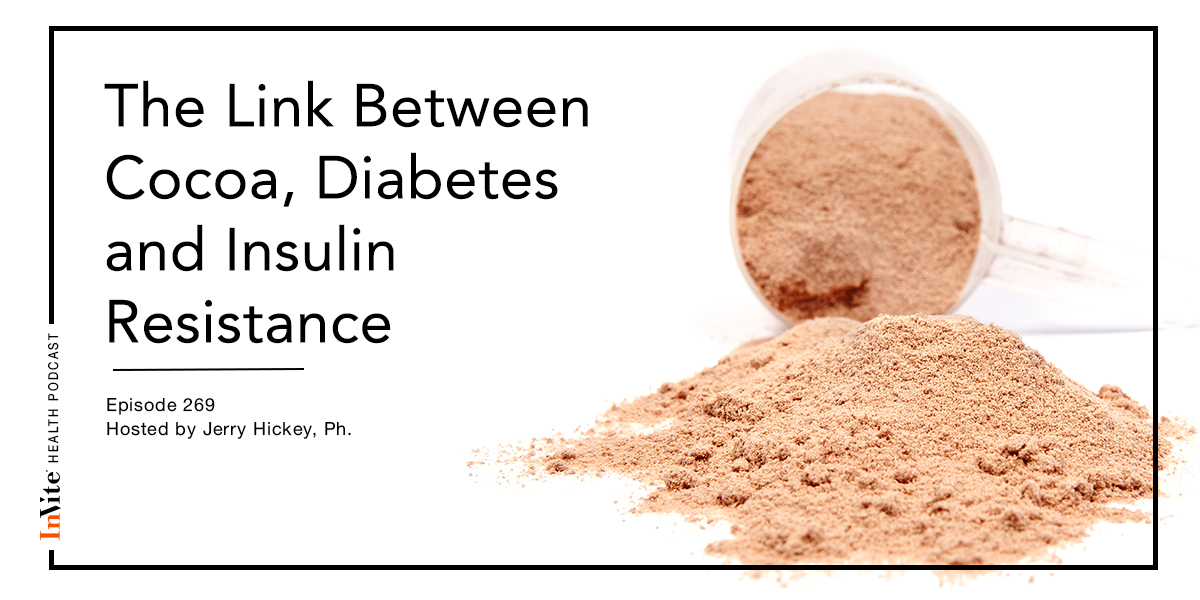
Cocoa has been shown for over 30 years to have some impact on diabetes and supporting healthy blood sugar levels. Even chocolate may have some of this ability. The problem is that when they convert cocoa into chocolate, you lose some of the things that are protective and beneficial that lower your risk of developing Type 2 diabetes.
Here’s a study by Norwich Medical School at the University of East Anglia and published in the American Journal of Clinical Nutrition. It’s looking at the effect of cocoa and its flavan-3-ols on cardiovascular health. This meta analysis found that cocoa helped circulation and high blood pressure, but what we’re looking for in this conversation is its effect on lowering the risk of diabetes and it did. It improved insulin resistance. They saw that the insulin was working better because the cocoa seriously reduced serum insulin over time. It lowered fasting blood glucose and reduced the blood insulin levels. It was making everything go back to normal.
THE SCIENCE BEHIND COCOA FOR OVERALL HEALTH – INVITE HEALTH PODCAST, EPISODE 249. Listen Now >>
For more studies on the benefits of cocoa, listen to the full podcast episode.
Supplements for blood sugar issues
The good news is that pre-diabetes and even full-blown diabetes in a lot of people can be reversed if you start eating healthy and you really start exercising. Let me tell you some supplements that you really need if you’re starting to develop blood sugar problems:
- Vitamin D: This interacts with magnesium and zinc to control your blood sugar.
- Vitamin C: This is important because your body isn’t using it correctly as an antioxidant to protect yourself.
- Vitamin B1: This is involved with the transketolase pathway, which helps control your blood sugar.
- Cocoa: This powerful nutrient can be found in our Cocoa Hx and TRUE by InVite Clarity formulas.
Thank you for tuning in to the Invite Health Podcast. You can find all of our episodes for free wherever you listen to podcasts or by visiting www.invitehealth.com/podcast. Make sure you subscribe and leave us a review! Follow us on Facebook, Twitter and Instagram at Invite Health today. We’ll see you next time on another episode of the Invite Health Podcast.