Recent Posts

Disinfecting For The Coronavirus May Be Killing Your Good Bacteria – Invite Health Podcast, Episode 149

Disinfecting For The Coronavirus May Be Killing Your Good Bacteria – Invite Health Podcast, Episode 149

On today’s episode, we are going to talk about all of that hand washing you’re doing and all of those disinfectants you are using to keep the Coronavirus at bay. This is not a bad thing! But the problem is that it can impact your good bacteria and actually kill it off.

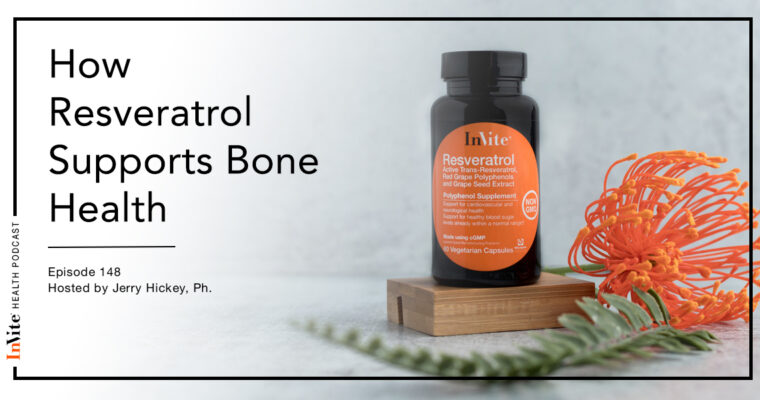
How Resveratrol Supports Bone Health – Invite Health Podcast, Episode 148

How Resveratrol Supports Bone Health – Invite Health Podcast, Episode 148

When you are young, there is a balance between bone building and bone removal cells. But we lose this balance with age. Resveratrol, according to many clinical studies, helps restore this balance. Here’s what you need to know. 

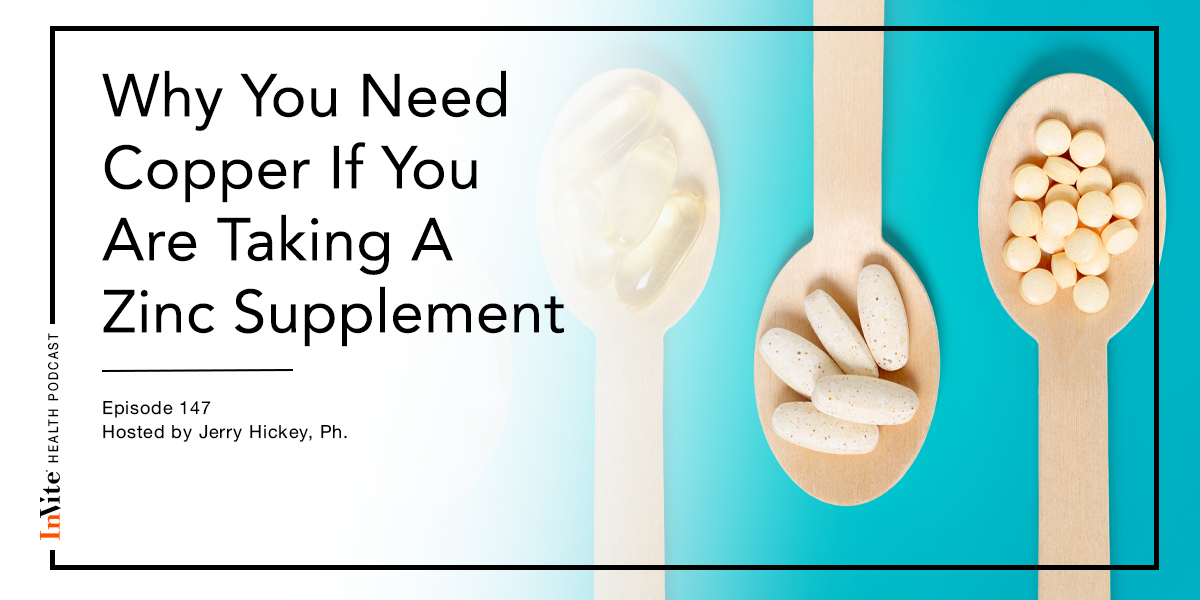
Why You Need Copper If You Are Taking A Zinc Supplement – Invite Health Podcast, Episode 147

Why You Need Copper If You Are Taking A Zinc Supplement – Invite Health Podcast, Episode 147

Invite Health Podcast, Episode hosted by Jerry Hickey. Ph

Subscribe Today!

Apple PodcastsGoogle PodcastsiHeartRadioSpotify

On today’s episode, we are going to be talking about the micronutrient Copper. Micronutrient means that you only need it in small amounts but it is an essential mineral that does many important things for the body, including being needed for proper immune system function. Here’s the issue – we are still in the Coronavirus Pandemic and many are realizing that zinc is extremely important for their immune system. But if you are taking a lot of Zinc for your immune system, you may need a little bit more copper. Let’s discuss!

The Link Between Zinc and Copper

Zinc is important for the immune system. You need zinc for many functions:

  • To create immune cells
  • For immune cell function
  • For cellular repair after an infection
  • To prevent your own immune system from damaging organs and tissues

The Importance of Zinc For Immunity During The Coronavirus. Listen Now >>

Many people are taking high doses of zinc to help reduce the risk of developing a severe infection, which I believe is a good idea. The problem is that Zinc interferes with the absorption of copper. 

Copper is an essential mineral and it is involved with:

  • Energy creation
  • Iron metabolism
  • Connective tissue
  • Bone formation
  • The formation of neurotransmitters in our brain.

Copper is also required as an antioxidant and importantly during the times of the Coronavirus, for immune system function. Normally, you get enough from your food and also in your multiple-vitamin. But if you take Zinc, you may need a little bit more to play it safe. Dietary sources of copper include shellfish, seeds and nuts, wheat bran, whole grains, chocolate, and organ meats.

invite health podcast offer

Important Functions of Copper In Your Body

Energy production

You need copper to create energy from the food you eat. Without it, you cannot create energy. A copper-dependent enzyme called cytochrome c oxidase plays a critical role in creating energy out of your food. It triggers the reduction of oxygen into water, generating an electrical gradient, which is an energy source used by the power plants called mitochondria of our cells to create the vital energy-storing molecule, ATP.†

Connective tissue formation

Another copper-containing enzyme, lysyl oxidase, is required for the formation of collagen and elastin. Collagen is required to build skin, hair, and nails, bone, joint tissue, ligaments and tendons and many other tissues. Elastin is needed for the elasticity and resilience of your skin. So, copper is essential for the formation of strong and flexible connective tissue. It also helps maintain the integrity of connective tissue in the heart and blood vessels and also plays a role in bone formation.†

Learn More About The Importance Of Collagen. Click Here >>

Iron metabolism

Four copper-containing enzymes, known as ferroxidases convert iron into its ferric iron form. This is the form that iron takes on to be transported to bone marrow to make red blood cells. Adequate copper is necessary for normal iron metabolism and red blood cell formation. Anemia is a clinical sign of copper deficiency. With this deficiency, it is difficult to transport iron and instead of creating red blood cells the iron tends to accumulate in the liver leading to hepatic iron overload and/or cirrhosis.†

Immune system function

Copper is known to play an important role in the development and maintenance of immune system function, but the exact mechanism of its action is not yet known. Neutropenia (abnormally low numbers of white blood cells called neutrophils) is a clinical sign of a deficiency in humans. It is also needed for phagocytosis; the ability of very large immune cells called macrophages to engulf and destroy infectious microbes. You don’t want to be low in Zinc or Copper during virus season.†

Other Key Functions:

  • Central nervous system
  • Neurotransmitter synthesis
  • Formation and maintenance of myelin
  • Melanin formation
  • Antioxidant functions

Thank you for tuning in to the Invite Health Podcast. You can find all of our episodes for free wherever you listen to podcasts or by visiting www.invitehealth.com/podcast. Make sure you subscribe and leave us a review! Follow us on Facebook, Twitter and Instagram at Invite Health today. We’ll see you next time on another episode of the Invite Health Podcast.

invite health podcast disclaimer

jerry hickey invite health podcast

Nutritional Support for Wound Healing – Invite Health Podcast, Episode 146

Nutritional Support for Wound Healing – Invite Health Podcast, Episode 146

The process of wound healing is very complex; here is what is happening inside of your body when you have a wound and the nutritional support you can provide it to heal efficiently, according to Jerry Hickey, Ph.

Bilberry Fruit: The Forgotten Berry – Invite Health Podcast, Episode 145

Bilberry Fruit: The Forgotten Berry – Invite Health Podcast, Episode 145

We have all heard about the importance of getting adequate fruits and vegetables, but there are certain berries that can really provide a significant amount of health support. One berry in particular that is oftentimes overlooked is the bilberry.

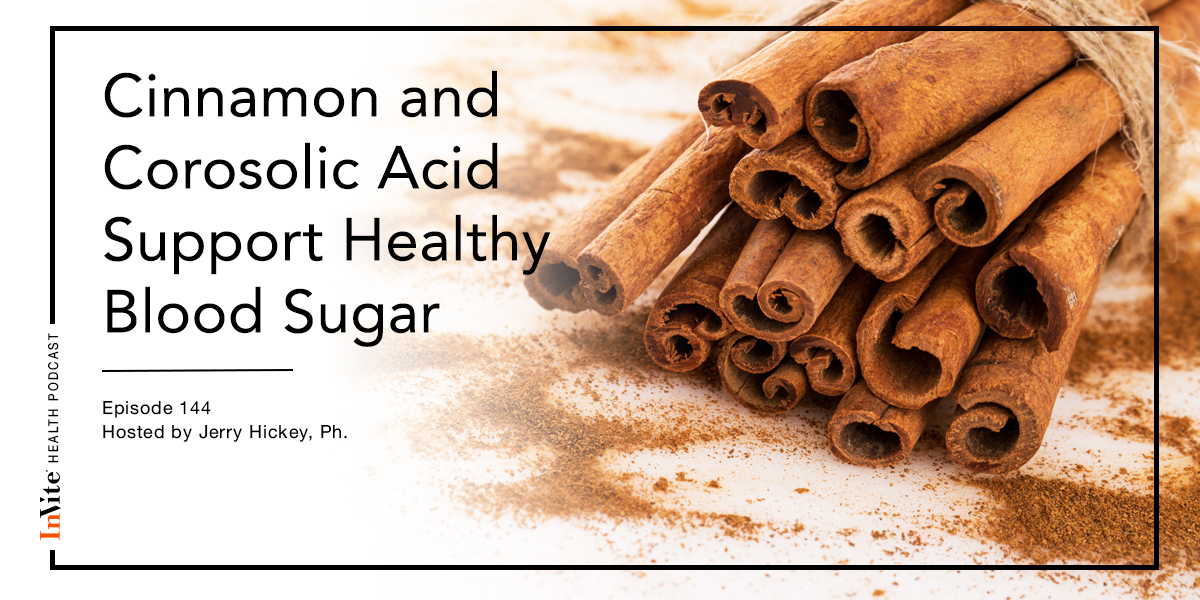
How Cinnamon and Corosolic Acid Support Healthy Blood Sugar Levels – Invite Health Podcast, Episode 144

How Cinnamon and Corosolic Acid Support Healthy Blood Sugar Levels – Invite Health Podcast, Episode 144

Invite Health Podcast, Episode hosted by Jerry Hickey. Ph

Subscribe Today!

Apple PodcastsGoogle PodcastsiHeartRadioSpotify

There are a couple of plant ingredients that I would like to talk to you about today that have been shown to be beneficial in people with elevated blood sugar – the bark of the cinnamon tree and a plant that grows in the Philippines called banaba that contains corosolic acid.

According to the National Institute of Health, over 30 million Americans have diabetes. An additional 84 million have prediabetes; their blood sugar is elevated but not enough to be diagnosed with diabetes. However, prediabetes often progresses into full blown diabetes, which is a vicious disease. After ten years of having diabetes, about 80% of people end up with diabetic retinopathy. This is when fat is getting inside the back of the eye, causing little blood vessels on the back of the eye to burst. Diabetes also tends to damage the kidneys, your nerves, ages your skin, and impacts your hearing, brain, and heart.

There is good news! Studies are showing that, for people who have been diagnosed with diabetes over the past two or three years (if they start to exercise, eat better and follow certain recommendations), they can actually get away from a diagnosis of diabetes. Here are a couple of tips:

  • Have a glass of water a half an hour before each meal to help cut back on overeating
  • Eat your carbohydrates at the end of your meal to slow down the absorption of sugar
  • Walk for 10-20 minutes after each meal and aim for an hour of walking each day

The Science Behind Cinnamon and Blood Sugar Control

Cinnamon comes from the inner bark of a beautiful tree that grows in countries of Southeast Asia and islands off the coast. You know cinnamon as a spice and it is delicious. The United States Department of Agriculture has performed several studies on the water soluble extracts of cinnamon and have found that it lowers blood sugar. This water soluble extract is referred to as ‘Type A water soluble polymers” and it lacks the spiciness found in cinnamon. The word polymer sounds a bit scary but it simply means it is a group of similar looking molecules bonded together in a chain.

Cinnamon improves glucose and lipids of people with type 2 diabetes. In this study 60 people with type 2 diabetes (30 men/30 women) between the age of 46 to 58 were given various dosages of Cinnamon or placebo for 40 days. Cinnamon reduced fasting blood glucose by 18-29%, triglycerides by 23-30%, LDL-cholesterol dropped by 7-27%, and total cholesterol by 12-26%. There were no significant changes in the placebo group. Using Cinnamon in patients with type 2 diabetes will reduce risk factors associated with diabetes and cardiovascular disease. The study is published in the December 2003 issue of the journal Diabetes Care.

invite health podcast offer

Aqueous Extract of Cinnamon reduces fasting blood sugar in diabetics on oral drugs. In this study, 79 patients with Type 2 diabetes who were taking medication other than insulin or on a strict diet were given an Aqueous Extract of Cinnamon corresponding to 3 grams of Cinnamon a day for 4 months or an inactive placebo. The Cinnamon Extract caused the fasting blood glucose to drop by 10.3% on average, far more than placebo (3.4%). The study is published in the May 2006 issue of the European Journal of Clinical Investigation.

The Science Behind Banaba (Coroscolic Acid) and Blood Sugar Control

Banaba is a plant native to the Philippines and Southeast Asia. It is a species of crepe myrtle, so it becomes a beautiful tree with typically purplish flowers. Banaba leaf preparations have been used in Philippine folk medicine for treatment of diabetes. Certain constituents especially corosolic acid have hypoglycemic activity; in other words, has been shown to help lower the amount of sugar in your blood.

  • Research shows that taking a particular banaba extract standardized for Corosolic Acid within 2 weeks, lowers blood sugar by 10% in people with type 2 diabetes.†
  • Research also shows that taking a combination product containing banaba and cinnamon inner bark for 12 weeks lowers hemoglobin A1c (HbA1c) by about 0.65% in people with uncontrolled type 2 diabetes.†
  • Research shows that taking a product containing banaba and cinnamon inner bark for 12 weeks improves how well insulin is produced by the body in someone with prediabetes. It also improves how sensitive the body is to the effects of insulin.†

Corosolic Acid lowers blood sugar significantly. Researchers from the Department of Diabetes and Clinical Nutrition at Kyoto University gave 31 people either 10mg Corosolic Acid or inactive placebo a number of times, 5 minutes before an oral glucose tolerance test consisting of drinking 75-g of sugar in water in a cross-over design. The test subjects had diabetes, or impaired glucose tolerance, impaired fasting glucose, and 4 had normal sugar activity. The Corosolic Acid lowered blood glucose within 60 minutes and reached statistical significance by 90 minutes. The study is published in the August 2006 issue of the Irish medical journal Diabetes Research and Clinical Practice.

Corosolic Acid significantly improves blood sugar in type II diabetics. In this study type II diabetics who were not using insulin were supplemented with Corosolic Acid for two weeks. The supplement significantly improved blood sugar levels by 20% to 30%. The study is published in the July 2003 issue of the Irish publication Journal of Ethnopharmacology.

Thank you for tuning in to the Invite Health Podcast. You can find all of our episodes for free wherever you listen to podcasts or by visiting www.invitehealth.com/podcast. Make sure you subscribe and leave us a review! Follow us on Facebook, Twitter and Instagram at Invite Health today. We’ll see you next time on another episode of the Invite Health Podcast.


invite health podcast disclaimer

jerry hickey invite health podcast