Invite Health Podcast, Episode hosted by Jerry Hickey. Ph
Subscribe Today!
If you look up the word detoxification on the internet, millions of sites come up discussing the colon or liver. But we need to discuss detoxifying your breasts. We need to discuss this because you likely have been exposed to scores of chemicals in personal hygiene and beauty products such as your deodorant, shampoo, and skin cream. These toxins are absorbed through your skin, and because they resemble estrogen’s, they collect and concentrate in your breasts and are related to breast inflammation and breast cancer.
Here are the latest studies
A fairly recent report from Germany shows how dangerous chemicals in personal care products can be for women. Researchers evaluated many chemicals used in deodorants, skin care, toothpastes, and hair care products and found some were very powerful estrogen’s, with the strongest estrogenic activity found in synthetic fragrances and parabens. The researchers then added these chemicals to breast cancer tissue and it made the cancer cells grow and multiply rapidly. They then arbitrarily screened 98 different women and found high levels of these chemicals in the bloodstream of 96 of these women.
Many similar reports have come out recently and one of these by scientists at Silent Spring Institute, published in the journal Environmental Research shows that Black women are often exposed to dozens of hazardous chemicals through the hair products they use, more so than other ethnic groups. This is the first study to measure concentrations of endocrine-disrupting chemicals— substances that interfere with the body’s hormones —in a variety of hair products marketed to Black women.
“Chemicals in hair products, and beauty products in general, are mostly untested and largely unregulated,” says lead author Jessica Helm, PhD, a scientist at Silent Spring. “This study is a first step toward uncovering what harmful substances are in products frequently used by Black women, so we can better understand what’s driving some of the health issues they’re facing.”
The researcher notes that Black women go through puberty at a younger age, and have higher rates of uterine fibroids and infertility than other groups of women. The rate for breast cancer and endometrial cancer is also increasing among Black women.
The new study looked at 18 different categories of hair products chosen based on results from a survey of Black women that included hot oil treatments, anti-frizz hair polishes, leave-in conditioners, root stimulators, hair lotions, and hair relaxers.
The researchers tested each product for the presence of 66 endocrine disruptors that are associated with a variety of health effects including reproductive disorders, birth defects, asthma, and cancer. A total of 45 endocrine disruptors were detected, with each product containing anywhere between 4 and 30 of the target chemicals:
- Astonishingly 84 percent of chemicals detected in the tests were not listed on the product label
- All products contained synthetic fragrance chemicals (the strongest chemical estrogens)
- 78 percent of the products contained parabens
- Parabens, fragrances, nonylphenols, and diethyl phthalate were commonly found in root stimulators, hair lotions, and hair relaxers
- Cyclosiloxanes were more frequently detected in anti-frizz products and at the highest concentrations of any chemical measured
Health-conscious consumers often rely on online safety ratings of consumer products based on the ingredients listed on the labels. “Unfortunately, companies aren’t required to disclose everything that’s in their products, so it’s hard for consumers to make informed choices,” says co-author Robin Dodson, ScD, an environmental exposure scientist at Silent Spring.
The study focused on hair products for several reasons. Certain products, including hair straighteners and moisturizers, are more commonly used by Black women, often to meet social beauty norms. Black women also purchase and use more hair products than other groups.
“Black women are over-exposed and under-protected from toxic chemicals,” says Janette Robinson Flint, executive director of Black Women for Wellness, a nonprofit based in California that conducts research and education on toxic chemicals in personal care products through its Healthy Hair Initiative. “This study is evidence that hair products are an important source of toxic chemicals and that we need to remove these risks to protect Black women’s lives and prevent harm.”
Very recently researchers analyzed data from nearly 47,000 women in the US. These women were followed for an average of more than eight years as part of the federally funded Sisters Study. All of the women had a sister who’d been diagnosed with breast cancer, but they didn’t have breast cancer themselves at the start of the study. The study found that women who regularly used permanent hair dye in the year prior to enrolling in the study, were 9% more likely to develop breast cancer than those who didn’t use hair dye. The risk was notably higher among black women. Their use of permanent dyes every five to eight weeks or more was associated with a 60% increased risk of breast cancer. There was little to no increase in breast cancer risk among women who used semi-permanent or temporary hair dyes, however.
The study also found that women who used chemical hair straighteners at least every five to eight weeks were about 30% more likely to develop breast cancer than those who didn’t use these products regardless of ethnicity.
Your Beauty Product Cheat Sheet
Just a note here; when I create personal care products such as shampoos, facial creams, and toothpastes, the following apply and you should try to adhere to these parameters. Here’s what you need to know about harmful product ingredients and safe product ingredients. Take note of this the next time you are shopping for new beauty products – it’s very important.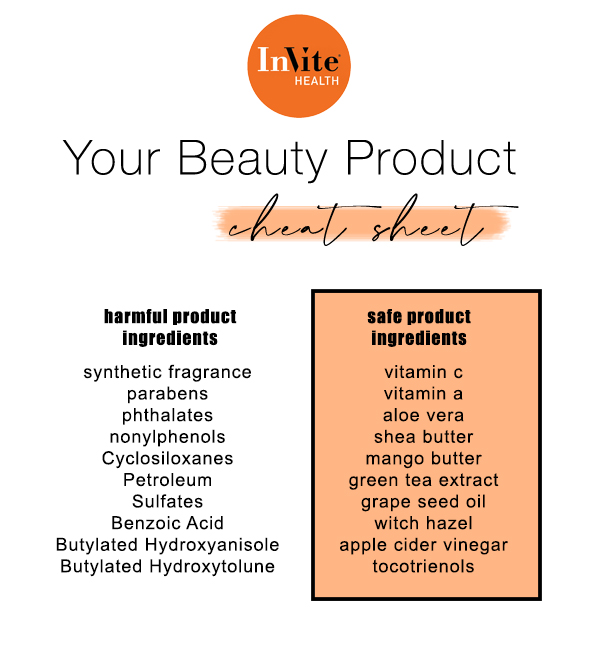 Breast Detoxification
Now, what can you do to help detoxify your breasts? Eat cabbage vegetables! Make sure you cook them or they will slow down your thyroid gland and consuming them 4 or 5 times a week is helpful. Cabbage vegetables contain an ingredient called glucobrassicin that helps protect women’s breasts, ovaries, uterus, cervix, and vulva. Glucobrassicin is one of the ingredients that gives vegetables such as broccoli or kale their strong flavor. When you chew the vegetable, an enzyme in the plant breaks glucobrassicin down into a phytochemical called Indole-3-Carbinol or I-3-C as it’s commonly known, but that’s not the end of the story. The good bacteria in your intestines then stack the I-3-C into various lengths one of them being DIM, which stands for diindolylmethane and this is a strong protector of female organs.
Research shows that both I-3-C and DIM fight viruses in the herpes family and also viruses in the wart family. As you may know some wart viruses, notably HPV-16 and HPV-18 are strong risks for cervical cancer and also vulvar and vaginal cancers and penile cancer in men (ouch). I-3-C and DIM have been shown to help fight these viruses but for the breasts they have additional benefits.
Your total exposure to estrogen over your lifespan is a risk for breast cancer. When your body finishes using estrogen, especially the powerful one called estradiol, it sends it off to your liver which detoxifies it so you can remove it totally from your body. Unfortunately, this doesn’t work as well as intended and other dangerous estrogens are formed from the estradiol. I-3-C and Dim cause the liver to convert used estradiol into a more protective form associated with a lower risk of breast cancer. So cabbage vegetables supply an ingredient that helps detoxify estrogen.
Healthy bacteria, such as those supplied in some, but not all Probiotic supplements have a direct influence on breast health. Bacteria in the Lactobacillus family, the strains Lactobacillus rhamnosus and Lactobacillus plantarum, are two of the dominant strains in breast milk; we know they belong there. When you supplement with these strains, they grow in number in your intestines, a process called colonization. During the first week of supplementation they hitch a ride on your immune cells and migrate throughout your body, many winding up in the milk ducts of your breasts and this is very-very good. They break down chemical estrogens, so called bad bacteria cannot achieve this, and they remove these chemicals from your’ breasts. They also inhibit bad bacteria from inflaming your breasts. Inflammation is another process related to cancer. These bacteria also work on the ingredients in the cabbage vegetables mentioned previously, the I-3-C and DIM that when formed protect the breasts and cervix.
Additionally, flax seeds are protective. They contain an ingredient called a lignan. The good bacteria in your intestines work on these lignans to create the compounds associated with a lowered risk of breast cancer.
Just to review, cabbage vegetables and flax seed contain ingredients that when metabolized by good species of bacteria in your intestines are breast protective. Also, certain strains of Lactobacilli bacteria, namely Lactobacillus rhamnosus and Lactobacillus plantarum belong in your breasts and are protective and help detoxify them.
Thank you for tuning in to the Invite Health Podcast. You can find all of our episodes for free wherever you listen to podcasts or by visiting www.invitehealth.com/podcast. Make sure you subscribe and leave us a review! Follow us on Facebook, Twitter and Instagram at Invite Health today. We’ll see you next time on another episode of the Invite Health Podcast.