
The InVite® Difference: Superfoods
It can be difficult to incorporate healthy foods into your diet, so we have designed superfoods to include into your nutritional routine.
Nutrition. Vitamins. You.
It can be difficult to incorporate healthy foods into your diet, so we have designed superfoods to include into your nutritional routine.
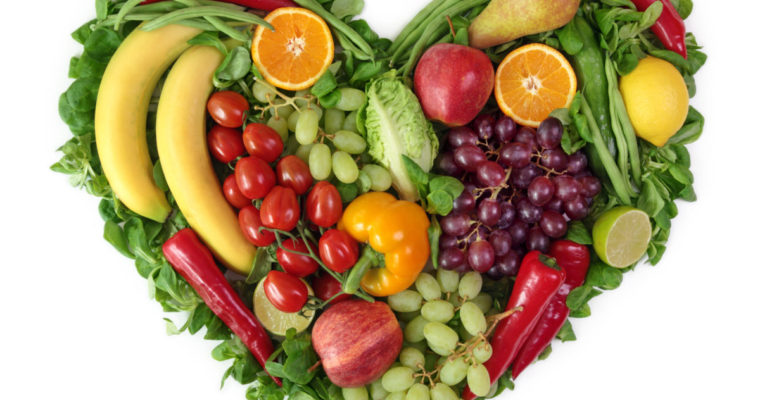
It is easy to eat your way to high cholesterol levels. But it may also be easy to lower LDL-cholesterol by changing the foods that you eat.

Researchers have labeled the presence of excess body fat that poses a danger to your health as ‘overfat’. This excess body fat, especially in the abdominal region, is commonly associated with an increased risk of chronic diseases, morbidity, mortality and reduced quality of life.
A recent article, published in the journal Frontiers in Public Health, suggests it to be even more prevalent in English speaking countries, like the United States and New Zealand; up to 90% of adult males and 50% of children may suffer from being ‘overfat’. In these countries, 80% of women fall into this category.
Earlier this year researchers Philip Maffetone, Ivan Rivera-Dominguez and Paul B. Laursen reported to the same journal that up to 76% of the world’s population may be ‘overfat’. This epidemic can be linked to the recent rise in the incidence of abdominal adiposity (the unhealthiest form of excess body fat) in both adults and children. This can negatively impact the body’s insulin-resistance (converting and storing carbohydrate foods as fat).
The common method of determining the amount of fat in the body has been to step on a scale or to calculate your BMI (Body Mass Index). Researchers thought this ineffective and, instead, measured waistlines (at the level of the belly button) and compared it to the height. The waist measure, according to the study, should be less than half a person’s height.
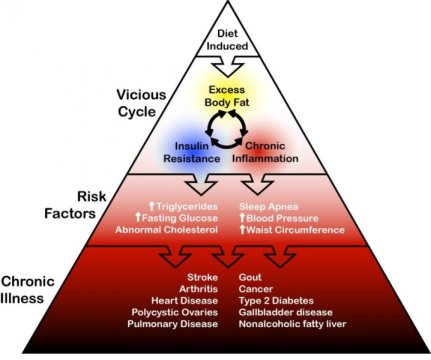
“Rather than thinking of these disorders as separate, individual clinical problems, it might be best to consider the relationships between overfat, its various risks, and its associated downstream diseases as a spectrum or progression where the vicious cycle of overfat, insulin resistance and chronic inflammation lies at one end, (constituting the population with early measurable abnormality), while the presence of chronic conditions resides at the other end.”
Going on a diet and consistently monitoring what you eat are two different methods. The first – a diet – is a short-term method to eating healthy. The other – constantly monitoring what you eat – is a long-term, lifestyle change. In order to monitor your dietary intake, record your food intake, count calories, cut calories, and avoid going longer than 4-5 hours between healthy meals.
Physical activity is a must for weight loss and management. Thirty minutes of moderate-intensity aerobic activity daily (150 min/week) is recommended to reduce chronic disease risk and 60 minutes of moderate daily activity (300 min/week) is recommended to prevent weight gain in adulthood.
White kidney beans supply a carbohydrate blocker that inhibits the enzyme amylase from breaking starches down into sugar; absorbing less sugar from foods such as bread, potato, pasta or rice helps reduce your intake of calories.
Probiotics are live bacteria that support the activity of the body’s healthy bacterial population. They help burn calories by releasing the appetite-reducing hormone GLP-18. They decrease body fat by increasing levels of the protein ANGPTL4. Probiotics can also reduce inflammation and may improve gut health. A meta-analysis of 17 randomized clinical trials in humans indicates that probiotics help treat obesity.
CLA (Conjugated linoleic acid) made from safflower oil helps reduce body fat by inhibiting the activity of the enzyme lipoprotein lipase which normally would transfer fats from the bloodstream into fat cells. CLA also promotes carnitine palmitoyltransferase, which helps burn fat, improving energy. A meta-analysis of 18 randomized, double-blind, placebo-controlled clinical trials (the gold-standard of clinical trials) concluded that taking 3.2g/d of CLA effectively reduces body fat in humans.
New research suggests that iron may have a protective effect against heart disease, which could pave the way for new treatments in the future. What is Heart Disease? Cardiovascular Disease (CVD), known as heart disease, is related to Atherosclerosis, a condition that develops when plaque …

Many of us rely on a caffeinated cup of coffee or tea at the start of our day to get ourselves going and provide that boost of energy we all need. Caffeine is commonly used to increase wakefulness and improve concentration and focus. But how …
A new study by researchers at Rush University Medical Center in Chicago shows has developed a diet plan, called the MIND diet, that may reduce the risk of developing Alzheimer’s disease by as much as 53 percent. Even those who didn’t stick to the diet perfectly but followed it “moderately well” reduced their risk of Alzheimer’s by about a third.
Nutritional epidemiologist Martha Clare Morris, PhD, the lead author of the MIND diet study, says diet, genetics and other factors like smoking, exercise and education play a role. But the MIND diet helped slow the rate of cognitive decline and protect against >Alzheimer’s regardless of other risk factors.
The study, published in the journal Alzheimer’s & Dementia, reviewed data from more than 900 people between the ages of 58 and 98 who filled out food questionnaires and underwent repeated neurological testing. It found participants whose diets most closely followed the MIND recommendations had a level of cognitive function the equivalent of a person 7.5 years younger.
This diet combines many elements of two other popular nutrition plans which have been proven to benefit heart health: the Mediterranean diet and the DASH (Dietary Approaches to Stop Hypertension) diet. MIND stands for Mediterranean-DASH Intervention for Neurodegenerative Delay.
But the MIND diet also differs from those plans in a few significant ways and proved more effective than either of them at reducing the risk of Alzheimer’s. The MIND diet recommends frequent servings of green leafy vegetables. Kale, spinach, broccoli, collards and other greens are packed with vitamins A and C and other nutrients. At least two servings a week can help, and researchers found six or more servings a week provide the greatest brain benefits.
The Mediterranean and DASH diets do not specifically recommend these types of vegetables, but the MIND diet study found that including greens in addition to other veggies made a difference in reducing the risk of Alzheimer’s.
Like other diets focused on weight loss and heart health, the MIND diet emphasizes the importance of vegetables for brain health. The researchers recommend eating a salad and at least one other vegetable every day to reduce the risk of Alzheimer’s.
Even “modest adherence” to the MIND diet measurably reduced a person’s chances of developing Alzheimer’s disease, and the longer you stick with it, the greater the benefits. “People who eat this diet consistently over the years get the best protection,” said lead author Martha Clare Morris. “You’ll be healthier if you’ve been doing the right thing for a long time.”
“Additionally, exercise, getting enough sleep, and challenging the brain with math and learning, or doing crossword puzzles is important for maintaining memory. So is treating depression. Engaging in social interaction is important; spend time with friends and if you don’t have enough maybe consider introducing yourself to some neighbors. I would add real cocoa, organic green tea, and mushrooms to the list of desirable foods along with the culinary herbs rosemary, cinnamon (in moderation), turmeric, and oregano. I would also have fish more than once a week; two or three times seems more like it.”