Recent Posts

New Study: GABA Ingredient May Help You Fall Asleep Faster

New Study: GABA Ingredient May Help You Fall Asleep Faster

Gamma-amino butyric acid (GABA) is a chemical messenger, a neurotransmitter, naturally found in the human brain and eyes. Its main function is to reduce the activity level of neurons, which, a new study says, may boost sleep – helping individuals to fall asleep faster. The 

The Benefits of Coffee on National Coffee Day

The Benefits of Coffee on National Coffee Day

Other than water, tea and coffee are the most consumed beverages in the world. It may seem like a cat and mouse game when it comes to studies on coffee; one week a study is published about how bad coffee is for your body and 

Hispanic Heritage Month: Health Spotlight

Hispanic Heritage Month: Health Spotlight

Hispanic Heritage Month, the 30-day period between September 15 and October 15, was created under President Lyndon Johnson to celebrate the histories, cultures, and contributions of American citizens whose ancestors came from Spain, Mexico, the Caribbean, and Central and South America. Celebrating ancestry is so important for people originally from different countries, so this day is very special to many people. Throughout 1930-1940, many people in America and their other territories took a national census that revealed details about their address and job roles. This could be useful information for Americans currently trying to work out their family’s history. Perhaps that could help more people to understand their heritage, maybe some people would be celebrating this Hispanic Heritage Month if they knew more about their ancestors. According to the Library of Congress’ National Hispanic Heritage Month’s website, “The day of September 15 is significant because it is the anniversary of independence for the Latin American Countries Costa Rica, El Salvador, Guatemala, Honduras and Nicaragua. In addition, Mexico and Chile celebrate their independence day on September 16 and 18, respectively.”

During Hispanic Heritage Month, museums and communities throughout the United States come together to celebrate the nations rich cultural Hispanic and Latino heritage through performances, lectures and many family activities. Check out how the Smithsonian is celebrating and how you can get involved by clicking here!

In honor of Hispanic Heritage Month, InVite® Health brings you important health information that affects Hispanics and Latinos in the United States. Here’s what you need to know –

Hispanic & Latino Health in the U.S.

According to the Centers for Disease Control and Prevention (CDC), Hispanics or Latinos are the largest racial/ethnic minority populations in the U.S. – about 1 in 6 people living in the United States are Hispanic. By 2035, this could nearly be 1 in 4 people. But Hispanic and Latino health is a major concern in the United States.

The Hispanic Access Foundation, is a non-profit organization that improves the lives of Hispanics in the U.S. and promotes civic engagement by “educating, motivating and helping them access trustworthy support systems.” Their website states, “Poor health outcomes, unfortunately, are a common reality in the Hispanic community. From a lack of insurance and access to healthcare to high-risk environments, there is a significant need to educate Hispanics on health issues and increase their access to healthcare services.”

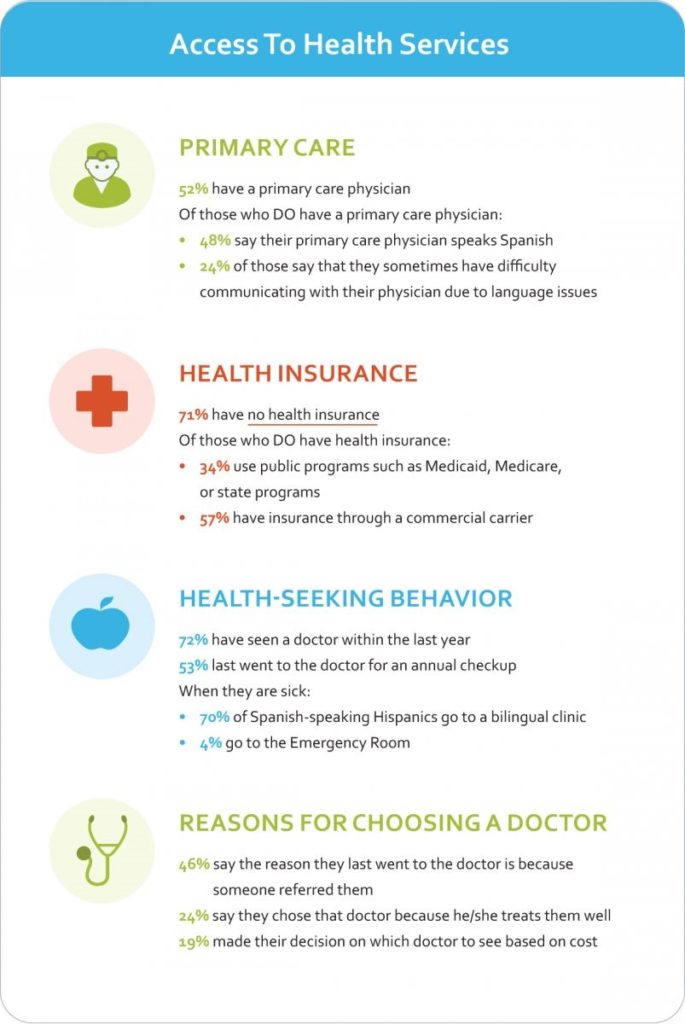
A study performed by the foundation in 2012 found that Spanish-speaking immigrants in communities in Washington and Colorado found that “many people did not have a primary care physician, many were uninsured, and many more reported difficulties communicating with their primary care physician due to language barriers.”

aaaa

* https://hispanicaccess.org/sites/default/files/images/AccessToHealth_R1_0.jpg


Leading Causes of Death for Hispanics

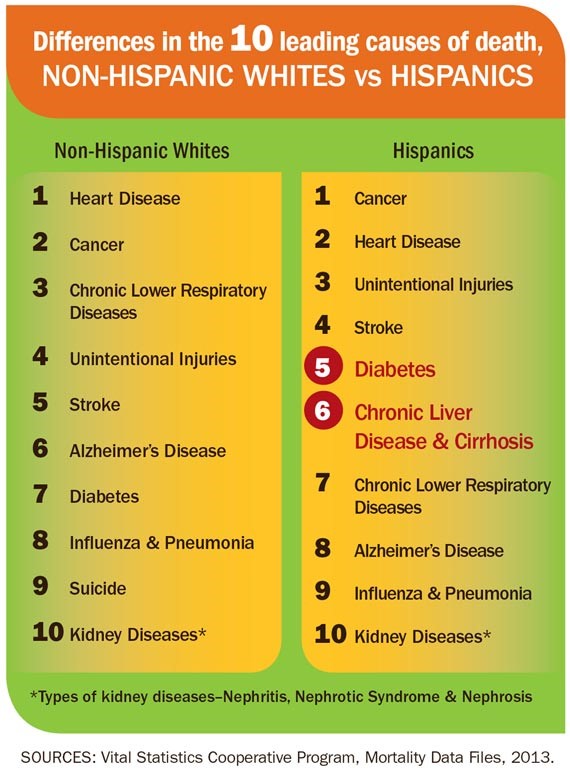
According to the CDC, the Hispanic death rate is 24% lower than whites, but Hispanics are about 50% more likely to die from diabetes or liver disease than whites (“non-Hispanic” whites). Hispanics and Latinos have a higher degree of illness or health risks than whites – 24% more poorly controlled high blood pressure and 23% more obesity.

The top 6 leading causes of death in Hispanics, according to the Vital Statistics Cooperative Program, are –

  1. Cancer
  2. Heart Disease
  3. Unintentional Injuries
  4. Stroke
  5. Diabetes
  6. Chronic Liver Disease & Cirrhosis (a condition where the liver does not function properly due to long-term damage)

sdfsfsf

How can we help lower these numbers?

There are plenty of things that can be done in Hispanic communities to lower the risks of developing these diseases and conditions.

  1. Know your family history. If you have a family history of heart disease or diabetes, visit both a physician and nutritionist to be sure you are doing everything you can to steer clear of developing these conditions.
  2. Know and understand your current medical standing.
  3. If you have one of these conditions or diseases, be sure to keep up with your treatment.
  4. Leverage community health services. The U.S. Department of Health and Human Services (HHS) “recognize the important contributions of promotores in reaching vulnerable, low-income and underserved members of Latino/Hispanic populations and promote increased engagement to support health education and prevention.”
  5. Bring health into your home. Teach your family the importance of nutrition and leading a healthy life by including them in making home cooked meals and encouraging outdoor activities. Check out these “fotonovelas”, a type of comic book that are common in Spanish-language cultures made to promote health and health education for Hispanic audiences.

For more information on how you can get your health back on track, visit www.invite.nyc today!

InVite® Health Current Sale

Meet InVite’s Six Newest Experts!

Meet InVite’s Six Newest Experts!

The InVite® Health team includes dedicated and highly certified experts – Nutritionists, Naturopathic Doctors and Pharmacists – who are always available to guide you on your journey to your best health. Every InVite® Health retail store has a nutrition specialist and expert available to assist 

New Study: Early Exposure to Mercury Blocks Effects of Exercise on the Brain

New Study: Early Exposure to Mercury Blocks Effects of Exercise on the Brain

According to new research funded by the National Institute of Environmental Health Sciences (NIEHS), part of the National Institutes of Health, cognitive function improves with aerobic exercise, but not for people exposed to high levels of mercury before birth. This is one of the first 

New Study: Exercise May Reduce Cancer Risk Brought on by Alcohol

New Study: Exercise May Reduce Cancer Risk Brought on by Alcohol

According to the CDC, nearly 90 percent of Americans report drinking alcohol during their lifetimes, and more than half of adults say they have consumed alcohol in the past month. However, more than half of American adults also do not exercise. A new study suggests exercising regularly (moderately or vigorously) may offset some of the potentially lethal health effects of regular alcohol consumption.

Senior author Emmanuel Stamatakis, an associate professor of exercise, health and physical activity at the University of Sydney in Australia reports, “Alcohol is the most commonly consumed psychotropic drug that, in contrast to most other drugs, is socially and culturally acceptable. Alcohol consumption is high, and there are no signs that this will change. We need to find ways to reduce some of the health risks associated with drinking.”

The Study

Researchers confirmed an increased risk of death from alcohol-related cancers, as well as death from all causes among those who drank more than just occasionally, compared to people who never drank. But regular exercise seemed to diminish or eliminate the risks completely.

The researchers analyzed data from 36,000 men and women over the age of 40 who took part in an annual Health Survey for England or the Scottish Health Survey in the 1990s and 2000s. Participants were separated into six categories –

  1. Never consumed alcohol
  2. Ex-drinker
  3. Occasional drinker
  4. Drinks more than occasionally but within current guidelines
      (U.S. standard drinks per week for women and 12 U.S. standard drinks per week for men)
  5. Hazardous drinking
  6. Harmful drinking

Researchers also recorded weekly exercise using METS, a measure of energy expended. According to the study, an average of 7.5 MET-hours per week roughly translates to a little over two hours of brisk walking at 3 miles per hour.

shutterstock_106893341The Results

Researchers found that people drinking within the guidelines and getting little to no exercise were 16% more likely than people who never drank to die of any cause during the course of the study and 47% more likely to die of cancer. Those in the “hazardous” category “had similar risks as those within the guidelines”. Those in the “harmful” category carried a 58% higher risk of death from all causes and an 87% higher risk of death from cancer.

At 7.5 MET-hours per week (regular exercise), individuals drinking within the guidelines had about the same risk of all-cause mortality as those who never drank and 11% higher risk of cancer death. “Hazardous” drinkers had 18 percent higher risk of all-cause mortality and 9% higher risk of cancer death.

Those who logged 15 MET-hours per week (vigorous exercise) that drank within guidelines had a 10% to 20% lower risk of death, compared to the “never-drinkers” and even “harmful” drinkers that had about the same risk of death from cancer as the “never-drinkers” and just 13% higher risk of all-cause mortality.

It is important to note that at all levels of exercise, “harmful” drinking still carried significantly elevated death risks.

Benefits of Exercise

“There are few things that make humans look better, feel better, be more productive, and live a longer and better quality of life,” Stamatakis said. “For people who don’t do any physical activity, starting with a 10 minute walk every week and building to 30 minutes per day is a great first step.”

Richard Walker, MD, says, “Now, what about exercise, where is it? Good question! It’s essentially non- existent in most of our life styles. Why? Because we’re too busy doing everything else then we try to “fit it” into the daily schedule. Fitting exercise into your life style will never work. There’s never going to be any room for exercise because its not a “part” of your lifestyle. Here’s the difference: being a part of your life is the same as your car, your family, your job or your bed being part of your life. They just are and everything you decide revolves around it or them. You don’t have to figure out how you’re going to fit them in, they’re already in! Similarly, one must do the same with exercise.

Tips for Weight Loss and Exercise

“None of the answers are available in one pill, one product, one method, or one anything for everyone. The answer lies in understanding what’s happening to your body and your world. We’ll develop this model of help systematically –

  1. Make a Decision – You must make a decision if you really want to do something about your weight. If you’re not really committed to work on it, then don’t! You’ll get even more frustrated, spend more money, and get more frustrated because it’s not working. You’ll then quit, eat more comfort foods, and gain even more weight.
  2. Get Help Now – you need to find a professional who will tell you the truth. Then you should be prepared to attack each issue causing your problem.
  3. Exercise – Assuming that you’ve read this article because you want to lose weight, then you’ve also decided to change your life style. Exercise now becomes an integral part of your life. Your goal should be at least 30 minutes of exercise, 4 days a week. When your weight begins to decrease and you get to a plateau – don’t quit. The plateau is because your body is making metabolic adjustments.”

Still need more motivation to get you moving? Here are some important studies you should read right now –

Weight loss may strongly benefit patients with atrial fibrillation and exercise leading to fitness is even better.

Exercise May Slow Alzheimer’s

Source: http://www.reuters.com/article/us-health-fitness-cancer-risks-idUSKCN11M1PW

InVite® Health Current Sale