Recent Posts

Mushroom Hx

Mushroom Hx

Mushroom Hx Dr. Claire Arcidiacono, ND   Omelets, risotto and even salads are all places you might find mushrooms. But did you know mushrooms are also an amazing supplement for our immune system? There are so many different types of mushrooms that sometimes it can …

PROTEINS~WHAT ARE THEY?

PROTEINS~WHAT ARE THEY?

PROTEINS~WHAT ARE THEY? By: Allie Might, FMC, INHC, ATT   While we all know protein, do we really know how much we need on a daily basis? It’s also something we all like as there seems to be endless choices. There is also no wrong …

The Common Cold!

The Common Cold!

The Common Cold!

Dr. Claire Arcidiacono, ND


Today we will be talking about something everyone knows about and that topic is the common cold! Having a cold is probably one thing that both children and adults understand. But what cause’s a cold? Well when you have a cold you are actually suffering from a virus, in most cases it is a Rhinovirus. When we talk about upper respiratory infections the common cold is an example of what we mean. How do we catch a cold? Well the virus enters our body through the eyes, nose and mouth. Like most viruses it travels on droplets in the air that are released when someone coughs, sneezes or even just talks!  When someone who is sick touches an object or even shakes your hand the virus gets on that object. If you touch it and then touch your eyes, mouth or nose BAM the virus can infect you too!

Exposure is probably one of the largest risk factors for getting a cold.  It is one of the reasons why people are encouraged to stay home if they are sick. Having a weakened immune system is also a risk factor. Having a history of smoking or being exposed to 2nd hand smoke also increases your risk of getting a cold. Infants and young children are also at a higher risk of catching a cold.

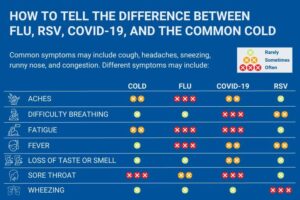
What are the symptoms of a cold? While I know most people can probably list these all by heart I just want to do a quick reminder of what they are.  Usually in 1-3 days after exposure to the virus symptoms can start and they can include runny/stuffy nose, sneezing, sore/ scratchy throat, cough, low grade fever, headache and even just plain old “I don’t feel good”. (1) Unfortunately the common cold isn’t the only virus that can cause these symptoms. I’ve included a chart that compares them! (2)

Now while most people recover from a cold within a few days – a week there can be complications that occur. These can include sinus or ear infections. There may also be acute bronchitis. If you have asthma or emphysema or chronic bronchitis the symptoms can get worse. You may develop a cough that lingers after infections. (3)

While most people with a cold don’t need to see a doctor sometimes it’s necessary. For children up to 12 weeks if there is a fever of 100.4 degrees it’s a good idea to see their doctor. In older children if there is a rising fever or fever lasting more than 2 days, if there is any trouble with breathing, wheezing, ear pain, or just intense symptoms as well as unusual  fatigue or fuzziness it can also be a good idea to see their doctor. Lastly if there is a change in appetite it’s important to see their doctor. In adults it’s a good ideas to see a doctor if there is a fever over 101.3 degrees that lasts more than 3 days, if the fever returns after being gone or there is shortness of breath, wheezing or the symptoms unusually severe. (1) If there is a high fever in either children or adults it may be a good idea to see your doctor. (3)

When it comes to a cold prevention is key! And that starts with 1 simple word- hygiene! Wash your hands and clean frequently touched surfaces. Cover your mouth and nose when you sneezes or cough. If your sick stay home! Don’t share glasses or eating utensils. If you can stay away from those that are sick. (1) It is also helpful to make sure that your environment is not too dry so that your sinus don’t dry out which would leave you at risk for a cold. (3) It’s always a good ideas to help boost our immunity. In that case what can we do to boost our immunity?

  • Tea: One of my favorite things to do for a sore throat is to make a tea with lemon, honey and turmeric with ginger. To make this simply add 1 or 2 tablespoons of lemon juice, 1 or 2 tablespoons of honey and the contents of 2 capsules of Turmeric with Ginger to herbal tea. Please see Invite’s Turmeric with Ginger!
  • Olive Leaf Extract has been found in studies to be antiviral. (4) This means that it kills the virus that causes infections such as the common cold. Please see Invite’s Olive Leaf Extract and Renalaid.
  • NAC is another great choice! As I have said in my prior blogs one of the benefits of NAC is that it can help to thin the mucus that often is associated with colds. (5) Please see Invite’s NAC, Daily Detox and Detox Hx
  • Black Seed has been found to help with symptoms such as runny nose, itchy nose and rhinitis. (6) Please see Invite’s Black Seed with Rosemary and Cordyceps formula. Also for more information on Black Seed see my blog on this exciting supplement!
  • For more information on immune boosting supplements that I always recommend during cold season please check on my blogs on Beta Immunity and Immunity Hx.
  • Next week we will be talking about Mushroom Hx

Sources:

  1. https://www.mayoclinic.org/diseases-conditions/common-cold/symptoms-causes/syc-20351605
  2. https://www.nfid.org/resource/how-to-tell-the-difference-between-flu-rsv-covid-19-and-the-common-cold/
  3. https://www.lung.org/lung-health-diseases/lung-disease-lookup/facts-about-the-common-cold
  4. https://www.ncbi.nlm.nih.gov/pmc/articles/PMC9953111/#B4-biomolecules-13-00238
  5. https://clinicaltrials.ucsf.edu/trial/NCT03822637#:~:text=Historically%2C%20studies%20of%20mucolytics%2C%20like,those%20with%20significant%20mucus%20impaction.
  6. https://www.sciencedirect.com/science/article/abs/pii/S0196070910001407


GRAINS~MORE THAN CARBS

GRAINS~MORE THAN CARBS

GRAINS~MORE THAN CARBS By: Allie Might, FMC, INHC, ATT   Who doesn’t love the grain group? Its most commonly associated with carbohydrates (carbs). However, are they really that bad for us and are they truly necessary? Let’s explore this simple, delicious, versatile and often scary …

Boost your Immune Health with Beta Immunity

Boost your Immune Health with Beta Immunity

Boost your Immune Health with Beta Immunity Dr. Claire Arcidiacono, ND   Today I want to talk about a supplement that is great for those times when you’re fighting off a cold or other upper respiratory infection. That supplement is Beta Immunity! Beta Immunity is …

DAIRY~THE OPTIONS AND BENEFITS

DAIRY~THE OPTIONS AND BENEFITS

DAIRY~THE OPTIONS AND BENEFITS

By: Allie Might, FMC, INHC, ATT


Dairy is that food group that seems to be one of the easiest to consume and the most indulgent. This group is commonly associated with calcium and strong bones. It has a wide variety of choices but just how much do we need each day? Are we exceeding the recommended amount?

The USDA recommends that adults have three cups of dairy per day. This can be achieved in many ways. For instance, a cup of milk or fortified soy milk or a cup of plain yogurt is an easy way to start your day off with some dairy. Cheese is probably most people’s favorite way to add dairy into their diet as it’s the most diverse and delicious…it’s also easy to overindulge on cheese. You can have anything from a comforting cottage cheese to soft cheeses like ricotta or feta to hard cheeses such as cheddar, Parmesan or Swiss.

While dairy is a main source of calcium, it also supplies important nutrients such as, but not limited to, vitamins A, D and B’s, and minerals like phosphorus and potassium. Dairy is also a source of protein, making it a nice snack or addition to a light meal.

As we are getting our daily recommendation if dairy, how much calcium should we have per day? According to the Mayo Clinic, it is recommended that adults get 1,000-1,200mg of calcium per day. This is important for healthy bones and can be obtained from a combination of consuming dairy as well as adding in a calcium supplement.

BONE POWDER: This is comprehensive formula that is in powder form. Taking one scoop a day supplies calcium, magnesium, vitamins D and K, silica and boron. It can be mixed into water or plain yogurt, and can even be taken along with a Collagen Hx powder.

CALPLEX: This formula is a combination of calcium, vitamin D, phosphorus and boron. This unique formula supplies the bones with vital minerals in an easy to take tablet. This is a good option for anyone that doesn’t want to take extra-large tablets or prefers to take magnesium separately.

CALCIUM/MAGNESIUM: This is the classic calcium supplement that most this of when looking to add calcium to their vitamin regimen. It has a 2:1 ratio of calcium and magnesium so taking four of these a day helps to get in the extra nutrients for the bones in a simple way.


TROPICAL BONE PARFAIT

1 cup Plain Greek Yogurt

1 scoop Bone Powder

½ cup Rolled Oats

1 Tablespoon Chopped Almonds

1 Tablespoon Unsweetened Coconut Flakes

Pinch of Sea Salt

Combine Greek yogurt and Bone Powder in a bowl until completely mixed together. In a separate bowl, combine oats, chopped almonds, coconut flakes, sea salt and toss together (reserve a teaspoon of this mixture on the side). In a glass or jar, start with a third of the yogurt on the bottom of the jar. On top of the yogurt, layer in half of the oat mixture. Add half the remaining yogurt on top of the oats, then the rest of the oats on the yogurt. Finally, add the rest of the yogurt and garnish with the teaspoon of oats that were set aside. Enjoy as a light and healthy breakfast.


www.myplate.gov/eat-healthy/dairy

www.health.clevelandclinic.org/calcium-rich-foods

www.hsph.harvard.edu/nutritionsource/dairy/

www.mayoclinic.org/healthy-lifestyle/nutrition-and-healthy-eating/in-depth/calcium-supplements/art-20047097

www.health.clevelandclinic.org/is-milk-good-for-you