Recent Posts

FRUITS~NATURE’S TREAT

FRUITS~NATURE’S TREAT

FRUITS~NATURE’S TREAT By: Allie Might, FMC, INHC, ATT   Fruit is one of those groups that we all know and love. In my experience, it’s always that food that most people don’t seem to have problems getting into their daily diet. However, let’s explore this 

Understanding the Complexity of Asthma

Understanding the Complexity of Asthma

Understanding the Complexity of Asthma Dr. Claire Arcidiacono, ND   As I mentioned in my prior blog today I will be talking about a well-known respiratory condition. That condition is Asthma. Let’s take the time to go over just how common it is, shall we? 

MY PLATE~OUR DIET GUIDELINE AND FOUNDATION FOR HEALTH

MY PLATE~OUR DIET GUIDELINE AND FOUNDATION FOR HEALTH

MY PLATE~OUR DIET GUIDELINE AND FOUNDATION FOR HEALTH

By: Allie Might, FMC, INHC, ATT


March is National Nutrition Month so I thought it would be the perfect opportunity to go back to basics. We all remember when we were growing up and learning about the food pyramid in school. It taught us about the different kinds of foods and how much to eat. Let’s now return to that simpler time and discuss MyPlate.

Every so often, the USDA (United Stated Department of Agriculture) re-evaluates and makes updates or modifications to the food pyramid. This happened a few years ago and they released MyPlate. This show use what is recommended we eat for a healthy diet. While there are guidelines specifically for such things like vegan, vegetarian or even heart hearth, let’s just focus on the traditional and basic MyPlate for this discussion.
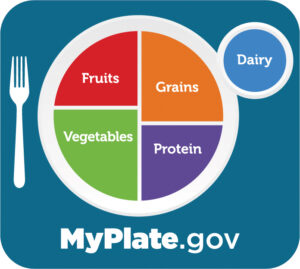
 

MyPlate features the five basic food groups, which include vegetables, fruits, proteins, grains and dairy. They’ve sectioned out a plate to show us what they recommend for a health balanced diet.  For example, you’ll see on the image above how it’s recommended that have of your daily intake should consist of fruits and vegetables, with more vegetables than fruit. Keep in mind that these are basic guidelines and may be adjusted depending on one’s specific needs, like vegan diets or if someone is diabetic.

You’ll notice a few groups are missing from MyPlate. These are such things like fats, sugar and even water. While these are important dietary topics, they aren’t considered food groups, and MyPlate concentrates on the five basic food groups. These sub-groups (as I like to call them) are definitely important, and we will discuss them more in depth this month.

Something I do want to add to this is discussion on healthy dietary guidelines to the addition of a multivitamin. These can help enhance the good eating habits we establish for ourselves based on the My Plate recommendations. But which is best? Let’s look at the options.

DAILY MULTIVITAMIN with GRAPE SEED EXTRACT: This is a very basic and easy to take multivitamin. Due to only needing to take one a day, I like to recommend this for anyone new to multivitamins or teens who are just needing a little extra nutrients throughout the day.

MULTI ENERGY POWDER: This is a multivitamin that is very easy to take, as it comes in a powder and just needs to be mixed into water. I like this for any adult, particularly those who just don’t want or like to take too many pills.

CORE MULTIVITAMIN: This is the classic, comprehensive multivitamin. It is made up of a wide variety of essential vitamins, minerals and antioxidants. It’s a great all around choice for any adult.

CORE MEMORY MULTIVITAMIN: This is a new formula that is for those individuals looking for a good multivitamin as well as support for healthy brain and memory function. This is the classic Core Multivitamin with Choline, Ginkgo Leaf Powder and Lithium (as Lithium orotate) added.

MEN’S MULTIVITAMIN: This is a multivitamin specifically made for the needs of men in mind. It is the Core Multivitamin with Maca, Quercetin, Black Cumin Seed and Beta-Sitosterol added. I like to recommend this for men over the age of 40 to help support their specific needs like prostate health and healthy libido.

PERFORMANCE MULTIVITAMIN: This multivitamin was designed for those individuals that lead an active lifestyle or are looking to help support their energy levels. The Performance starts with the Core Multivitamin and adds Rhodiola Rosea Root and Superoxide Dismutase (SOD) to help with energy and endurance. I like this for adults that need a little extra pick-me-up to get through the day.

WOMEN’S MULTIVITAMIN:  This multivitamin was made for the unique needs of women. The Core Multivitamin came together with Iron, Collagen Hydrolysate, Purple Corn Flower and Diindolymethane (DIM) to not only supply vitamins, minerals and antioxidants, but to also address healthy iron levels, immune system connective and breast tissues. I like to recommend this for any women still experiencing menses.

As you can see, the foundation of a healthy diet starts with our meals as outlined by MyPlate and then can be enhanced by the right multivitamin. I look forward to getting in depth all month long discussing each food group and “sub-group”. We’ll be seeing how much we need of each and compare the best choices versus what to watch out for. A perfect way to begin spring!


www.myplate.gov

www.myplate.gov/eat-healthy/what-is-myplate

www.hsph.harvard.edu/nutritionsource/multivitamin/



Immunity Hx: The Super Immune Supplement

Immunity Hx: The Super Immune Supplement

Immunity Hx Dr. Claire Arcidiacono, ND   I wanted to do my product highlight on what I consider to be the cornerstone of immune heath. In fact Immune is in its very name, Immunity Hx! Immunity Hx is a combination of vitamin C, vitamin D3 

BEETS: THE FORGOTTEN VEGETABLE

BEETS: THE FORGOTTEN VEGETABLE

BEETS: THE FORGOTTEN VEGETABLE By: Allie Might, FMC, INHC, ATT   Beets are so incredibly versatile, delicious and incredibly under used in the day to day diet. They come in a wide variety of colors and sweetness and can be prepared in a number of 

RSV- Respiratory Syncytial Virus

RSV- Respiratory Syncytial Virus

RSV- Respiratory Syncytial Virus

Dr. Claire Arcidiacono, ND


I wanted to begin our series on respiratory health by talking about something that has been all over the news lately. And that is RSV. But what exactly is RSV? RSV stands for Respiratory Syncytial Virus. This is a virus that infects the lungs and respiratory tract. While RSV in adults and older children tends to be mild in younger infants and older adults RSV can cause severe infection and complications.

The symptoms of RSV usually resemble cold like symptoms. These can include sneezing, congested or runny nose as well as a cough. There may be a sore throat. There may also be headaches. If there is a fever it will be what is considered to be a low grade fever. In some cases RSV may also cause more severe symptoms. These symptoms can include a higher fever, more severe cough, wheezing, shortness of breath and a blue tinting to the skin. Infants may also experience lethargy, irritability and poor feeding.  Infants may indicate trouble breathing when their chest muscles and skin pull inward with each breath. For those who experience more severe symptoms the disease can spread throughout the respirator tract leading to pneumonia and bronchiolitis. I would also like to say that RSV can lower our immune system leading to an increased risk of developing COVID-19.  It’s very important to remember that if you or your child has difficulty breathing, a high fever or blue skin it is time so seek immediate medical attention.

I have said numerous times that for many people RSV causes mild symptoms. In more vulnerable individuals there can be more severe symptoms. For children 12 months and younger there is an increased risk of complications. Premature infants are also at a higher risk for more severe disease. Older adults (65+) are also at a risk for more severe disease. Anyone with any type of heart or lung disease are also at an increased risk of complications. For those with compromised immune systems there is a risk of severe symptoms and complications.  (1) Pregnant women are also considered to be a high risk group. Children with neuromuscular disorders are considered to be a risk for sever disease. Children of American Indian and Alaska native descent are also at risk for more sever disease. (2)

How do we catch RSV? Well as it says in the name it is a virus and spreads like any other virus. It enters our body via eyes, nose or mouth. It can travel on infected respiratory droplets or in other words if someone coughs or sneezes next to you it can travel on those droplets to get to you. The virus can also survive on hard objects for hours. For example if someone sneezes on a table top and you touch it then you touch your eyes, mouth or nose you can get infected. An infected person is most contagious for the 1st week after getting infected.  However an infected person can still be contagious and still spread the virus for up to 4 weeks after the symptoms stop. RSV season tends to be from fall to the end of spring. (1)

What are some of the most common complications of RSV? Severe complications can include bronchiolitis, pneumonia, bronchitis and even respiratory failure. RSV may worse existing conditions such as asthma, congestive heart failure or COPD and there may be hypoxia or even a notable decrease in oxygen levels. RSV can cause dehydration. There is also an increased risk of developing ear infections. In the US every year RSV leads to between 100-300 deaths in children under 5. It also leads to between 6,000-10,000 deaths in adults 65+. (3)

What can we do to help decrease the spread of RSV? The 1st step is to wash our hands and avoid touching our eyes, nose and mouth.  Clean frequently touched surfaces. Cover your mouth and nose whenever you sneeze or cough. Be considerate and stay home when you are sick. Lastly avoid close contact with anyone who is sick. (2) What supplements can help to boost our immune system? Well let’s review those, shall we?

  • NAC is one of those supplements that have many benefits! Studies have found that NAC is very helpful at reducing/ thinning mucus. Studies have also found that NAC can help fight off both viruses and bacteria. Additionally studies have found that NAC can help to regulate our immune response. (4) All of these benefits are reasons why NAC is one of my favorite things to recommend at this time of year. Please see Invite’s NAC as well as our Detox Hx and Daily Detox Powder!
  • Olive Leaf is another supplement that really does more than you could think 1 tiny supplement could do! Now if you read my series on heart health you would have seen me mention olive leaf for the heart. But studies have also found that Olive Leaf is antimicrobial (helps to kill viruses and bad bacteria, basically the “bad guys). Olive Leaf has also been found to help boost our immune system. (5) As someone who comes into contact with so many different people every day whether it be at work or on the subway I always take Olive Leaf. Please see Invite’s Olive Leaf Extract as well as our Renalaid powder!
  • Nucleotides have been found to help boost our immune system. (6) This is important during this time of year because it helps our body to naturally fight off the viruses that we come into contact with. Please see Invite’s Nucleotides
  • Probiotics are another type of supplement that come up over and over again! Studies have found that probiotics can help to boost our immune system. (7) Please see Invite’s extensive line of probiotics
  • But wait what about vitamin C, D or Zinc? Well our product highlight will be the product that contains all 3 of these important nutrients. That is Immunity Hx!


Sources:

  1. https://www.mayoclinic.org/diseases-conditions/respiratory-syncytial-virus/symptoms-causes/syc-20353098
  2. https://www.cdc.gov/rsv/high-risk/infants-young-children.html
  3. https://my.clevelandclinic.org/health/diseases/rsv-respiratory-syncytial-virus
  4. https://www.ncbi.nlm.nih.gov/pmc/articles/PMC8234027/
  5. https://www.ncbi.nlm.nih.gov/pmc/articles/PMC4227229/
  6. https://pubmed.ncbi.nlm.nih.gov/10569229/
  7. https://www.ncbi.nlm.nih.gov/pmc/articles/PMC9818925/