Tag: inflammation

From A Naturopaths Point of View Part 3

From A Naturopaths Point of View Part 3

From A Naturopaths Point of View Part 3 Dr. Claire Arcidiacono, ND   Self-diagnosis? One of the most integral parts of a consult with an Invite nutritionist t is knowing exactly what is going on in your body. In other words it’s important to see 

Mucositis

Mucositis

Mucositis Dr. Claire Arcidiacono, ND   Cancer treatment can affect our digestion. One common side effect is called mucositis.  What is mucositis you ask? Basically it is inflammation of your mouth and digestive system. (1)  This occurs because cancer therapies are designed to attack any 

Neuropathy

Neuropathy

Neuropathy

Dr. Claire Arcidiacono, ND


Neuropathy is usually something that most people associate with diabetes. This is an accurate connection because one of the most common causes of neuropathy is diabetes. But did you know that neuropathy can also occur after cancer treatments? To start off this topic I’ll ask a simple question, what is neuropathy? Well neuropathy, or as some call it peripheral neuropathy is basically a condition where the peripheral nerves or in other words the nerves outside of the brain and spinal cord become damaged. This is very common in our hands and feet. (1)

The symptoms you can experience if you have neuropathy can include numbness or tingling in your feet, hands, legs or even arms. You may also feel as if you are wearing gloves or socks when you’re not. You may have sharp, jabbing pain that may even occur during activities that don’t normally cause pain. As the neuropathy progresses’ you may notice an increase in sensitivity to touch. There may also be muscle weakness and a lack of coordination. If your motor nerves are affected you may have an inability to move. You may notice an intolerance to heat. You may experience either excess sweating or an ability to sweat at all. There may also be a drop in blood pressure. You may also have bowel, bladder or digestive problems. (1) Lastly you may notice cramps in your feet. (2)

It’s important to see a doctor if you notice the symptoms of neuropathy starting to develop. When you see the doctor they will do a full medical history and a neurological exam. The doctor may also order certain blood tests, imaging tests and even nerve function tests. The doctor may also perform a nerve and skin biopsy. (3)

Neuropathy can lead to a loss of sensation. This means you may not feel if something is too hot to touch. As a result you may have complications such as burns. As a result of the loss of sensation you may end up with skin injuries or deeper wounds especially on the feet. Because of the lack of feeling in your feet you may not notice any injuries which increases the risk of developing an infection. (1) If an infection is left untreated it can lead to complications such as the need for an amputation. (4)  Lastly neuropathy often leads to a lack of balance which can lead to an increase in your fall risk. (1)

What can you do to help with the symptoms of neuropathy? Well as I said in my blog on chemo brain it is often best to wait till after treatment is complete to start supplements. This is to avoid any potential interactions. However life style changes can be implemented at any time.

  • Drink plenty of water. The typical amount recommended is ½ your body weight in oz. So if you weigh 120 pounds drink 60 oz of water. Additionally it is important to get plenty of healthy fruits and vegetables! (2) Check out Invite’s Greens Hx and Organic Greens. Remember there are no bad vegetables. Whatever kind you like is the best kind. I also want to point out that many stores will have sales on frozen vegetables which are just as nutrient dense as fresh. I know my parents love to stock up on frozen vegetables and even frozen berries especially when they are not in season!
  • Treat any underlying conditions that increase your risk of neuropathy. For example if you have diabetes it is important to maintain control of your blood sugar. (2) Please check out my blog series on this topic.
  • Be careful when using sharp objects such as knives. (2)
  • Monitor your extremities for injuries and wear protective gear as well as use any assistive devices and proper lights. (2)
  • ALA has been found in studies to be helpful in reducing pain associated with neuropathy when used as part of a treatment protocol. (5) Please see Invite’s Alcar+ALA and our Alpha-Lipoic Acid
  • B1 has been found to help with the symptoms of neuropathy especially in the beginning stages. (6) Please see Invite’s Nerve Hx and our B Complex 100.
  • B12 has been found to help with the pain associated with neuropathy. B12 deficiency is also known to make neuropathy worse. (7) Personally I always recommend B12 for anyone who has neuropathy. Please see Invite’s B12 lozenges as well as our Methyl-B
  • Magnesium according to the Foundation for Peripheral Neuropathy can help with the signs of neuropathy that are associated with chemotherapy use.(8) Please see Magnesium Glycinate, Citrate and Bio Avail Magnesium powder!
  • Turmeric has been found to be very helpful in reducing the pain associated with neuropathy. (9) Please see Invite’s Bio-Curcumin & 5- Loxin formula!


Our product highlight will be our Methyl-B formula!


Sources:

  1. https://www.mayoclinic.org/diseases-conditions/peripheral-neuropathy/symptoms-causes/syc-20352061
  2. https://www.cancer.org/cancer/managing-cancer/side-effects/pain/peripheral-neuropathy.html
  3. https://www.mayoclinic.org/diseases-conditions/peripheral-neuropathy/diagnosis-treatment/drc-20352067
  4. https://stoppingmedicalmistakes.com/how-an-infection-could-lead-to-amputation-oregon-medical-malpractice-lawyer-explains-sepsis/
  5. https://www.ncbi.nlm.nih.gov/pmc/articles/PMC9264721/#sec-a.m.ctitle
  6. https://www.sciencedirect.com/topics/neuroscience/benfotiamine
  7. https://pubmed.ncbi.nlm.nih.gov/32722436/
  8. https://foxintegratedhealthcare.com/neuropathy/8-great-vitamins-for-neuropathy/#:~:text=4.,nuts%2C%20avocados%2C%20and%20legumes.
  9. https://www.ncbi.nlm.nih.gov/pmc/articles/PMC8125634/#sec8-ijms-22-04666title

Cerebral Care

Cerebral Care

Cerebral Care Dr. Claire Arcidiacono, ND   I wanted to take the time to talk about one of my favorite formulas for our memory and brain health. This formula is called Cerebral Care. But what is it about this formula that I like so much? 

The Wonders of Black Seed

The Wonders of Black Seed

The Wonders of Black Seed Dr. Claire Arcidiacono, ND   I am very excited to start this conversation on black seed. Black Seed is an amazing nutrient for our respiratory system. Invite health has a unique formula which includes Black Seed, Cordyceps and Rosemary Extract. 

Understanding the Complexity of Asthma

Understanding the Complexity of Asthma

Understanding the Complexity of Asthma

Dr. Claire Arcidiacono, ND


As I mentioned in my prior blog today I will be talking about a well-known respiratory condition. That condition is Asthma. Let’s take the time to go over just how common it is, shall we? Approximately 7.7% of Americans have asthma. That amounts to about 24.9 million Americans. Of those approximately 20.2 million are adults and 4.6 million are children. Asthma appears to be more prevalent in females. (1)

But what exactly is asthma? When you have asthma your airways become swollen and the pathway for air to travel comes narrow. There may be extra mucus in the airway. As you can probably guess this narrowing of the air passageway can make breathing difficult. Please see the attached picture for a side by side comparisons between a normal airway and in inflamed asthmatic airway. (2)
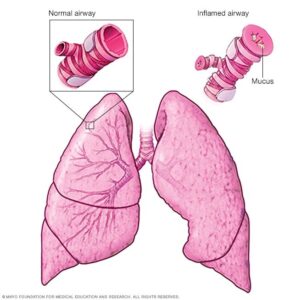
While symptoms of asthma can vary from person to person there are some common symptoms you can experience.  These include shortness of breath, wheezing when exhaling and coughing/ wheezing attacks that can be made worse when you have a virus. Other symptoms can include chest tightness or pain. There may be trouble sleeping due to shortness of breath and coughing. Symptoms of asthma may flare up due to exercise, occupational irritants and by allergens such as pollen or pet dander. I would also like to point out that while some people have symptoms only under certain conditions such as during physical exercise others will have symptoms all the time. (2)

While the cause of asthma is unknown we do know what the most common risk factors for asthma include.  One major risk factor for developing asthma is a family history. Having a family history of asthma can make up to 6X more susceptible to asthma. Children and adults that are overweight or obese are also at an increased risk for asthma. People who have a history of smoking or were exposed to 2nd hand smoke are also at risk.  Certain allergies such as eczema and hay fever seem to be risk factors for developing asthma. Certain viral infections can increase the risk of asthma. Both air pollution as well as work place exposers are risk factors as well. (3)  Asthma symptoms may be triggered by cold air. Certain medications such as beta blockers and aspirin may trigger asthma symptoms. Gastroesophageal reflux (GERD) may also trigger asthma symptoms. Strong emotions, stress and even being in the cold can all trigger asthma symptoms. Even certain preservatives may trigger asthma symptoms. (1)

While some people may not consider asthma to be “series” I want to emphasize that yes asthma can have some series complications. In fact each year more than 3,500 people die from asthma. And in fact approximately 60% of adults and 44$ of children with asthma have poor control over their illness. (1) Complications from asthma can also include a permanent narrowing of the bronchial tubes which can affect how you breathe. Flare-ups can also lead to missed school or work and even interfere with activities of daily living such as sleep. There may also be side effects from long term use of medications used to treat asthma. Lastly asthma can lead to fatigue and even poor mental health. (4)

Asthma is treatable. While it is important to follow your doctors treatment plan there are things you can do to help improve your respiratory health.

  • Elimination diets are a great way to determine if something you are eating is making your asthma flare up. It is well known that certain preservatives can trigger asthma. By doing an elimination diet you eliminate these preservatives and thus can determine if doing so helps your control over your asthma. (5)
  • NAC is one of those supplements that comes up quite frequently. Studies have found that NAC is potentially anti-asthmatic. (6) In other words NAC is found to help stabilize the lungs when you have asthma. NAC has also been helpful in reducing mucus formation which as I mentioned in asthma there may be excess mucus. (7)  Please see Invite’s NAC and our Detox Hx as well as the Daily Detox Powder!
  • Quercetin has been found in studies to be protective against asthma symptoms. It has also been found to help protect against airway fibrosis. (8) Please see Invite’s Quercetin formula!
  • Magnesium! I bet you’re saying magnesium again Dr. Claire? Well magnesium is going to pop up a lot in my different blog series. It’s just one of those things that seems to do everything. Magnesium has been found in studies to help reduce symptoms of asthma and even help to improve lung volume.  Interestingly enough those with more severe symptoms appeared to benefit the most. (9) Please see Invite’s extensive line of magnesium products!
  • Vitamin D has been shown in studies to help reduce asthma symptoms! (10) Please See Invite’s Immunity Hx (this was the product highlight I did not long ago!) as well as Invite’s extensive line of Vitamin D!
  • Black Seed will be the next product highlight! Look for that blog soon!

Sources:

  1. https://acaai.org/asthma/asthma-101/facts-stats/
  2. https://www.mayoclinic.org/diseases-conditions/asthma/symptoms-causes/syc-20369653
  3. https://www.lung.org/lung-health-diseases/lung-disease-lookup/asthma/learn-about-asthma/what-causes-asthma
  4. https://www.healthdirect.gov.au/asthma
  5. https://www.webmd.com/asthma/food-allergies-and-asthma
  6. https://bjbas.springeropen.com/articles/10.1186/s43088-021-00188-7#:~:text=Conclusions,eosinophil%20infiltration%2C%20and%20oxidative%20stress.
  7. https://clinicaltrials.ucsf.edu/trial/NCT03822637#:~:text=Historically%2C%20studies%20of%20mucolytics%2C%20like,those%20with%20significant%20mucus%20impaction.
  8. https://karger.com/pha/article-abstract/108/5/432/853230/Quercetin-Alleviates-Asthma-Induced-Airway?redirectedFrom=fulltext
  9. https://www.ncbi.nlm.nih.gov/pmc/articles/PMC9543098/#:~:text=in%201990%20studied%20the%20bronchodilating,signs%20and%20symptoms%20%5B7%5D.
  10. https://www.ncbi.nlm.nih.gov/pmc/articles/PMC8389855/