Tag: depression

Can Omega-3 Fatty Acids Help with Pandemic-Related Depression? – InVite Health Podcast, Episode 372

Can Omega-3 Fatty Acids Help with Pandemic-Related Depression? – InVite Health Podcast, Episode 372

The events of the COVID-19 pandemic have caused more people to experience issues with depression and anxiety. Learn about how omega-3 fatty acids can help with these issues from Amanda Williams, MPH.

How to Manage Stress As You Return to School – Invite Health Podcast, Episode 166

How to Manage Stress As You Return to School – Invite Health Podcast, Episode 166

On top of living through a global pandemic, students and employees are heading back to school and work. This could mean a time of chronic stress is upon us. But you should know about Phosphatidylserine – a powerful brain health nutrient for learning and memory.

How SAMe Can Help Against Depression – Invite Health Podcast, Episode 153

How SAMe Can Help Against Depression – Invite Health Podcast, Episode 153

Invite Health Podcast, Episode hosted by Jerry Hickey. Ph

Subscribe Today!

Apple PodcastsGoogle PodcastsiHeartRadioSpotify

SAMe, or S-Adenomethionine, is a compound that we naturally make in the human body. Our highest concentrations are in our liver and our brain. SAMe has been shown to help maintain a stable mood and to support joint and liver health. But this compound has also been studied for its benefit against depression. Depression effects about 15 million Americans each year. The annual cost for treatment is about $50 billion.

What is SAMe’s role in the body?

This compound does a bunch of things in the human brain. It has an anti-inflammatory effect because it raises the level of a very key antioxidant called Glutathione. Glutathione levels vary from person to person and they drop with age. It breaks down peroxides which is important for the brain. Your brain is a super, high-energy organ. There is a great deal of circulation needed, in order to carry all of the calories from your food to your brain so you can use that for energy. In fact, is it thought that your brain takes 20%  of all of the calorie content from each meal! Yet, your brain is only 2% of the dry weight of your body. As a byproduct of using sugar for energy, the cell releasing peroxide. This can damage and destroy the cell, so the body has to have ways to find the peroxide, which is where Glutathione comes into play.†

SAMe has to be enteric coated (an additional coating) in order to get past the stomach acids and the intestinal enzymes, which can deactivate and breakdown SAMe.

Besides this nutrient helping to restore antioxidant levels in the brain, it also creates neurotransmitters. We know of about 100 neurotransmitters in the brain. Some are needed for energy, others are needed for sleep and the immune system. SAMe is involved with four key neurotransmitters†:

  1. Serotonin
  2. Melatonin
  3. Dopamine
  4. Norepinephrine

Clinical Research on SAMe

An arm of the government that is within the Department of Health and Human Services is called The Agency for Healthcare Research And Quality. Their job is to collate evidence so that different organizations and agencies can base clinical guidelines off of them. When it came to SAMe and depression, researchers compiled 28 human clinical trials in their meta-analysis. In all 28 trials, SAMe worked; it improved the Hamilton Rating Scale for depression (a questionnaire that helps doctors judge how severe depression is and how to guide them regarding treatment).

invite health podcast offer

The Department of Psychiatry at the University of Pennsylvania School of Medicine, The Department of Psychiatry at New York Medical College, Baylor Research Institute in Dallas, The Department of Psychiatry Michigan State University, Browne University Department of Psychiatry, The Department of Psychiatry UCLA, Columbia University Medical Center and Harvard Medical School in Boston published a review of SAMe for clinicians in the Journal of Clinical Psychiatry. The review included 115 human clinical trials and found promising evidence of the efficacy and safety of SAMe, when used as mono-therapy (used with an anti-depressant).

Published in the American Journal of Psychiatry from the Center for Treatment Resistant Depression from Massachusetts General Hospital and Harvard Medical School. Researchers added SAMe to the SSRI drugs of 73 patients who had major depressive disorder. They found that if they added SAMe to the drug (in patients where the drug was not working), the drugs started to work. It was far superior to placebo.

Questions about SAMe for Depression? Leave a comment below to join the discussion!

Thank you for tuning in to the Invite Health Podcast. You can find all of our episodes for free wherever you listen to podcasts or by visiting www.invitehealth.com/podcast. Make sure you subscribe and leave us a review! Follow us on Facebook, Twitter and Instagram at Invite Health today. We’ll see you next time on another episode of the Invite Health Podcast.

invite health podcast disclaimer

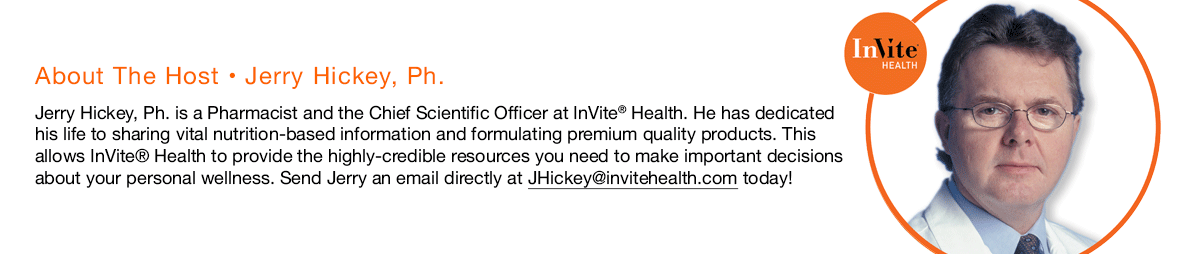
jerry hickey invite health podcast

5-HTP for Depression, Anxiety & Stress – Invite Health Podcast, Episode 86

5-HTP for Depression, Anxiety & Stress – Invite Health Podcast, Episode 86

5-HTP easily enters your brain and is quickly converted into serotonin. Serotonin is known as the ‘happiness molecule’ and is a very important neurotransmitter. This is why 5-HTP has been studied for its benefit for mood and overall brain health.

Study: Too Much Sugar During The Holiday Season May Lead to Depression

Study: Too Much Sugar During The Holiday Season May Lead to Depression

A new study suggests that eating added sugars can actually trigger metabolic, inflammatory and neurobiological processes tied to depressive illness. Here’s what that means for you during the holiday season, when so many foods are centered around sugar.

New Study: Resveratrol Opens Door for Treatments for Depression & Anxiety

New Study: Resveratrol Opens Door for Treatments for Depression & Anxiety

Photo by Suzana Sousa on Unsplash

A new study published in the journal Neuropharmacology from Xuzhou Medical University in China has revealed that the plant compound resveratrol, which is found in red wine or obtained by supplementation, displays anti-stress effects by blocking the expression of an enzyme related to the control of stress in the brain.

What is Resveratrol?

If you are interested in anti-aging (and who isn’t?), you’ve probably heard of the benefits of Reservatrol. You have heard of how it is derived from grapes, how it occurs naturally in wine, and how it is a natural polyphenolic compound that is well known for its phytoestrogenic and antioxidant properties. Resveratrol is one of the first supplements that drew a significant amount of attention from the scientific and medical communities throughout the world. As a matter of fact, it has been researched extensively for its many health benefits. To date, there have been over 4,000 human studies with Resveratrol.

Interested in learning about Resveratrol’s Impact on Longevity? Click here to read more >>

Resveratrol is an important antioxidant that targets free radicals and limits the impact of oxidative stress on our cells. Because of this, studies on this plant compound have concluded that it may help to support metabolism, improve lean body mass and support healthy aging.

Resveratrol and Extreme Stress

According to the study’s researchers, while research has identified resveratrol to have antidepressant effects, the compounds relationship to stress was unknown, specifically an enzyme that is influenced by the stress hormone corticosterone called phosphodiesterase 4 (PDE4). “Corticosterone regulates the body’s response to stress. Too much stress, however, can lead to excessive amounts of the hormone circulating in the brain and, ultimately, the development of depression or other mental disorders,” explain researchers.

This Plant Compound May Also Be A Safety Net for Your Heart! Click here to read more >>

In a study on mice, researchers revealed that the enzyme PDE4, induced by excessive amounts of corticosterone, causes depression and anxiety-like behavior. The enzyme lowers levels of a molecule that signals the body of physiological changes which can lead to physical alterations in the brain.

Researchers conclude that Resveratrol displayed neuroprotective effects against corticosterone by inhibiting the expression of PDE4.

Source

Xia Zhu, Wenhua Li, Yongkun Li, Wenhua Xu, Yirong Yuan, Victor Zheng, Hanting Zhang, James M. O’Donnell, Ying Xu, Xiaoxing Yin. The antidepressant- and anxiolytic-like effects of resveratrol: Involvement of phosphodiesterase-4D inhibition. Neuropharmacology, 2019; 153: 20 DOI: 10.1016/j.neuropharm.2019.04.022

Interested in speaking with a certified healthcare professional? Leave us a comment below to get started and join the conversation!

INVITE® HEALTH CURRENT SALE