Dry Eye
Dr. Claire Arcidiacono, ND
Are your eyes stinging, burning or red? You might have something called dry eye! Now I bet the first thing you’re going to say is but Dr. Claire I drink water all day! How can I have dry eye? While on the surface dry eye may seem like its just related to our water intake the truth is that it’s actually more complicated than that. Basically when you have dry eye your tears don’t provide adequate lubrication which can lead to inflammation and even damage to our eyes. (1)
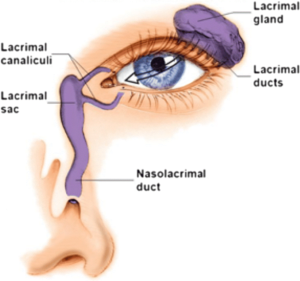
Tears are made up of 3 parts. These include mucus, water and a lipid portion. (2) This combination is what keeps our eyes lubricated. Problems with any 1 of these layers can cause dry eye. So normally the tear gland or lacrimal gland supplies the tears that are wiped across your eyes when you blink. The excess then drains into your nose via the tear duct or nasolacrimal duct. () I know this sounds complicated so I’ve attached a picture so you can get a visual on what it looks like! (3)
What kind of symptoms can you expect when you have dry eye? You may notice that your eyes are red and there may be mucus in or around your eyes. You may feel like there’s something in your eyes. Additionally there may be a stinging, burning or scratchy feeling. You may notice that your vision is becoming blurry and you may experience eye fatigue. You may develop a sensitivity to light as well as difficult with driving in low light. If you wear contacts they be difficult to wear. Lastly as a response to the dry, irritated eyes you may develop watery eyes. (1) Some people with dry eye describe it as a burning, achy, even “gritty” feeling in their eyes. (4)
How do you know if it’s dry eye? The best thing is to see your eye doctor for a definitive answer. First they will do a comprehensive eye exam. Then they may do a test to measure the volume of your tears. They can also check the quality of tears as well as how much water there is in your tears. Lastly they can check your tear samples to ask for markers of dry eye disease. (1) Who knew tears could be so complicated?
Now what exactly are the risk factors for dry eye? Anything that can decrease tear production can lead to dry eye. Certain eye disease as well as certain chronic diseases can decrease tear production. These can include allergies, graft vs. host disease, Lupus, RA, Sarcoidosis, Scleroderma, Sjogrens, thyroid disorders and even vitamin A deficiency! Even certain medications can decrease our tear production. These common medications can include anti-histamines, decongestants, blood pressure medications, Parkinson’s medications and hormone replacement drugs. Even birth control can increase risk of dry eye. Similarly hormone changes that occur during pregnancy or during menopause can increase dry eye risk, which means that women are at a higher risk in general for dry eye. Something called corneal nerve de-sensitivity can increase risk. Lastly as we age there can be a decrease in tear production, and this decrease becomes more common after age 50. (1)
In addition to lower tear production anything that increases tear evaporation can lead to dry eye. Once again a vitamin A deficiency is a risk. Being in a place that in windy, smoky or even dry can increase evaporation. Having allergies is a risk. Certain eye diseases such as posterior blepharitis, ectropion, and entropion increase risk. Lastly blinking less often such as when you’re focused or if you have certain conditions such as Parkinson’s. Lastly you are more likely to have dry eye if you wear contacts or have a history of refractive surgery. (1)
Now a series question – can dry eye have complications? Yes it can. Tears protect our eyes. One of the things they protect us from is infection. They also protect us from damage to our eyes. Without the correct amount of tears you are at risk for infections, damage to the eye which can lead to corneal ulcers and even vision loss. Dry eyes can even decrease the quality of life as it can make certain activities of daily living difficult. (1)
What can you do if you have dry eye?
- Well it’s important to use any eye drops or medications your doctor may proscribe. Your doctor may recommend an eye plug or even surgery.
- Use a humidifier and avoid smoky, windy places as well as places with strong AC.
- Limit your screen time!
- Make sure you are getting plenty of fluids and sleep.(1)
- Omega 3s have been found in studies to help with dry eye. (5, 6) Please see Invite’s Fish Oil and Krill Oil!
- Bilberry, when combined with omega 3 has been found to reduce the signs of dry eye in just 3 months! (6) Please see Invite’s Purples Hx for Bilberry as well as our Macula Advanced!
- Vitamin A has been found to help with the symptoms of dry eye. (7) Please see Invite’s Macula Advanced as well as our extensive line of multivitamins!
- B12 supplementation has been found to help with the symptoms of dry eye. (8) Please see Invite’s B12 Lozenges as well as our Methyl-B formula.
- Our next blog will be investigating how Invite powders can be helpful for our eye health!
Sources
- https://www.mayoclinic.org/diseases-conditions/dry-eyes/symptoms-causes/syc-20371863
- https://clevelandeyeclinic.com/2022/10/05/three-types-of-tears/
- https://www.google.com/imgres?imgurl=https%3A%2F%2Fwww.researchgate.net%2Fpublication%2F330235361%2Ffigure%2Ffig1%2FAS%3A962139279863809%401606403288317%2FStructures-involved-in-tear-production-CopyrightR-The-McGraw-Hill-Companies-Inc.png&tbnid=Y7LiaYmFrLql5M&vet=1&imgrefurl=https%3A%2F%2Fwww.researchgate.net%2Ffigure%2FStructures-involved-in-tear-production-CopyrightR-The-McGraw-Hill-Companies-Inc_fig1_330235361&docid=5T55ySrA0DFnBM&w=850&h=797&hl=en-us&source=sh%2Fx%2Fim%2Fm4%2F7&kgs=e8ca78ffed881c86&shem=abme%2Ctrie
- https://www.xiidra.com/chronic-dry-eye/
- https://www.ncbi.nlm.nih.gov/pmc/articles/PMC4165511/#sec-a.m.etitle
- https://www.ncbi.nlm.nih.gov/pmc/articles/PMC9892183/#S5title
- https://www.ncbi.nlm.nih.gov/pmc/articles/PMC6462169/
- https://pubmed.ncbi.nlm.nih.gov/26266431/