Why Melatonin Is Important During COVID-19 – InVite Health Podcast, Episode 209
Is it important to use Melatonin during the COVID-19 infection? The indication is yes. It is really important for the immune system.
Nutrition. Vitamins. You.
Is it important to use Melatonin during the COVID-19 infection? The indication is yes. It is really important for the immune system.

The blue light from your screen can be extremely damaging for your eyes and overall wellness. Here’s how multivitamins can help.

Invite Health Podcast, Episode hosted by Jerry Hickey. Ph
Subscribe Today!


Vitamin E is a very well-known nutritional supplement. It’s a chain-breaking antioxidant and fatty tissue. Considering that the brain is about 60% fat, it would seem that Vitamin E should be very important for protecting brain health, and that is turning out to be very true.
There are two families of Vitamin E, and it turns out that not all Vitamin E is created equal when it comes to protecting the brain. The original vitamin E that you’re familiar with was first discovered in 1922 by researchers at the University of California. It is an important factor for fertility and its name is derived from Greek words meaning ‘birth’ and ‘to carry’.
What are Tocopherols and Tocotrienols?
There are four members of this family, collectively known as tocopherols. The only form of vitamin E that has an established daily value is alpha-tocopherol, meaning that the government deems this vitamin is needed at a minimum level for good health and to sustain life. In 1964, a whole different family of Vitamin E was discovered and it also has four members. These are known as tocotrienols and research is finding that minimum levels are likely essential for brain health. This brings the number of known variants of Vitamin E up to eight – four tocopherols and four tocotrienols and it seems that you need all four for memory health.
Experiencing Brain Fatigue? L-Tyrosine Can Help! – InVite Health Podcast, Episode 190. Listen Now >>
A very recent study prompted me to record this episode. Researchers in Japan gave elderly adults with memory loss a combination of a carotenoid called Astaxanthin and the four tocotrienols. This was a randomized, double-blind, placebo-controlled human clinical trial. It was published in the Journal of Clinical Biochemistry and Nutrition. The researchers found that within three months, the two supplements improved memory across a range of activities and was extremely safe to take.†
For more information about astaxanthin and other carotenoids, tune into the full podcast episode.

You only need tiny amounts of tocotrienols. In fact, a very interesting study done at the Ohio State University Wexner Medical Center looked at animals that spontaneously developed strokes. They gave them tocotrienols in their food and found that the tocotrienols helped limit the amount of damage the strokes caused in their brains. They only had to give the animals tiny amounts; it seemed like nano amounts were enough to protect their brains.†
They did a follow-up study with healthy elderly women and they gave them very small amounts of tocotrienols. They found that the amount of tocotrienol that entered their brain was 12 to 20 times the amount needed to protect their brain from a stroke. The Wexner Medical Center is now doing studies where they are giving tocotrienols to patients who previously had strokes to see if the nutrient will help prevent damage if they have another stroke.†
CLINICAL STUDIES SAY MUSHROOMS PROVIDE BRAIN POWER – INVITE HEALTH PODCAST , EPISODE 168. Listen Now >>
A study from Ohio State University Medical Center published in the Annals of the New York Academy of Sciences in 2004 showed that tocotrienols possess powerful antioxidant properties. All of those things are good for the brain. They found that tocotrienol, especially alpha-tocotrienol, was massively more powerful than regular Vitamin E, even at very tiny servings. It protected the cells of the brain from glutamate toxicity. Glutamate is a neurotransmitter that becomes an excitotoxin when it gets overactive. This means that the brain cells can work themselves to death. The researchers found that even at tiny amounts, the tocotrienols protected the brain tissue from glutamate toxicity, as well as a whole slew of other toxins to the brain. They’re finding that tocotrienols are very powerful as neuroprotective agents and anti-inflammatory agents in the brain, even at very low dosages.†
Tune into the full podcast episode to hear more studies about the power of tocotrienols.
Thank you for tuning in to the Invite Health Podcast. You can find all of our episodes for free wherever you listen to podcasts or by visiting www.invitehealth.com/podcast. Make sure you subscribe and leave us a review! Follow us on Facebook, Twitter and Instagram at Invite Health today. We’ll see you next time on another episode of the Invite Health Podcast.



There have been a slew of scientific research studies looking at the implications of the stress and anxiety in just this month alone.
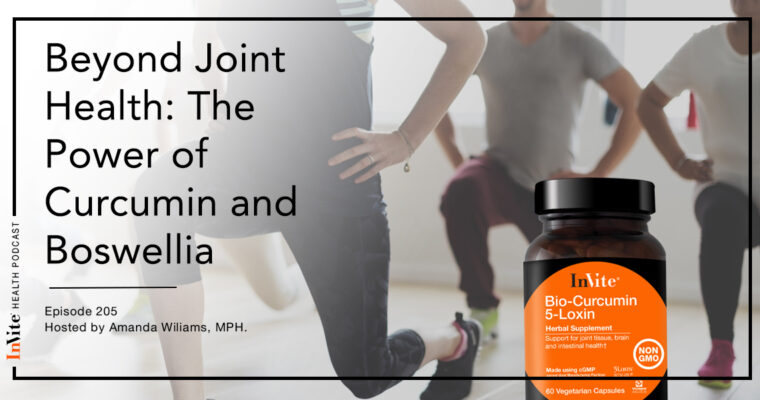
Curcumin is often paired with joint health. But studies have shown, when combined with Boswellia, they also support healthy inflammation.

Invite Health Podcast, Episode hosted by Amanda Williams, MPH
Subscribe Today!
It’s that dreaded time of year again, when the humidity starts to drop and that dry air starts to hit. That can impact so many aspects of our health, when we think about breathing, when we think about our skin. But we also want to think about our hair. For many people, they will experience extensive seasonal hair loss during this time. We transition into fall and into winter, and it is because of that lack of humidity that the hair really starts to suffer. Obviously, we can make things worse by having things such as color-treated hair and using heat on the hair itself via hair drying and using flat irons and curling irons. So what can we be doing to hydrate from the inside out as well as topically that allows for a nourishing effect?
Oftentimes, when people start to lose hair, they start to think that something is wrong internally. And in a sense, we can say yes, we do not have the right nutrients at a high enough amount to support the structural foundation of the hair.
The hair itself contains two different structures. We have the hair follicle itself, so that’s the bulb and that’s the living part that’s underneath the actual scalp. Then, we have the hair shaft, which is the non-living part, and that’s what we actually perceive as the hair. Now, there are many different components to the hair shaft that help to make the hair strong and flexible. We can look at things like keratin, for example, which makes a big impact. When we start to strip away a lot of the humidity, that can impact that keratin, so we have to think about what we should be doing.
It’s Time To Go Clean With Your Hair Care Routine! – InVite Health Podcast, Episode 180. Listen Now >>
What can we be doing from the inside?
We want to make sure that we are focusing in on nutrients that we know have hydrating properties. When we talk about hydrating properties, we want to think about things that are oil-based, both in terms of what we’re eating and in terms of supplementation. We want to talk about things like omega-3 fatty acids, so things like fish oil and flaxseed are always going to be beneficial. Incorporating those fatty fish like salmon into your diet can be very beneficial. We can look at those fat-soluble vitamins, such as tocotrienols, that very powerful form of Vitamin E that not only helps to support with its antioxidant properties, but it also really helps with that nourishment from the inside out, allowing for hydration through the bulb and into the hair shaft.
For more information about supplementation and diet changes that can benefit your hair health, tune into the full podcast episode.
How do outside factors impact our hair?
Hair itself is very porous and we have this fat-coated membrane that prevents the hair itself from a lot of the damage. However, when we have a loss of that fatty layer on the outside of the hair, this is when the hair becomes incredibly prone to more extensive damage. When we talk about the exposure to colorants and the chemicals that are used to dye your hair, when we talk about the high heat exposure from hair dryers, flat irons, and curling irons, this can do a significant amount of damage. Then, we add in the fact that the air itself is very dry during the fall and the winter, so this can allow that hair shaft itself to become very fragile, and it makes it more prone to breaking and splitting. This is really quite problematic.
Natural ways to help your hair
We don’t want to add insult to injury by using products with chemicals, so we want to think about things that come from nature that we know are incredibly nourishing. We think about things like coconut oil and olive oil, which we know allow the hair shaft to experience rehydration. We can look at collagen. This is key. During the fall and winter, we want to make sure that we’re not only using hydrolyzed collagen internally via a supplement, but we also want to topically be able to apply hydrolyzed collagen. It’s the same thing when we look at those tocotrienols. Not only do we want to incorporate the Tocotrienols with Pine Bark Extract orally, but we also want to topically be able to apply those powerful Vitamin E components.
We have this really great formulation, it is our Hair Repair Treatment Mask, and this is a really deep conditioning treatment for dry and damaged hair. We know during the fall and winter, people are more prone to the drying and damage of the hair. We don’t just stop with the hydrolyzed collagen, the tocotrienols, the coconut oil, and the olive oil. We also have shea butter in this, B Vitamins, and wonderful herbal extracts such as rosemary, nettle, sage, and lemongrass oil. All of these things coming from nature that help to support not only the hair shaft, but also deep down and looking at the bulb itself.
There’s also something really cool in the Hair Repair Treatment and that is egg oil. Eggs are an incredibly rich source of all different nutrients that are required for the health of the hair. When we look at all of the wide spectrum of vitamins and minerals that are contained within eggs, this is really important. The egg oil itself allows for this key way to really hydrate the hair.
Tune into the complete podcast episode to learn more about nutrients that can help your hair during the colder months.
Thank you for tuning in to the Invite Health Podcast. You can find all of our episodes for free wherever you listen to podcasts or by visiting www.invitehealth.com/podcast. Make sure you subscribe and leave us a review! Follow us on Facebook, Twitter and Instagram at Invite Health today. We’ll see you next time on another episode of the Invite Health Podcast.