Tag: brain

All About Vitamin B6 – InVite Health Podcast, Episode 328

All About Vitamin B6 – InVite Health Podcast, Episode 328

Vitamin B6 Invite Health Podcast, Episode hosted by Amanda Williams, MPH Subscribe Today! B vitamins play a really important role when it comes to supporting energy levels, metabolism, heart health, brain health and so many more systems that are crucial for the everyday functions of 

Nutrients To Target Restless Leg Syndrome – InVite Health Podcast, Episode 317

Nutrients To Target Restless Leg Syndrome – InVite Health Podcast, Episode 317

Have you ever heard of restless leg syndrome? Amanda Williams, MPH discusses how many people it affects and what nutrients may be beneficial.

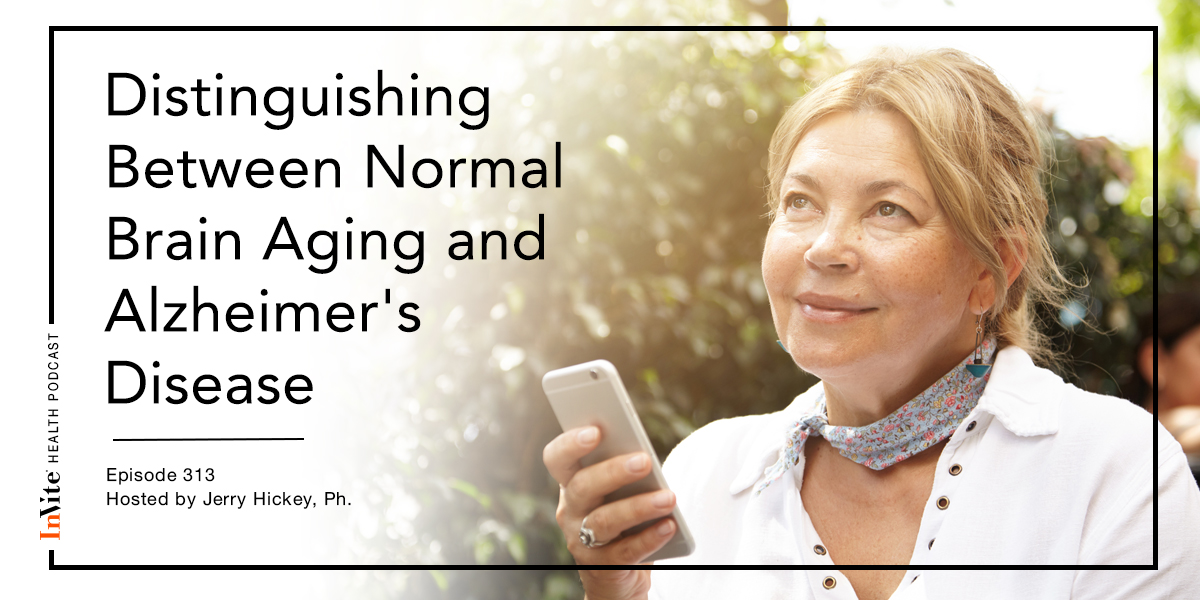
Distinguishing Between Normal Brain Aging and Alzheimer’s Disease – InVite Health Podcast, Episode 313

Distinguishing Between Normal Brain Aging and Alzheimer’s Disease – InVite Health Podcast, Episode 313

brain

Invite Health Podcast, Episode hosted by Jerry Hickey. Ph

Subscribe Today!

Apple PodcastsGoogle PodcastsiHeartRadioSpotify

Many older adults worry about their memory and the other abilities of their brain. For instance, they may find it’s taking longer to learn something new or maybe they’re forgetting to pay their bills once in a while. Well, is this normal forgetfulness or is this something else? This episode is designed to help you identify the difference between Alzheimer’s and normal brain aging.  

Forgetfulness and the aging brain 

Mild forgetfulness and absentmindedness is often a normal part of aging, not a sign of a serious memory problem. Fortunately, on a yearly basis, only a tiny percentage of people with what would be perceived as normal age-related memory loss will convert to dementia. It’s very rare.† 

This Gene Increases The Risk of Alzheimer’s; How to Fight Back – InVite Health Podcast, Episode 301. Listen Now >

A memory lapse for a second is normal and no big deal. Everybody forgets something, especially when we’re distracted or busy. This may happen more often as we get older. Mild memory loss is a normal part of aging and not something to worry about. It doesn’t necessarily mean you’re going to develop dementia. As we age, we can have some “senior moments,” as they call it.† 

When to become concerned about your memory loss

Dementia is not as common as you think it is. If memory loss makes it hard for you to carry out your daily tasks, then you have a sign that shouldn’t be ignored. For instance, are you forgetting something you just heard? A big clue that it’s something worse is asking something over and over again. That’s a big clue that the memory is having a big problem. Relying on a number of notes to get through your day is a clue. If you or your family are noticing these things happening to you, you really need to talk to your doctor.†

Another clue that it’s not just memory loss is if you’re struggling to do things like follow directions on something very familiar to you, like a recipe, or if you can’t keep track of things such as paying the bills like you used to. It could be a warning sign of memory problems.†    

According to the National Institute on Aging, a way to tell the difference between normal brain aging and a serious memory problem is that a serious problem makes it hard to do everyday things like driving and shopping. Signs can include:

  • Asking the same question over and over again
  • Getting lost in familiar places
  • Not being able to follow instructions
  • Becoming confused about time, people and places

If you have problems with your daily typical activities, it could be a sign of a more serious memory issue. It’s normal to forget where you parked your car, especially if you were rushing when you parked or you’re distracted when you’re parking. But if it happens regularly, check with your doctor. That could be a sign of dementia.†

Tune into the full podcast episode for more details on the differences between normal aging in the brain and dementia. 

Enhanced Memory Support with Cognition Hx® – InVite Health Podcast, Episode 293. Listen Now >>

How to help your memory

If your memory is okay but you’re still concerned, you should use your brain. It’s like your muscles. If you don’t use it, then you lose it. Read, learn to play an instrument, sing, solve puzzles and be social. Exercise is great for the brain. It’s great for circulation to your brain, it’s great for brain health and heart health, but it’s also a stress reducer. Stress triggers the release of cortisol, a stress hormone. A little bit of that once in a while is good for the brain, but if you’re chronically stressed and you’re chronically releasing this, it is bad for your brain. A very safe option if you’re stressed is L-theanine, which comes from the green tea plant.† 

For more information about foods and supplements that can help boost your memory and brain health, listen to the full podcast episode. 

Thank you for tuning in to the Invite Health Podcast. You can find all of our episodes for free wherever you listen to podcasts or by visiting www.invitehealth.com/podcast. Make sure you subscribe and leave us a review! Follow us on Facebook, Twitter and Instagram at Invite Health today. We’ll see you next time on another episode of the Invite Health Podcast.


This Gene Increases The Risk of Alzheimer’s; How to Fight Back – InVite Health Podcast, Episode 301

This Gene Increases The Risk of Alzheimer’s; How to Fight Back – InVite Health Podcast, Episode 301

There is a gene called the APOE4 gene that significantly increases your risk of developing Alzheimer’s disease. You inherit these genes, however, a recently released report discusses how you can fight back and minimize your risk.

Enhanced Memory Support with Cognition Hx® – InVite Health Podcast, Episode 293

Enhanced Memory Support with Cognition Hx® – InVite Health Podcast, Episode 293

Have you ever set your keys down and then you can’t remember where you put them or walked into a grocery store and wondered what you went in there for? This could actually be a sign of cognitive decline. The good news is that the ingredients in Cognition Hx has been shown to support memory.

Covid-19 Lingering Effects on the Brain – InVite Health Podcast, Episode 273

Covid-19 Lingering Effects on the Brain – InVite Health Podcast, Episode 273

covid-19

Invite Health Podcast, Episode hosted by Amanda Williams, MPH

Subscribe Today!

Apple PodcastsGoogle PodcastsiHeartRadioSpotify

When we think about the long-term implications of COVID-19, we have to start to think beyond that of the respiratory system. Now that we know more about the coronavirus and the long-lasting impact in terms of symptoms, we have to really focus on what is happening in the central nervous system. I want to focus on that today because there are more and more studies and more and more research coming out that have really indicated that the coronavirus itself is highly affecting our brain. I want to talk about that today and some of the things you can be doing if you yourself are dealing with this or if you have a friend, family member or coworker who is dealing with this.† 

COVID long haulers

I want to talk about the COVID long haulers because I think that this is a really important thing to not overlook. There are more and more people who have been infected with COVID-19 who are experiencing, every single day, these long-lasting and really negative side effects or symptoms from COVID. We want to understand a little bit more about that.†

We know that some people who have had COVID can have chronic respiratory issues such as an ongoing cough or shortness of breath. Researchers at the University of California Davis have been looking at the COVID long haulers and are seeing that there are so many symptoms that people are complaining about well after they have recovered from the initial infection. So many of these symptoms are directly correlated with the central nervous system, including headaches, difficulty sleeping, fatigue and brain fog. Brain fog is one of the biggest complaints that people have been reporting back, as well as being incredibly forgetful and having difficulty focusing and concentrating on basic things that never challenged them before. Researchers are even finding that some people are losing focus or having a hard time concentrating even when they’re watching TV.† 

How to Manage The New Covid-19 Mutations – InVite Health Podcast, Episode 266. Listen Now >>

We have to understand that when we’re dealing with a viral infection, viruses don’t just go away. We can’t actually kill viruses. What we can do is stop the replication process of that virus. That’s what the targeted treatments are. When we think of the residual effects, this is something that we must think about. Some of this may end up being permanent damage, so we certainly don’t want that to become an issue when it comes to our brain.† 

invite health podcast offer

COVID-19 and your senses

When the pandemic first began, experts said that if you lost your sense of smell or the ability to taste, that is the initial clue that you likely have COVID-19. Now they’re starting to realize that there are many people who are having permanent damage done from COVID-19 infections. The long-term loss of smell and taste is something that is becoming more and more prominent. They’re even finding that some patients who initially didn’t have any issues with smell or taste are starting to develop these types of symptoms months later. I think this is an area that we should not completely dismiss or overlook.†   

Let’s take a look at some of the science that has come out looking at the lingering effects. The University of Texas Health Science Center in San Antonio looked at the data showing COVID-19 impact on the brain. This was funded through the Alzheimer’s Association and they published it in the journal Alzheimer’s & Dementia. The researchers wanted to see if there was any scientific evidence to make a case that the novel coronavirus was actually creating these long-term effects on the brain and central nervous system. Through this particular study, they were looking at the loss of smell, the inability to taste, chronic headaches and the way that the brain imaging itself was looking. Researchers have now realized that 86% of patients with mild COVID cases were reporting loss of smell, which is driven from our central nervous system as opposed to our respiratory system.†  

COVID-19 Research Recommends Vitamin D Supplementation – InVite Health Podcast, Episode 251. Listen Now >>

Tune into the podcast episode for more research on the long-term impacts of COVID-19.

How to support your brain during the pandemic

What can we be doing to help support our brains in the midst of the COVID-19 pandemic? This is the big question. First and foremost, we want to make sure that we have ample antioxidants on board every single day to fend off oxidative stress. We want to make sure that we have things like tocotrienols, Vitamin C and omega-3 fatty acids. We want to make sure that we are doing everything in our power to allow proper nourishing within the brain. We also want to think about brain connectivity, which we can support with things such as inositol. We can look at the Mind Synergy formulation, which provides beneficial and powerful nutrients that allow for neuronal connection.† 

Hear more of Amanda’s recommendations by listening to the full podcast episode. 

Thank you for tuning in to the Invite Health Podcast. You can find all of our episodes for free wherever you listen to podcasts or by visiting www.invitehealth.com/podcast. Make sure you subscribe and leave us a review! Follow us on Facebook, Twitter and Instagram at Invite Health today. We’ll see you next time on another episode of the Invite Health Podcast.
invite health podcast disclaimer

amanda williams invite health