Recent Posts

Understanding The Difference Between Vitamin K1 and Vitamin K2 – Invite Health Podcast, Episode 158

Understanding The Difference Between Vitamin K1 and Vitamin K2 – Invite Health Podcast, Episode 158

Oftentimes, many individuals are unaware that there are two forms of Vitamin K – Vitamin K1 and Vitamin K2. On today’s episode, we are going to talk about the difference between these two forms and the science behind how they are utilized by the human body.

The Importance of Vitamin D for Strength and Mobility – Invite Health Podcast, Episode 158

The Importance of Vitamin D for Strength and Mobility – Invite Health Podcast, Episode 158

Can Vitamin D improve strength in younger people and help keep you mobile when you are older? There are numerous studies that say Vitamin D is perfect for supporting strength and mobility.

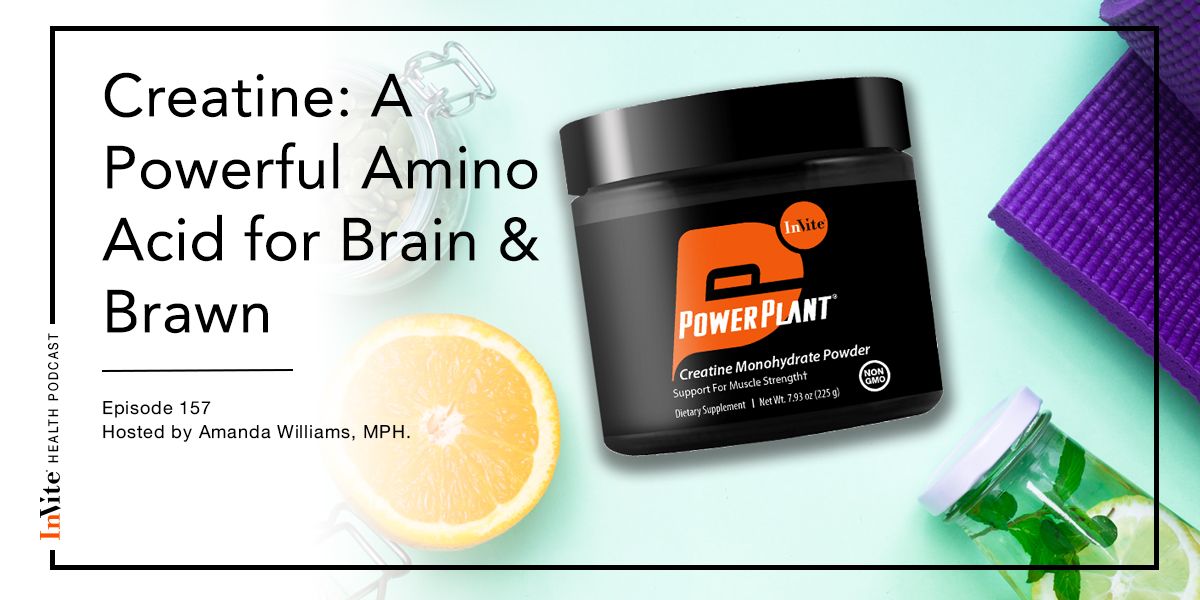
Creatine: A Powerful Amino Acid for Brain & Brawn – Invite Health Podcast, Episode 157

Creatine: A Powerful Amino Acid for Brain & Brawn – Invite Health Podcast, Episode 157

Invite Health Podcast, Episode hosted by Amanda Williams, MPH.

Subscribe Today!

Apple PodcastsGoogle PodcastsiHeartRadioSpotify

The body requires 20 different amino acids in order to function properly. Each one of these individual amino acids play a highly critical role in certain pathways, in certain functionalities of organ systems and our overall wellness. Creatine is one of those amino acids. It is commonly thought of as just a workout supplement, helping to build muscle mass. But on today’s episode, we are going to discuss more of the critical roles that it plays in the human body and some of the science behind it.

What is Creatine?

Creatine happens to be one of those nifty little amino acids that has all of this potential in the human body. You often hear about being using a Creatine Monohydrate supplement to support the building of muscle mass during workouts, pre- or post-workout, especially with energy output and ATP.

The majority of clinical research studies looking at Creatine are in the setting of athletic performance. In the journal of International Sports Nutrition, researchers were studying the effects of pre- vs. post-workout supplementation with the utilization of Creatine Monohydrate, looking at body composition and strength. It was shown to promote healthy fat mass and muscle mass.

Creatine Also Supports Memory! Learn More By Clicking Here >>

invite health podcast offer

The Science Behind Creatine

Another study that was done in Canada at McMaster University were looking at the benefits of Creatine Monohydrate supplementation in elderly individuals. Researchers were studying its impact on elderly individuals, in terms of helping to increase skeletal muscle mass but also looking at maintaining a healthy energy output and healthy body fat. What they discovered was that, not only was in beneficial for the maintenance of muscle mass but there was also a positive brain benefit.

Study after study has now been focused on its benefit for brain health, specifically cognitive function. Published in the journal of Neurology, researchers were studying this amino acid for its benefit in individuals that had neuromuscular diseases, like muscular dystrophy. This is important, because as we age we can end up with lipofusion, which is a build up of “cellular garbage” in the brain. The addition of Creatine seemed to be help clean this up and boost cellular energy.


Thank you for tuning in to the Invite Health Podcast. You can find all of our episodes for free wherever you listen to podcasts or by visiting www.invitehealth.com/podcast. Make sure you subscribe and leave us a review! Follow us on Facebook, Twitter and Instagram at Invite Health today. We’ll see you next time on another episode of the Invite Health Podcast.

invite health podcast disclaimer

amanda williams invite health

How SAMe Can Help With Joint Discomfort – Invite Health Podcast, Episode 156

How SAMe Can Help With Joint Discomfort – Invite Health Podcast, Episode 156

S-Adenomethionine, or SAMe, is a naturally-occurring compound found in nearly every tissue of the body. It is commonly used for brain health and mood, as it plays a role in your serotonin activity in the brain. But several studies have shown SAMe can assist with joint discomfort, as well.

The Nutritional Benefits of Blue-Green Algae: Spirulina – Invite Health Podcast, Episode 155

The Nutritional Benefits of Blue-Green Algae: Spirulina – Invite Health Podcast, Episode 155

Blue-green algae are extremely primitive microscopic bacteria that have been shown to have protective effects for the liver and support natural detoxification processes. Here’s what you need to know about one of the most popular algae called Spirulina.

Why Carnosine Is An Important Factor For Healthy Aging – Invite Health Podcast, Episode 154

Why Carnosine Is An Important Factor For Healthy Aging – Invite Health Podcast, Episode 154

Invite Health Podcast, Episode hosted by Amanda Williams, MPH.

Subscribe Today!

Apple PodcastsGoogle PodcastsiHeartRadioSpotify

One of the things that we know about the aging process is that certain enzymes, amino acids, neurotransmitters, and pathways start to diminish in terms of their normal activity as we get older. We can look at digestive enzymes for example; as we get older, our body produces less digestive enzymes as opposed to when we were 20 years old. This is why old people have a difficult time digesting certain foods. So what can we do to replenish these nutrients, enzymes, amino acids and more? There is one dipeptide that I want to talk to you about that can help, called Carnosine.

What role does Carnosine play in the body?

Carnosine is really interesting. It is found throughout your entire body and is a di-peptide, or a combination or two amino acids. With carnosine, what you have is a combination of beta-alanine along with histidine. Carnosine is especially found in high energy demand areas, including the heart, brain, and skeletal muscle. But as we age, levels begin to decline because our bodies make less Carnosine but also because it seems to become increasingly vulnerable to destruction as we age.†

Support Cellular Health With This Energy-Producing Powerhouse. Learn More >>

Carnosine also protects us from glycation, which can be extremely damaging. When you have too much sugar in your system, it bombards your body’s cells and hitches onto fats and proteins in a process known as glycation. This forms advanced glycation end products, or AGEs, which cause protein fibers to become stiff and malformed. But glycation is not only a factor for diabetes; it can happen to anyone. If this can occur in anyone and is dependent on levels of Carnosine, it is important to make sure you have adequate levels in your body to fight it off as best as possible.†

invite health podcast offer

The Science Behind Carnosine

When thinking about anti-aging, carnosine plays an important role. Other than working against glycation, this dipeptide works as a powerful antioxidant. This allows our bodies to fend off oxidative stress and protect our cells. We also know, based off of scientific research, that it can help to lengthen the lifespan of our cells.†

Telomeres are the end caps of the chromosomes. This is one way we can assess the aging process of the cell itself – by measuring the length of the telomere. If the telomere begins to shorten, this means that the lifespan of that particular cell. This can be impeded by having carnosine; it actually protects that chromosomal end cap from the damaging effects that the cell can be exposed to. One way to know how well you are aging is to test how well your cells are aging. A Cellular Aging Test can help you determine your cellular age by measuring the protective end caps of your DNA (called Telomeres) to compare your cellular age to your actual age in order to determine if you’re aging faster than normal. This Panel can also help evaluate how your diet and exercise changes are impacting your quality of life.

A study published in the journal Stroke from English researchers looked at the safety and efficacy of carnosine as a neuro-protective agent in ischemic strokes. It was found that the carnosine actually exhibited significant cerebral protection, or brain cell protection, against functional damage as well as histological damage.


Thank you for tuning in to the Invite Health Podcast. You can find all of our episodes for free wherever you listen to podcasts or by visiting www.invitehealth.com/podcast. Make sure you subscribe and leave us a review! Follow us on Facebook, Twitter and Instagram at Invite Health today. We’ll see you next time on another episode of the Invite Health Podcast.


invite health podcast disclaimer

amanda williams invite health