Knowledge is Power: Learn More About the Brain Health Program
As we age our brain function starts to decline but the MIND diet and supplements can help to enhance that. So read more about it now!
Nutrition. Vitamins. You.
As we age our brain function starts to decline but the MIND diet and supplements can help to enhance that. So read more about it now!
Do you know someone that is an athlete with a concussion? Tune if for a podcast with a special host Dr. Matthews, surgeon and vitamin D specialist.

Created By Melissa Bistricer, MS, RDN
Do you remember why breakfast is so important? The name breakfast means we are breaking the fast period from overnight. This is restoring the body with glucose in order to boost our energy levels and alertness. In the interim it is also providing other essential nutrients that are required for good health. This is why as we lead up to back to school we want to start our kids off with a breakfast packed with nutrients. Join along on our 6 week journey leading up to back to school colorful smoothie fun! †
Our Reds HxⓇ is packed with healthy fruits, vegetables, probiotic blend, proprietary blend, and ORAC blend this is beneficial to support energy, digestive health, skin, and cardiovascular health. When it comes to specifically looking into the pigmentation of fruits and vegetables we want to look at the color this will give us the best indication of the health benefits. The more vibrant and colorful the more nutrients and benefits they contain. †
Let us take a deeper look into the Reds HxⓇ product, we have our fruits containing pigmentation of oranges, reds, blues, and purples providing tons and tons of powerful antioxidants. Besides the powerful antioxidants the product also includes digestive health components with the six probiotic strains. There is also grape seed extract which is beneficial and supports antioxidant-cellular protecting activities. †
Yields: 1 smoothie
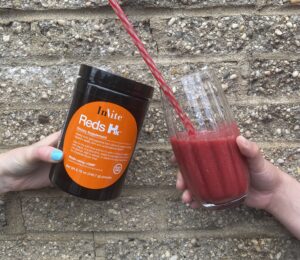
Smoothie Base:
1 cup Strawberries, frozen
1/2 cup Water
1 scoop Reds HxⓇ
Add-ins To Make It A Complete Breakfast:
2 Tablespoons Nut Butter (peanut, almond, cashew, or sun butter)
1/2 cup Milk, Kefir, or Nut milk (almond, cashew, oat, or coconut) – instead of the water
1/2 cup Yogurt (Greek, plain unsweetened)
Nutrition Facts Serving 1 smoothie base:
Calories: 60kcal Carbohydrates: 18g Protein: 1g Fat: 0.5g
Saturated Fat: 0g Cholesterol: 0mg Sodium: 21.5mg Dietary Fiber: 6g
Sugar: 10.4g Vitamin C: 35% Calcium: 2% Iron: 3%
GOLDEN MILK OVERNIGHT OATS RECIPE – HEALTHY & HELPFUL TIPS WITH MELISSA >> Make Now!
For more information or questions about the recipe feel free to contact melissa@whiskingnutrition.com
@invitehealth Try our Twisted Red Strawberry Smoothie whenever you need a refreshing strawberry taste with a boost of vitamins and minerals! #smoothie #rainbow #invitehealth #redshx ♬ Aesthetic – Tollan Kim


Written By: Allie Might, FMC, INHC, ATT For further questions or concerns email me at carcidiacono@invitehealth.com Everyone’s heard of collagen. It’s typically associated with cosmetic fillers and beauty products. However, collagen is also an essential nutrient as it is vital to every part of the body. …

You keep hearing the buzz work Collagen? Well to learn more listen to the podcast all about collagen by Allie Might, FMC, INHC, ATT.
Cardiologist
Subscribe Today!


Please see below for a complete transcript of this episode.
Informative Session With Cardiologist Dr. Davis – InViteⓇ Health Podcast, Episode 564
Hosted by Amanda Williams, MD, MPH.
*Intro music*
InViteⓇ Health Podcast Intro: Welcome to the InViteⓇ Health Podcast, where our degreed healthcare professionals are excited to offer you the most important health and wellness information you need to make informed choices about your health. You can learn more about the products discussed in each of these episodes and all that InViteⓇ Health has to offer at www.invitehealth.com/podcast. First time customers can use promo code PODCAST at checkout for an additional 15% off your first purchase. Let’s get started!†
*Intro music*
Amanda Williams, MD, MPH.: [00:00:39] I am Dr. Amanda Williams and I was just talking about cardiovascular health and the importance of regulation of chronic inflammation in the body, how problematic this really, truly is and how many people are just not aware of this. So it’s an area in terms of diet, exercise and of course the different nutrients that you’re taking. So I am now being joined by a interventional cardiologist, and I cannot tell you how excited I am because for all the years that I’ve been doing this, it’s so difficult to find a functional medicine cardiologist. And so to have the honor to speak with him today, I must tell you myself, I am just very excited about this. So let me give you a little bit of his background. He completed his internal medicine residency over at Johns Hopkins, and then he continued on for his training in interventional cardiology over at University of Virginia. So he is definitely well versed when it comes to cardiovascular medicine. But what’s really interesting about Dr. Christopher Davis is that he has zeroed in on the functional approach, understanding that the body is so much more than just the heart and how all of the other systems can have an impact on the health of the heart. So I certainly am very honored and appreciate your time today. Dr. Davis How are you doing?† [00:02:06]
Dr. Davis: [00:02:08] Dr. Williams I’m doing wonderful. It’s a pleasure to be here with you. I applaud what you’re doing as well, and I think we’re all just trying to get the message out that there are there’s a different approach to medicine. I think we all want to open our eyes and ears to it. So hopefully I will spread that message today.† [00:02:24]
Dr. Amanda Williams, MPH: [00:02:25] Oh, and I appreciate it, because as I mentioned, for the many years that I’ve been doing, you know, more of the functional nutrition approach, it’s very difficult to find a cardiologist who is on board with understanding the importance of diet and exercise and hormonal imbalances and looking at everything in totality. And so understanding that, you know, yes, I have, you know, Dr. Davis on today who understands all of this and that you look at the whole picture. Now, I have to ask you this. What got you interested in this in the first place when you really got going into the functional medicine with cardiology?† [00:03:03]
Dr. Davis: [00:03:06] Oh, I guess it started probably about ten years into my practice. And I’ve always been into health and wellness and fitness and I’m kind of been into sports and stuff all my life. And what ended up happening is obviously the biggest thing that opened my eyes was the introduction of this whole ketogenic diet or the higher fat diet, which, you know, for years and years and years as a cardiologist, the last thing I was saying to any patient that you need, more fat. But I was really into telling them about saturated fat. And how that saturated fat causes heart disease and they should eat a low fat diet and all the cards they wanted. And I was introduced. I went to a conference in Denver and one of the ketogenic conferences just out of curiosity, because there was so much interest in reversing diabetes. Diabetes obviously is a big risk factor for heart disease. So I was interested into diabetes what was going on there and the presentations that were made were absolutely I mean, for me it was eye opening. So it just started a curiosity in me. And then with that, curiosity was sparked one way into the next. And that to me, I think that health and wellness is much more than just a ketogenic diet, obviously. But it just showed me how much I didn’t know about how the body can heal itself and how we can deal with issues like diabetes outside of all the medications that we prescribe. And I also got tired honestly of saying, hey, you need to diet and exercise but not really giving my patients a way of doing that. I mean I said I could probably count how many thousands of times I said to the patients where you need to go on a diet losing weight, but never giving anybody an alternative to what that looks like. I think in our system that we’re in right now, we spend 7 to 10 minutes of the patient and we’re just not able to deal with, you know, what we what we can do in a traditional medical practice. And so I really just got frustrated with the system. I mean, I started to see all the other things that were problematic i.e. you mentioned the hormones and the gut health, but in my seven minute, ten minute visit, it just wasn’t something that I could deal with. So I was looking at all these other things nutritionally we could do lifestyle that we could do, but it just wasn’t that implemented. So I think it was more also changing my practice type to more of a I really moved from the whole insurance model to a cash pay model, and I do that literally in the matter of a year. And my wife thought I was crazy. I just walked away from I walked away from a very lucrative, lucrative medical background I have my own cardiology practice, probably 5000 patients. And I walked away from it because I knew that there was more for me to do. So anyways, long story short, I’m here now and what I do now is really a more holistic approach and what I mean holistic I mean the whole person understanding that there was a lot of stuff that people used to do from a medical perspective natural medicine, nutritional medicine, energetic medicine that that is the root of our medicine today. But we kind of brush near the road to my goal was to put all this stuff back together with all of my knowledge from Duke and Hopkins and UVA and still use that stuff too, but we can’t throw away what our ancient ancestors taught us. And so that’s one of my goals to kind of bring that back to the forefront.† [00:06:17]
WHAT YOU NEED TO KNOW ABOUT THE KETOGENIC DIET – INVITE HEALTH PODCAST EPISODE 556 >> Listen Now!
Dr. Amanda Williams, MPH: [00:06:18] And I think that that’s so important. And, you know, I give you credit for walking away, like you said, from a very lucrative and thriving practice and going out into this the non insurance model, because I know a lot of doctors are incredibly reluctant to do that. But like you said, if you want to provide the best comprehensive care, oftentimes that’s what you’re left with. And I do think it’s important because, you know, myself going through medical school, of course, we had no training in diet and nutrition. And it was the same kind of thing, like you said, well, just eat healthy and exercise, but what does that actually mean? And I remember seeing a study done quite a few years ago on cardiologists, and they said the average cardiologist really has no idea how to help their patients when it comes to diet. And I think that you kind of hit on that. Like you’re like I don’t know how many thousands of times I said just eat healthy, but not necessarily understanding that. Now, another area that I have a lot of interest in, and I don’t know if you can kind of talk to me about this a bit. I focus a lot of time and attention with customers when I’m, you know, working with folks on the importance of getting proper blood testing done. And they always say, oh, well, my doctor tested, you know, and I said they likely didn’t test, you know, the key things and especially when it comes to cardiovascular biomarkers, looking at things such as coenzyme Q10, looking at oxidized LDL levels, looking at the lipid particle size, is this something that you have found that has been very enlightening in your practice now that when you work with your your patients, that you can explain these things to them?† [00:07:51]
Dr. Davis: [00:07:54] Absolutely. Absolutely. I mean, I can’t tell you the importance of everything you said with respect to this is what I tell all of my patients. You know, a regular lipid panel coming to me with a panel that shows me your cholesterol level and HDL, which I consider a good cholesterol and LDL, which we consider a bad cholesterol and a triglyceride level. Coming to me with those numbers doesn’t mean anything to me. And I cannot tell you, you know, whether you have a high risk of heart disease or low risk heart disease, there is a lot more. I mean, we live in an age today where we can do the testing that is available. I’m not sure why every cardiologist is not doing advanced testing that’s looking at particle size, particle number other inflammatory markers such as lipoprotein phospholipase A, myeloperoxidase, peroxidase. I’m going in a whole line of inflammatory markers. But things like lipoprotein little A, there are some definite markers that are very high risk for underlying cardiovascular disease, yet we don’t typically monitor those or evaluate those things, when you go to your physician, whether it’s your general practitioner or the cardiologist, there are not many cardiologists that are using these advanced lipid tests. And I can tell you stories and presentations that I give. I have stories of people who come to me and everything is okay, their stress test is okay, their lipids are okay. However, when I do my testing, we’re doing advanced lipid tests and the lipoprotein little A is extremely high, or the small dense LDL or the oxidized LDL is extremely high. These are the cholesterol particles that are problematic. So if you’re not looking in the right place, I call it looking in the right place because I’m looking for all these tests. I’m not looking in the right place. I’m not going to get the right answer. So in those presentations, what I do is I show how even if we put those or if we put those numbers from the regular cholesterol panel and the risk calculator, ascvd risk calculator and a patient will come out as low risk, less than 5% chance of having heart disease in the next ten years. However, when you look at these numbers and we look at all those other numbers that I mentioned, he was extremely high risk, including some genetics table, e.g. I knew that this guy was extremely high risk. So I said, Well, I think we should probably take the next step. And so the next step for me, typical when I mean the next step I use a lot of coronary calcium scores, so I actually ended up getting a coronary CT scan and I mean that was so the risk was so high that I thought I should get a coronary CTA. A coronary CTA is a noninvasive test that we can do a CAT scan putting in machine and we can get a 3D rendering of what those arteries look like. And it turns out he had multiple blockages of more than 70% and multiple arteries, they had two arteries, they had greater 70% blockages, however, had to use their ascvd calculator and regular cholesterol that’s never found. That’s one case. And I can tell you multiple cases that I can share very similar results. † [00:10:38]

Dr. Amanda Wiliams, MPH: [00:10:39] You know, and it’s amazing. So looking in the right place. Absolutely. Those things are very important. It is. And I remember years ago, I actually just did my own blood testing. My husband did his and his cholesterol looked like, you know, frameable, you know, this is gold star cholesterol. But I did the the lipid particle size and it came back that he actually had a really bad, you know, high levels of his small density lipoproteins. And I thought, oh, my goodness, every doctor would tell him, oh, your cholesterol levels are good. And I’m like, this is actually a major cardiovascular risk for you. So we we had to make some modifications in terms of what he was doing, had him on some niacin and increases omega three intake. But we wouldn’t have known that if I wouldn’t have thought like, hey, let’s test the particle size. So it’s always so important. And as you mentioned, there’s so many different tests that it always baffles me when I talk to folks and they say, Oh, no, my cardiologist doesn’t look at this level or my cardiologist, you know, I’m like even basic like homocysteine levels can you know, can we look at that? Oh Yes. Yes. Yes. So it’s really quite amazing. Are you finding that within the field of cardiology that more cardiologists are starting to open their eyes to this? † [00:11:52]
Dr. Davis: [00:11:55] I think there are more, but there’s still far and few between. I think that the lipid hypothesis of heart disease, meaning the cholesterol’s high, that’s your risk for heart disease has been so profound and so dogmatic that it is a very hard nut to crack. We’ve all been taught, particularly cardiologists, that, you know, the lower the LDL or bad cholesterol, the better. I think that just it’s just a very it’s just so ingrained in our training and in society. It’s not just in our training, but it’s just the way we think about, you know, heart disease. And I think it really is time for us to, you know, and it’s not just about cholesterol either. I mean, the root of heart disease also is in things like toxins that are in our environment, heavy metals, environmental toxins, gluten in our diet. It causes gut issues. It’s causing more inflammation in our body. So as a cardiologist that really looks at the underlying root causes of of coronary disease, I mean, those are all the things that need to be considered. It’s not just about that cholesterol molecule. Yes, that’s important. And particularly when that cholesterol molecule has been or modified to a form that’s more pathological pathogenic. But we I don’t know. I mean, the reason I do what I do is to get out and to talk about it in the formats that we are right now on your show. And hopefully that it opens more eyes of the physicians and people inside to say, whoa, but what’s going to really take is, is the patients as well. Right. Patients educate themselves. And I want to empower the patient to say, well, what about well, wait a minute, Dr. Davis said. And what I my practice actually most people who have their own, they may have another cardiologist, they have their primary care doctor. But I really kind of they come to me and I just say, hey, well, listen, you should consider it consider it, consider it. And they’ll go back to the doctors. And some of those doctors say, okay, that makes sense and that and they’re going to follow through with it. Some of them don’t. But, you know, we can only try. And so the more people, the more doctors that are exposed, you know, somebody’s even doing something different. I think they started does open their eyes and ears. You do something really important. I’m I’m going to I’m going to kind of ditto on the homocysteine. † [00:14:03]
Dr. Amanda Williams. MPH: [00:14:05] You know what? I’m going to have you hold on that one for just 1 second, Dr. Davis, because we have to take a quick break, so stick around and we’ll hit the homocysteine. Plus, I want to talk a little bit more about some of the interventional advancements that they’ve made with things like resveratrol, for example. So we will be right back just after this. You’re listening to InViteⓇ Health Radio. I’m Dr. Amanda Williams and welcome back to the InViteⓇ Health Wellness Hour. I am Dr. Amanda Williams, I am joined by our functional interventional cardiologist, Dr. Christopher Davis. And I will give out his information for you guys as well so you can contact him directly revealvitality.com. So that’s revealvitality.com. And we know that Dr. Davis is very much so into looking at, you know, so many of the underlying stressors that arise in the body that not only affect the heart but affect every single system. And I think that this is important. And before the break, I know you said you want to come back and touch on homocysteine, so I’ll give the floor back over to you on that.† [00:15:08]
Dr. Davis: [00:15:11] Sure. So homocysteine is an inflammatory marker that’s associated with high risks of blood clotting. So in class, things like clots in your legs or deep venous thrombosis that can move to the heart or lungs causing a pulmonary embolism. And also the clots they cause microbes in the heart of heart attacks and strokes. So homocysteine can be very easily measured and homocysteine is often elevated and sometimes quite elevated in individuals. And the most common cause of homocysteine in elevated is B vitamin deficiency, specifically B2, B6, B9 and B12. And you know, a lot of times I know when you go to your doctor, you may have had your B12 level checked, may have even had your folate level checked, which is rather benign. But a lot of times your vitamins B2, riboflavin, B6, Doxepin they’ve never been checked and it’s very simple and I can’t tell you how many times by repleading the B vitamins with some type of b-complex vitamin, that homocysteine comes out and that risk of stroke I mean there’s data. And I showed you that to my patients as well, as that homocysteine climbs there is 4 to a 10 fold risk of having a stroke when the homocysteine is elevated to certain levels, particularly up into the 25 range or so when it should be less than ten is what I consider normal in the single digits there have been times where patients would come to me with extremely elevated homocysteine. This is just recent this week. This story just happened and it really kind of this is the kind of thing that really bothers me. I placed a patient on a b vitamin a complex that actually for the homocysteine being about 22, the guy had two strokes already and shows up with homocysteine elevated. And certainly there are probably other factors that contributed to it. Certainly that homocysteine was important. And so he had gone back to his relative position and I had put him on fish oil and vitamin D and homocysteine. Homocysteine is the point where no one knew it was a B vitamin complex. And and the doctor told me that you don’t need to be doing all these things. They don’t do anything. They’re not helpful. And that is one of the biggest problems I have, is that probably I would have said ten years ago and it was because I didn’t know and I was I wasn’t educated about these things and I wasn’t using this functional medicine approach. So I find it’s appalling to me because we are causing the potential to cause people more harm than good. And when you don’t understand the importance of just simple micronutrients, so that homocysteine is really important, if you’ve had a history of blood clots or even heart attack in the family or blood clots in the lungs, very simple. Very simple. And again, not to talk about when I go to talk, we could talk ever about why the homocysteine up and genetics and THFR. And I’m not going to go there. We could we could spend hours and hours and talk about all this stuff. But long story short, it can be treated simply. † [00:17:59]
Dr. Amanda Williams. MPH: [00:18:02] Right and this is an area once again, like you said, it can be so frustrating. When I came on board at InViteⓇ Health many years ago, it was an that was actually a product that I worked on in terms of the formulation for it. It’s called Methyl B, but it’s a activated B vitamin complex. And I kept saying, you know, we need this in our product line because there are so many people that have elevated homocysteine. And I, you know, fully agree with you. I’d like to see that level down in the single digits. And so with the methyl B, I have had so many people have just wonderful results. And of course, they go back to their doctor and they say, oh, you know, you don’t need to be taking that. And I always say, you know, the results speak for themselves when you can you can actually test things. It’s like being on, you know, omega three fatty acids. If you can start to see impacts, whether it’s inflammatory markers or if your triglyceride levels are starting to come down. But the one area that I’ve talked about many times on this radio show is I’m just absolutely fascinated by a study that they did out at LSU, where they were utilizing resveratrol and kind of saturating a cardiac stent with resveratrol and seeing the repair time post angioplasty and saying, wow, like this is really helping with the healing and targeting that inflammation post procedure. And it made me kind of go back further into research and I saw that over in Germany back probably about 15 years ago. They were doing resveratrol coated balloon catheters. And I thought, well, isn’t that fascinating? But yet you still don’t see it, you know, traversing into day to day practice here. Is this something that you’ve even witnessed kind of coming to the forefront?† [00:19:37]
Dr. Davis: [00:19:40] I actually I have not the power of residual as an antioxidant and inflammatory. I think we are very, very aware of that what those polyphenols are. And not just resveratrol some of the other family. Polyphenols are very, very helpful with inflammation. I have not heard about it being coated on a balloon, however, that would not surprise me, what happens there is any time we have natural products. I mean, something like a resveratrol or you know what, a coenzyme Q10 if you can’t patent these natural products. So what ends up happening is you don’t really hear much about it and how useful it is if it’s something is not patentable. And I can go on and on about those specific, you know, specific molecules that have been shown to be helpful in the literature. There’s tons literature. But if you can’t patent it, it never gets investigated and never gets incorporated into our treatment strategies. So that’s not surprising at all. And it is the first time I’ve heard about it actually being put on a balloon mechanism. 100% believe that could work.† [00:20:45]
Dr. Amanda Williams, MPH: [00:20:46] Yeah, yeah. It was a really interesting study that they did up there at LSU in their Department of Comparative Biomedical Sciences, where they were. And it was a combination, I believe they had resveratrol with the quercetin. So two, you know, powerful antioxidants and looking at that response rate. But yeah, as you mentioned, I know they’ve been working on it for years and years, I think, at Harvard, trying to figure out how to synthesize resveratrol so they can put a patent on that. And it’s an unfortunate thing because if we kind of go back to the basics of medicine, you know, most things came from, you know, plant based and now it’s always a struggle and a fight. The other thing being that you’re a cardiologist that I wanted to specifically ask you today is D ribose. I have a lot of folks who I work with that maybe, you know, they do have, you know, congestive heart failure or whatnot. And I’m always encouraging the utilization of D ribose just for kind of generating up that ATP within the cardiac myositis. Is that an area that you have found to be beneficial in your patients?† [00:21:44]
GETTING THE MAXIMUM OUT OF RESVERATROL – INVITE HEALTH PODCAST, EPISODE 479 >> Listen now!
Dr. Davis: [00:21:46] Absolutely. I actually use a lot of so the combination and this is all this is all data that Dr. Steven Sinatra was really the first and Dr. Sinatra and God bless his soul he just recently passed within the last couple of weeks but Dr. Sinatra was probably one of the he is is one of the grandfathers of in integrative cardiology and he was the person who put coenzyme Q10 on the map. And the importance of coenzyme Q10, particularly when utilizing statins and the importance of coenzyme Q10 in the electron portrayed as we make energy how ATP is made by a mitochondria. But he also was at the forefront of using D-Ribose and L-Carnitine in conjunction with that coenzyme Q10 to improve overall mitochondrial function in the heart. So people who had heart muscles cardiomyopathy were tremendously improved with the combination of coenzyme Q10, L-Carnitine and D-Ribose. So I use that in all of my heart failure patients. So I’m a I’m a big believer in not only I’ll be honest, the other people that I use a lot of D-Ribose in the athletes, people who are really competitive and from an energy and mitochondrial efficiency standpoint, you’re absolutely right. D-Ribose is a very important part of that. † [00:23:06]
Dr. Amanda Williams, MPH: [00:23:07] Well, I know we’re running short on our time here, so I definitely want to thank you so much for for joining me today. I would love to to go further into conversation with you. I find you so incredibly fascinating with your your background and your knowledge. So hopefully you can come back and join me again someday and we can go more into the science on all all of the different nutrients that can be beneficial. And of course, because you’re a functional doctor, you know, really get into some of the more complexities when it comes to hormonal pathways and how that has an impact as well. But I definitely want to thank you so much, Dr. Davis, for for your time today. And remember guys it’s reveal vitality.com so I appreciate you joining me today. † [00:23:47]
Dr. Davis: [00:23:49] Absolutely it was a pleasure being here. Thanks so much.† [00:23:50]
Dr. Amanda Williams, MPH [00:23:50] All right. You take care. So as you all know, I talk often about Ubiquinol. I talked about the grape seed extract today, which is kind of that cousin to the resveratrol. We have our ribose complex. That’s why I had asked him specifically about ribose, because I do find that to be very important when it comes to cardiac functionality. And it’s one of those things where, as you said, for exercise for athletes, but it’s we have so many wonderful products that definitely reach out to us. We know what we’re doing over here when it comes to the science so invitehealth.com stop by one of our store locations. Reach out to me directly. awilliams@invitehealth.com. Enjoy the rest of your day. Thank you so much!† [00:23:50]
*Exit Music*