Recent Posts

HUMAN PAPILLOMAVIRUS~ WHAT EXACTLY IS HPV?

HUMAN PAPILLOMAVIRUS~ WHAT EXACTLY IS HPV?

HUMAN PAPILLOMAVIRUS~ WHAT EXACTLY IS HPV? By: Allie Might, FMC, INHC, ATT   Human Papillomavirus, or HPV as it’s commonly referred to as, has been discussed quite often lately. However, do we really know what it is and how it’s spread? Having a good understanding 

Summary on Respiratory Health

Summary on Respiratory Health

Summary on Respiratory Health Dr. Claire Arcidiacono, ND   I hope that this blog series on respiratory health has been both fun and informative! I have tried to review some of the most common respiratory concerns that come up here at Invite health. Additionally I 

Pneumonia

Pneumonia

Pneumonia

Dr. Claire Arcidiacono, ND


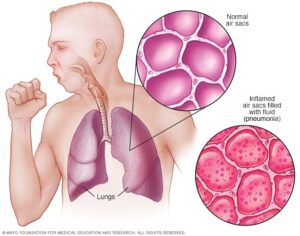
I wanted to finish up this series on respiratory health with a discussion on pneumonia. While pneumonia can be mild it can also become life threatening. What is pneumonia? Basically pneumonia is an infection that causes inflammation in the air sacs in one or both lungs. As a result of the inflammation the sacs may fill with fluid or pus which can trigger a cough. Please see the attached picture. (1)

What can cause pneumonia? Pathogens that usually cause pneumonia include bacteria, bacteria like organisms, fungi and viruses. Pneumonia is classified according to type of organism that causes it as well as where you acquired the infection. The first type is the most common and is called community -acquired pneumonia. As the name implies this occurs outside of hospitals or other health care facilities, or in other words “in the community”. The next type is called hospital acquired pneumonia. This tends to be caused by bacteria more than the other pathogens. Related to hospital acquired is health-care acquired pneumonia which is pneumonia that occurs in people who live in long-term care facilities or receive care in outpatient clinics such as kidney dialysis centers. Lastly there is aspiration pneumonia which is where you inhale food, drink, vomit or saliva into your lungs. This is more likely if there is a problem with your gag reflux.

While anyone can get pneumonia there are certain risk factors that increase your risk. To start with the 2 age groups most at risk are children under 2 and adults over 65. Being hospitalized and being on a breathing machine increase your risk.  Having a chronic disease such as asthma or COPD increase your risk. Having a weak or suppressed immune system can also increase risk.  Lastly smoking can also increase the risk of pneumonia.

What are the most common symptoms of pneumonia? Well you may have a cough with phlegm. There may be chest pain when you cough or breath.  There may be fatigue as well as fever, sweating and shaking chills. Your digestive system may be affected resulting in nausea, vomiting or even diarrhea. In those over 65 there may be a lower than normal body temperature as well as confusion. (1)

When it comes to pneumonia it is important to talk about complications. Pneumonia can lead to bacteremia which is where bacteria literally get into our blood. Sounds series right? Well it absolutely is. Bacteremia can lead to septic shock.  Pneumonia can also lead to lung abscesses which are pockets of puss in our lungs. Pneumonia can also cause what is called pleurisy, pleural effusions and empyema. If the pneumonia is severe it can lead to respiratory failure. Pneumonia can even lead to failure of certain organs such as the kidneys and heart. (2) As you can see pneumonia can haves dangerous complications. What can you do to help reduce the risk of pneumonia?

  • There are a number of life style factors that can help. Talk to your doctor about whether or not a vaccine is right for you. Practice good hygiene. Have a food diet.  Quit smoking. (3)
  • Olive Leaf has been one supplement that has come up over and over again. In fact studies have found that Olive Leaf is helpful in ameliorating lung disease such as pneumonia. (4) Please see Invite’s Olive Leaf and Renalaid.
  • Garlic, according to studies “could be used as an effective antibacterial nutrient” for pneumonia causing bacteria. (5) Please see Invite’s Aged Garlic.
  • NAC is another nutrient that has come up frequently in this series. Studies have found that NAC may decrease the oxidative and inflammatory damage in pneumonia. (6) Please see Invite’s NAC.
  • Black Seed has been found in studies to help slow the growth of bacteria such as those that are associated with pneumonia. (7) Please see Invite’s Black Seed formula.

Our last blog on this topic will be a nice summary to wrap things up before we move on!

Sources:

  1. https://www.mayoclinic.org/diseases-conditions/pneumonia/symptoms-causes/syc-20354204
  2. https://www.webmd.com/lung/complications-pneumonia
  3. https://www.nhlbi.nih.gov/health/pneumonia/prevention
  4. https://www.ncbi.nlm.nih.gov/pmc/articles/PMC10295110/
  5. https://pubmed.ncbi.nlm.nih.gov/12602248/
  6. https://www.ncbi.nlm.nih.gov/pmc/articles/PMC6250560/
  7. https://www.researchgate.net/publication/348808654_EFFECTIVENESS_TEST_OF_BLACK_CUMIN_SEEDS_NIGELLA_SATIVA_EXTRACT_ON_THE_GROWTH_OF_KLEBSIELLA_PNEUMONIAE_AND_PSEUDOMONAS_AERUGINOSA_BACTERIA

Understanding Probiotics

Understanding Probiotics

Understanding Probiotics Dr. Claire Arcidiacono, ND   If there’s one topic that is sure to confuse people it’s the topic of probiotics. Invite health has a powerful line up of probiotics. But how are they different? How do you know which one is right for 

URINARY TRACT INFECTION (UTI) ~ EVERYTHING YOU NEED TO KNOW, BUT HAVE NEVER ASKED

URINARY TRACT INFECTION (UTI) ~ EVERYTHING YOU NEED TO KNOW, BUT HAVE NEVER ASKED

URINARY TRACT INFECTION (UTI) ~ EVERYTHING YOU NEED TO KNOW, BUT HAVE NEVER ASKED By: Allie Might, FMC, INHC, ATT   Urinary Tract Infections, or UTIs as they are commonly referred to as, can affect people of all ages for various reasons. However, women seem 

The Flu

The Flu

The Flu

Dr. Claire Arcidiacono, ND


Flu season, the dreaded time of the year when it seems like everyone has the flu. Flu season or the time of the year when the flus is at its peak usually occurs from October – May in the United States. But what really is the flu? The official name of the everyday common flu is Influenza and it is caused by a virus. (1)

Let’s do a quick review of the common symptoms of the flu. At first the flu may just feel like a cold with symptoms such as a runny nose, sneezing and a sore throat. However the symptoms are usually worse with the flu than you would expect. The flu often involves a fever and chills as well as the sweats. There is often muscle aches as well. There may also be eye pain, headache as well as fatigue. In addition to a cough you may have shortness of breath.  Children are more likely to experience vomiting and diarrhea than adults.

While anyone can get the flu there are certain risk factors that increase your chance of getting sick. The first risk for more severe illness is age. In children under 12 months or in adults over 65 there is a higher risk of severe illness. Those who work or live in locations with residents such as nursing homes or hospitals are at an increased risk of getting the flu. Those with chronic illness and a weakened immune system are also at risk of the flu.  Pregnant people are also at a higher risk of developing the flu. Those who have a BMI of 40 or more are at risk for more severe illness and even complications from the flu. While most people recover quickly from the flu there are some possible complications that can occur.  What are these possible complications you ask? In those under 20 years old who use long term aspirin therapy there is a risk of developing Reyes syndrome if they contract the flu. Other complications can include pneumonia, bronchitis, ARDS as well as asthma flare ups. The flu can increase the risk of ear infections. Lastly the flu can affect our hear t and trigger heart problems. (2)

How is the flu transmitted? Well it’s a virus so it travels on airborne droplets just like any other viral infection. Just like with the other viral infections we have covered if Bob coughs either on you or on a surface that you then touch and then you touch your eyes, mouth or nose you can catch the flu. As you may have noticed touching a contaminated surface and then touching our eyes, mouth or nose is a very common way to get sick. So don’t touch your face and wash your hands folks! (3) Just a heads up when you have the flu you are contagious from 1 day before your symptoms start and up to 7 days after you start to feel sick. (1)

What can you do to slow the spread of the flu? Well as I’ve said before wash your hands, clean frequently touched surfaces and don’t touch your face! Be considerate and cover your coughs and sneezes. Lastly talk to your doctor to determine if the flu vaccine is right for you. In addition it’s important to support your immune system. How can we do that? Well there’s plenty of ways to help our overall immune health.

  • Life style – Make sure you have a healthy diet full of fruit, vegetables and healthy proteins! Work to reduce stress and get enough restful sleep. If you smoke quit smoking. Reduce the amount of alcohol you consume. All of these life style hacks if you will can help to boost our immune system. (4)
  • Olive Leaf has been found in studies to help reduce the symptoms of viral infections and to even help reduce the length of hospitalization for those with. Using Olive Leaf extract has also been found to reduce the overall length of a virus. (5) Overall when it comes to Olive Leaf studies agree that Olive Leaf extract is a powerful antiviral nutrient. (6). Please see Invite’s Olive Leaf extract and Renalaid.
  • NAC is another great choice! As I have said in my prior blogs one of the benefits of NAC is that it can help to thin the mucus that often is associated with viral infections such as the flu and even a cold. (7) As I talked about in my bronchitis blog NAC has been found to be very helpful in reducing a cough such as when you have bronchitis or the flu. (8 )Please see Invite’s NAC, Daily Detox and Detox Hx
  • Black Seed has been found to help with symptoms such as runny nose, itchy nose and rhinitis. (9) Please see Invite’s Black Seed formula. Also for more information on Black Seed see my blog on this exciting supplement!
  • Probiotics have been found in studies to help reduce the symptoms of viral infection. In fact we all know the saying “our immune system starts in the gut” and that’s where a good probiotic comes into play. (10) Please see Invite’s Core Probiotic, Probiotic Maintain, Probiotic Hx, Women’s Probiotic and Probiotic Weight. In addition we have our chewable Prozyme digest.
  • For more information on Invite Health’s Immunity Hx and Beta Immunity please see my blogs on these amazing nutrients!


Our next topic will be the confusing world of probiotics!


Sources:

  1. https://www.dshs.texas.gov/influenza-flu-provider-information/faqs
  2. https://www.mayoclinic.org/diseases-conditions/flu/symptoms-causes/syc-20351719
  3. https://www.mayoclinic.org/diseases-conditions/flu/symptoms-causes/syc-20351719
  4. ttps://www.cdc.gov/nccdphp/dnpao/features/enhance-immunity/index.html
  5. https://www.ncbi.nlm.nih.gov/pmc/articles/PMC9617633/
  6. https://www.ncbi.nlm.nih.gov/pmc/articles/PMC9953111/
  7. https://clinicaltrials.ucsf.edu/trial/NCT03822637
  8. https://www.ncbi.nlm.nih.gov/pmc/articles/PMC9487680/
  9. https://www.sciencedirect.com/science/article/abs/pii/S0196070910001407
  10. https://asm.org/articles/2024/january/are-probiotics-effective-against-covid-19